
Gibson Serial Number Lookup – Free Decoder Tool + Complete Dating Guide
Use our free decoder tool to instantly identify the year your Gibson was made — covering every serialization system from the early Kalamazoo label era through today’s 9-digit format, plus Factory Order Numbers, pot codes, and model-specific guides for the Les Paul, ES-335, and SG. Just like our Gibson shipment totals guide, it can help you discover the rarity and value of your Gibson!
Updated March 2026
Gibson Serial Number & FON Decoder
Enter your serial number or Factory Order Number below to identify the year your Gibson was made — free, instant results.
Where is the serial number located and how is it applied?
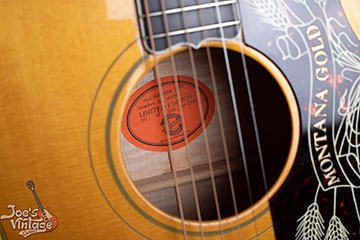 On the Interior Label
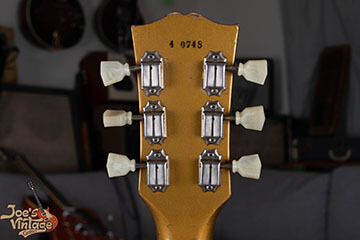 Ink/Silkscreened on Headstock
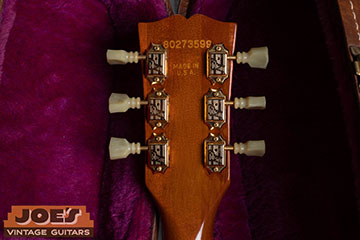 Stamped Into the Wood
What color is the label inside your guitar?
Important Detail: Is the serial number a gold/silver decal on the back of the headstock, or is it stamped into the wood?
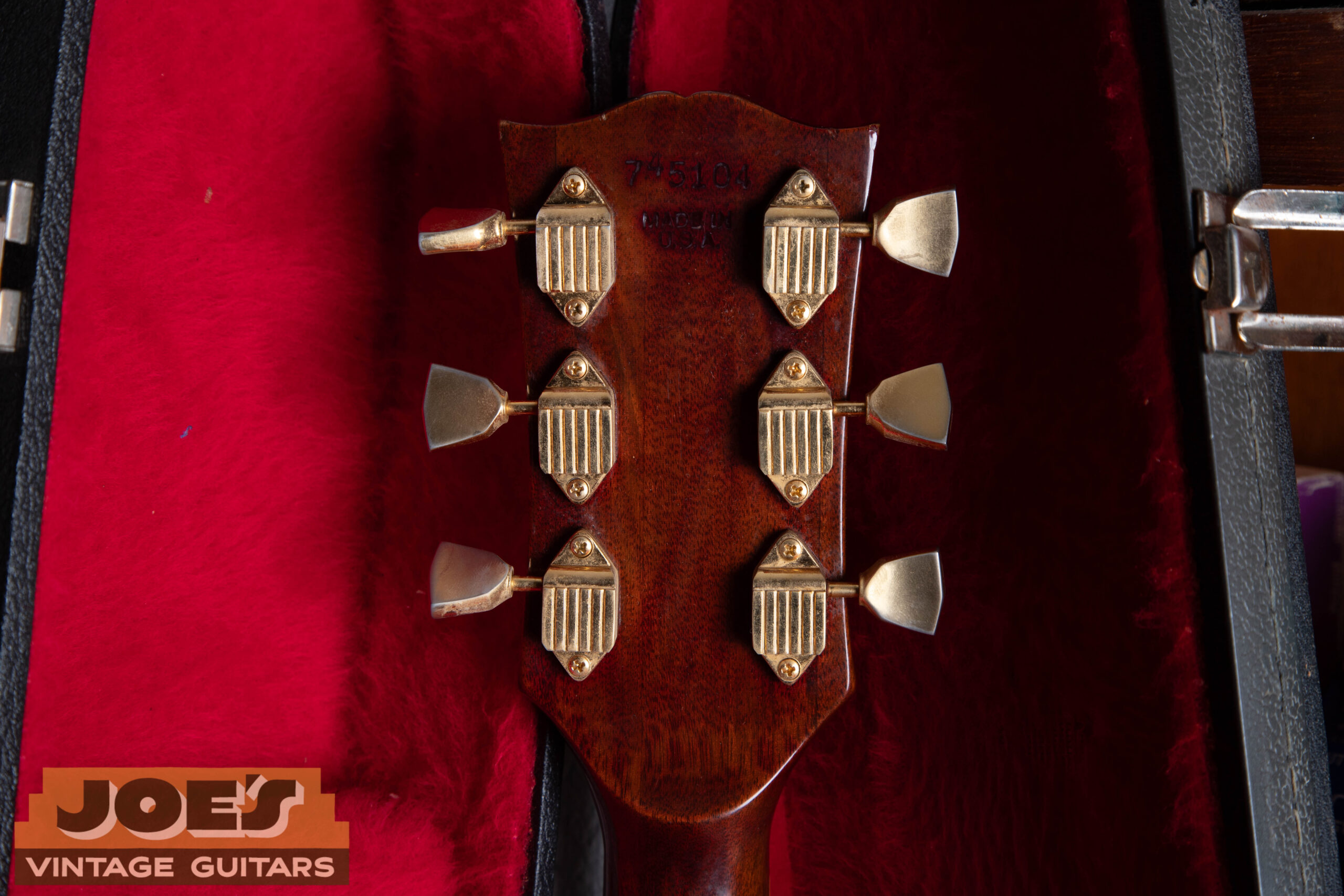
Visual Check: Is there a "MADE IN USA" stamp on the back of the headstock (usually directly below the serial number)?
Estimation Results
Expert Tip: Serial numbers alone aren't 100% foolproof on vintage instruments. Text photos to (602) 900-6635 for a free professional dating from a vintage guitar specialist.
Before you decode your serial number, it helps to know where to look. Gibson used different serialization methods across different eras — and the location and appearance of the number is often your first clue to dating the instrument. Use the guide below to identify what you’re looking at, then scroll up to decode it.
Where To Locate Your
Gibson Guitar's Serial Number
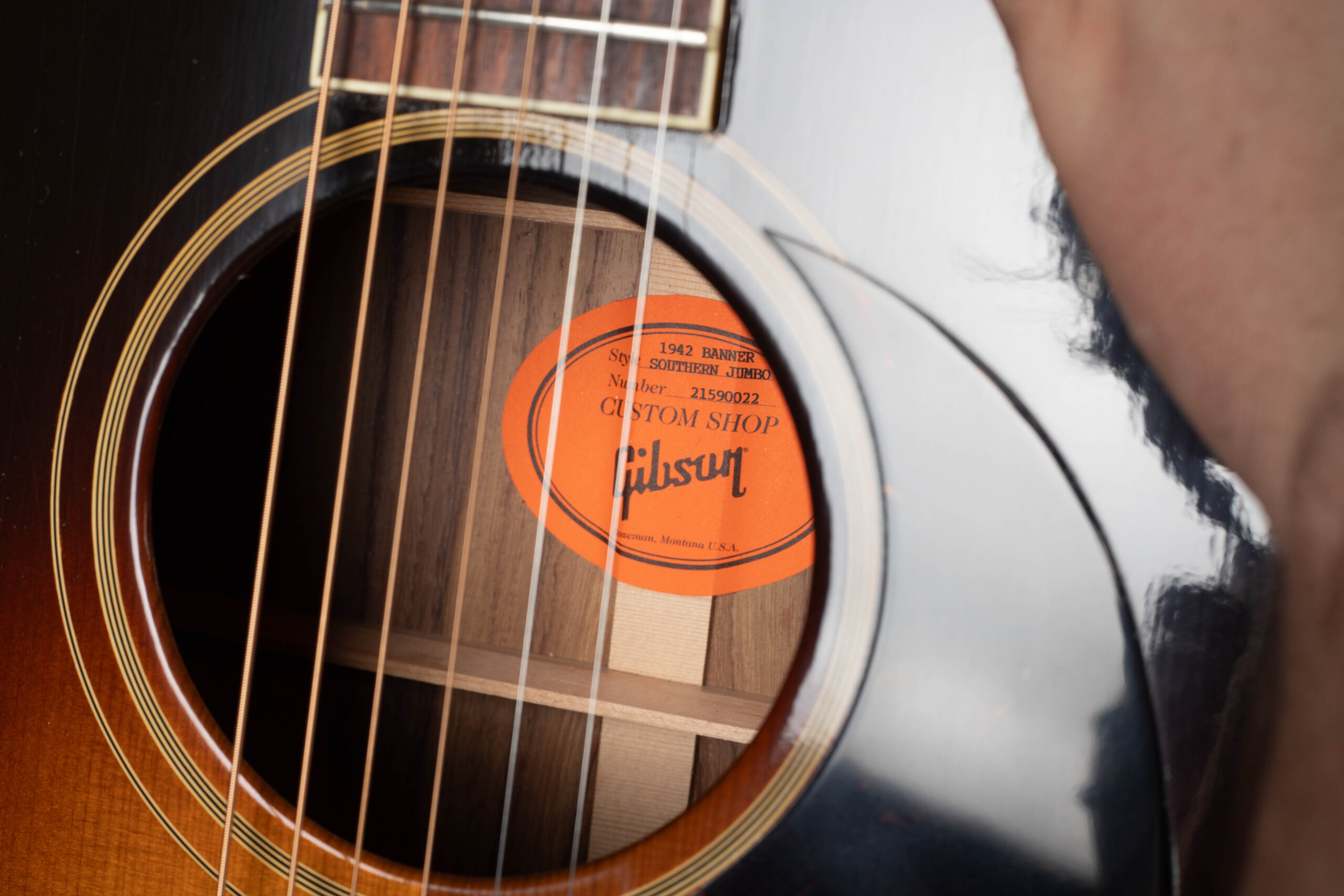
On the Interior Label
Found on acoustic and hollow-body electrics. Look through the soundhole or f-holes for a paper label — white oval on early models, orange oval from 1947 onward. The serial number is handwritten or stamped directly on this label.
Acoustics & Hollow Bodies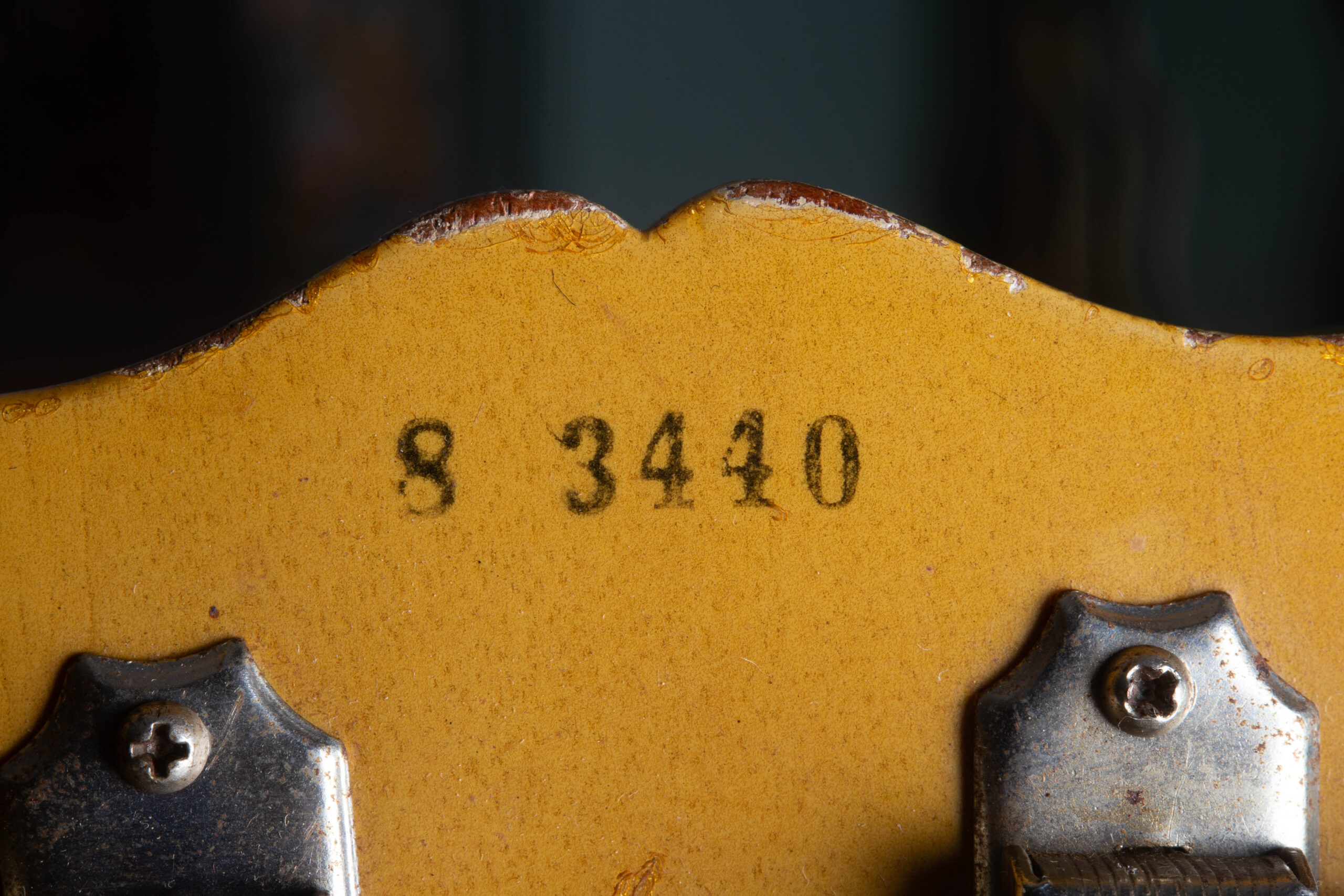
Back of the Headstock
Found on solid body and semi-hollow electrics. The number is either ink-stamped, silkscreened, or die-stamped into the wood depending on the era. Post-1970 models also have a "MADE IN USA" stamp directly below the serial number.
Solid Body & Semi-Hollow ElectricsGibson Factory Order Numbers (FON): The Complete Dating Guide (1902–1945)
Before Gibson developed a formal serial number system, every instrument that left the Kalamazoo factory was assigned a Factory Order Number — a production batch code stamped or written in ink directly onto the bare wood inside the body. For most pre-war Gibson acoustics, the FON is not just a helpful clue — it’s the primary method of dating the instrument. Understanding how to read a Gibson FON can mean the difference between correctly identifying a rare 1930s archtop and misattributing it by a decade. If you’re trying to determine how the year of manufacture affects your Gibson’s value, the FON is where that research begins.
Where to Find a Gibson Factory Order Number
FONs are typically found on the interior back or side bracing, stamped or written in pencil or ink. On archtops, look through the f-holes with a flashlight. On flat-tops like the J-45, J-50, and SJ or the early LG series, peer through the soundhole and look toward the back bracing. The number may appear faint or partially worn — this is entirely normal on genuine pre-war instruments and is itself a sign of authenticity rather than a red flag.
How to Read Gibson FONs: The Early Sequential Era (1902–1916)
Gibson’s Factory Order Number system went through several distinct phases between 1902 and 1945. From 1902 through 1916, a simple sequential system ran from 1 to 3,650 — with no letters or prefixes of any kind. Numbers then jumped to the 11,000–12,000 range from 1917 through 1923, before dropping back down to the 8,000–9,999 range from 1925 through 1931. The early 1930s saw another reset, with numbers starting again from 1 through 1934. The system became significantly more reliable in 1935 when Gibson introduced alphabetical suffixes — a letter at the end of the batch number indicating the production year, running from A in 1935 through H in 1942. From 1940 through 1945, numbers ran from 1 to 7,900 and letters may or may not be present. Because many of these number ranges were reused across different decades, the FON alone is rarely definitive — physical features of the instrument must always be examined alongside it. If you need a confirmed date on a pre-war Gibson, our free appraisal service is the most reliable next step,
How to Read the Alphabetical Suffix
From 1935 through 1942, Gibson added a letter at the end of the Factory Order Number to indicate the production year — this is called the suffix. For example, a FON reading 1247C ends in the letter C, meaning it was made in 1937. Only the first letter matters for dating — any additional letters after it indicate model specifications and can be ignored. Use the decoder below to identify your year:
Because Gibson reused FON number ranges across multiple eras, a FON alone is rarely enough to date an instrument with certainty. Always cross-reference against physical features including the headstock logo style, tuner type, bracing pattern, and binding details. For example, the "E" suffix was used in both 1939 and 1941, and early sequential numbers (1–3,650) appear in multiple decades. When in doubt, a free professional appraisal is the most reliable path to a confirmed date — and if you've already identified what you have and are ready to sell, we'd love to make you an offer.
Gibson FON Dating: The Banner Era & Post-War Recovery (1942–1951)
The years surrounding World War II represent the most inconsistent period in Gibson’s entire serialization history. Production was dramatically reduced, quality control on record-keeping suffered, and many instruments left the Kalamazoo factory with incomplete or missing FONs entirely. Despite this, guitars from the Banner era (1942–1945) and the immediate post-war recovery (1945–1951) are among the most sought-after vintage instruments ever made. A confirmed date from this window — combined with the right features — can dramatically affect what your guitar is worth.
How to Identify a Banner Era Gibson (1942–1945)
The single most reliable identifier of a wartime Gibson is the ‘Banner’ headstock logo — a small pennant reading ‘Only a Gibson is Good Enough’ that appeared on instruments made from 1942 through 1945. If your guitar has this banner, it was almost certainly made during the war years regardless of what the FON says. Banner-era instruments are also identifiable by their use of alternative tonewoods, simplified binding, and in some cases non-adjustable truss rods as materials became scarce. These wartime compromises paradoxically produced some of the most tonally remarkable acoustics Gibson ever made — lightly built, resonant, and extraordinarily rare.
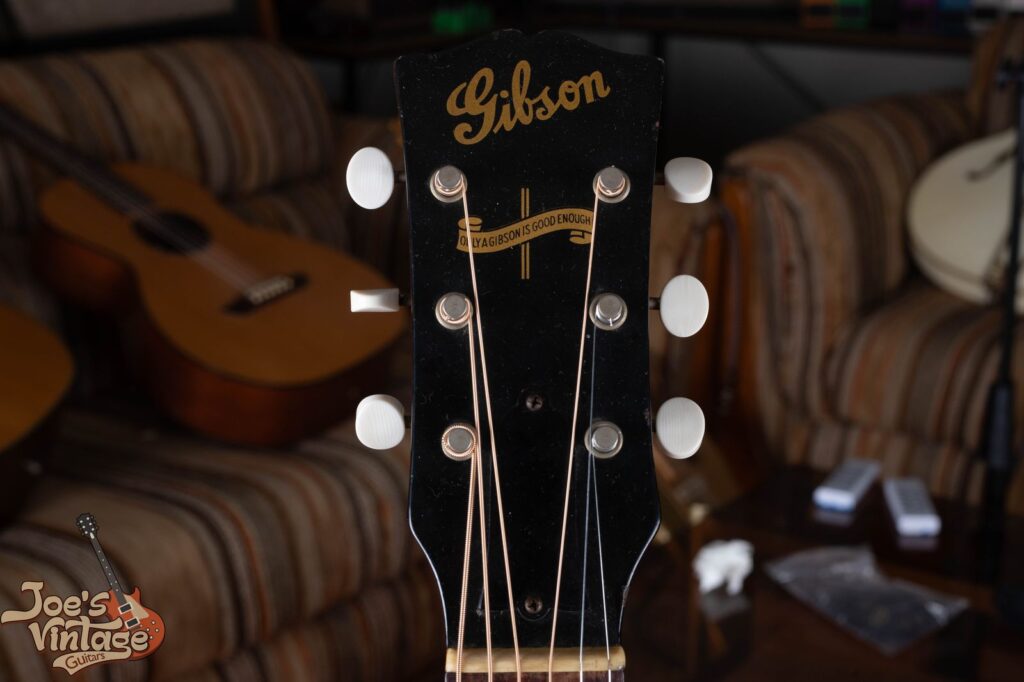
The Banner logo is the single most reliable identifier of a wartime Gibson — if your guitar has this, it was almost certainly made between 1942 and 1945.
Post-War Gibson FONs (1945–1951)
As Gibson ramped production back up after the war, FON record-keeping gradually stabilized — but the 1945–1951 window remains unreliable by Gibson’s own standards. The ranges below represent the best available data for instruments from this period. For guitars from 1945 through 1947 in particular, FONs are not considered reliable and physical dating by features is strongly recommended. This era is historically important because Gibson began to expand its electric guitar line to include iconic models such as the ES-350, ES-300 and ES-175.
Gibson FON Dating: The Standardized Alphabetical Prefix Era (1952–1961)
After years of inconsistent record-keeping, Gibson introduced its most reliable pre-modern FON system in 1952 — an alphabetical prefix at the beginning of the Factory Order Number indicating the production year. Unlike the suffix system of the 1930s where letters appeared at the end of the number, these prefix letters appear at the very start and are consistent, well-documented, and rarely ambiguous. Simply find the letter at the beginning of your FON and match it to the chart below for a precise production year.
This era also happens to cover what many consider the greatest decade in Gibson’s entire history — encompassing the original Les Paul Goldtops and Standards, the birth of the ES-335, ES-345 & ES-355 the introduction of the PAF humbucker, and the peak of Kalamazoo craftsmanship. Understanding how dramatically the specific year of manufacture affects value during this period makes getting the date right especially important.
The Most Reliable Pre-Modern FON System Unlike earlier eras where number ranges were reused and letters were inconsistent, the 1952–1961 alphabetical prefix system is highly reliable and well documented. A single prefix letter gives you a precise production year with a very high degree of confidence — no cross-referencing required in most cases. This makes it one of the most useful dating tools for the most collectible era in Gibson's history.
Decoding Gibson Serial Numbers: The White Label Era (1902–1947)
Gibson’s earliest serial numbers were handwritten or stamped on a white oval paper label inside the body of the instrument — visible through the soundhole on flat-tops or through the f-holes on archtops. These labels predate the iconic orange oval and represent some of the rarest instruments Gibson ever produced. The serial numbers from this period ran sequentially from 1 through 99,999 and are generally reliable for dating when combined with physical features of the instrument.
One important authentication note: genuine white label instruments from this era will show their age. The ink or pencil used for handwritten numbers will have faded or browned naturally over a century. If you encounter a white label with crisp, clean ballpoint pen writing or modern-looking ink, treat it as a serious red flag for a counterfeit or a replaced label.
The white oval label is Gibson's earliest serialization method, found inside acoustic and archtop instruments from 1902 through 1947. Genuine examples will show natural aging — browning of the paper, faded or oxidized ink, and handwriting consistent with fountain pen or early stamping. A label that looks too clean or uses modern ballpoint pen ink is a serious red flag for a counterfeit or replaced label.
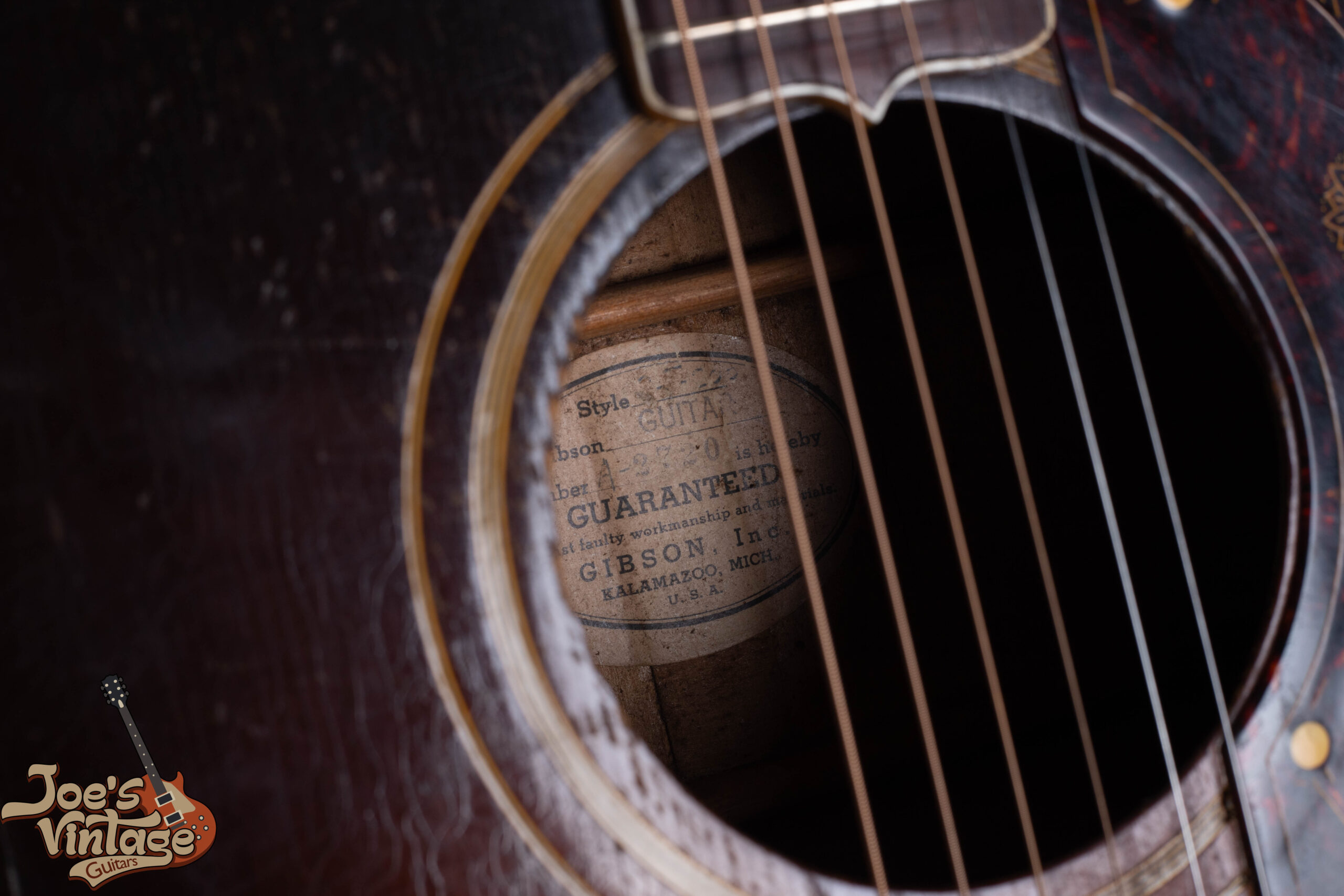
Authentication Note: What a Genuine White Label Should Look Like After more than a century, genuine white oval labels will show their age — natural browning or yellowing of the paper, faded or oxidized ink, and handwriting consistent with fountain pen or early stamping methods. Modern ballpoint pen writing, bright white paper, or crisp clean ink on a label claiming to be pre-war are serious red flags. The label condition itself is one of the most important authentication tools for instruments from this era. When in doubt always seek a second opinion from a specialist.
Gibson A-Prefix Serial Numbers (1947–1961)
The A-prefix serial number system is one of the most reliable dating tools Gibson used during the postwar era — and one of the most searched. If your Gibson has a serial number beginning with the letter A followed by a four or five digit number, this chart will date it precisely. These numbers were used across multiple label types, so don’t be thrown off if your label isn’t orange — A-prefix serials appear on white labels, orange labels, and VERY occasionally on instruments with no label at all where the number was stamped directly onto the back of the headstock. The system ran from A 100 in 1947 through approximately A 34,645 by the end of 1960, at which point Gibson’s serialization began to break down into the chaotic reused number system covered in the next section. Always cross-reference your A-prefix number against physical features for a confirmed date — a one-year margin of error is not uncommon.
Note: A-Prefix serial numbers do not apply to solid-body instruments from this era. For solid body guitars from this era, check out the headstock ink stamp serial section.
This orange oval label shows a typical A-prefix serial number from the postwar era. Note that A-prefix numbers also appear on white labels and headstock stamps — the prefix letter is what matters for dating, not the label color.
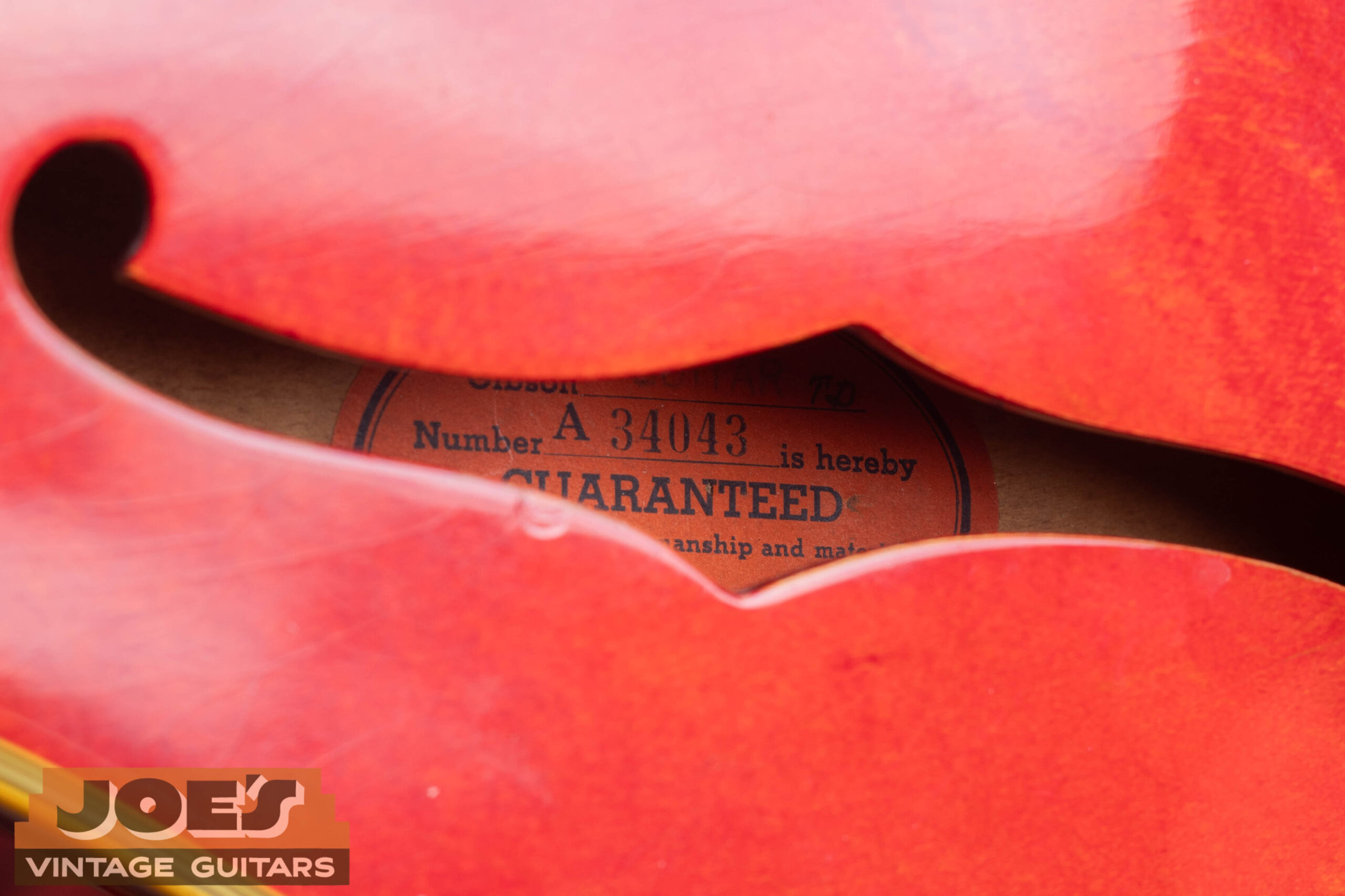
A-Prefix Numbers Appear on Multiple Label Types Don't assume your guitar is from a different era just because the label color doesn't match what you expected. Gibson used A-prefix serial numbers across white oval labels, orange oval labels, and direct headstock stamps during this period. The prefix letter and number are what matter — not the label. A one-year margin of error between the serial number date and confirmed physical feature date is normal and not a cause for concern.
Gibson Ink Stamp Serial Numbers: Solid Body Electrics (1952–1960)
While Gibson was using the A-prefix label system on its hollow and semi-hollow instruments throughout the 1950s, solid body electric guitars received their serial numbers in an entirely different way — stamped directly onto the back of the headstock finish in ink, with no interior label at all. This system was used on the Les Paul Goldtop, Les Paul Custom, Les Paul Special, Les Paul Junior, and their successors from 1952 through approximately 1960.
The ink stamp system is straightforward once you know the rule: the very first digit of the serial number is the last digit of the production year. Everything after it is a sequential production number. A serial beginning with 7 was made in 1957. A serial beginning with 9 was made in 1959. The graphic below makes this immediately clear — and the year key shows you exactly what was happening at the Kalamazoo factory in each year of the system’s run.
On solid body electric guitars, Gibson stamped the serial number directly onto the back of the headstock finish rather than using an interior label. This 1955 Les Paul Custom shows a typical example — a five digit number with no prefix, ink stamped onto the finished headstock.
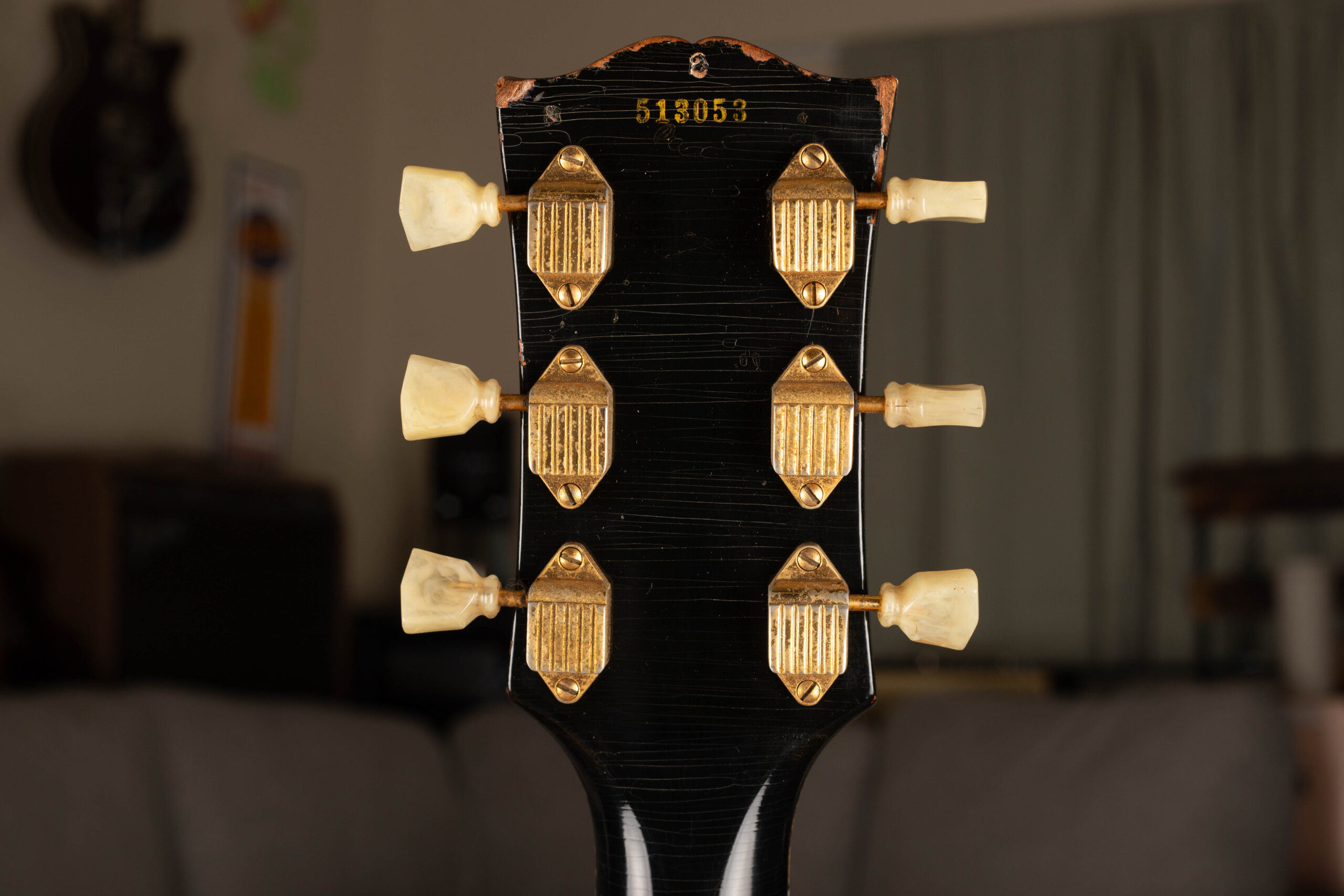
How to Read a Gibson Ink Stamp Serial Number
The first digit is the last digit of the production year. The remaining digits are the sequential production number. So a serial beginning with 5 was made in 1955 — not 1950 or 1965.
Serial 59244 = Made in 1955, production unit 9,244
Don't Confuse the Ink Stamp System with the A-Prefix System The headstock ink stamp system was used exclusively on solid body electric guitars — Les Paul models, the SG's predecessors, and similar instruments. During the exact same period, Gibson was using the A-prefix label system on hollow and semi-hollow instruments. If your guitar has an interior label with an A-prefix number, refer to the A-prefix chart above. If it has a stamped number on the back of the headstock with no prefix letter, this is the system that applies.
Gibson Serial Numbers 1961–1970: The Reused Number Era
If you have a Gibson from the 1960s and your serial number appears to match multiple years, you’re not doing anything wrong — Gibson’s serialization during this period is genuinely one of the most chaotic in the history of American instrument manufacturing. Beginning in 1961, Gibson exhausted their existing number sequences and began reusing old ranges rather than introducing a new system. The result is that tens of thousands of serial numbers from this era were stamped onto instruments in two, three, or even four different years — making the serial number alone nearly useless as a dating tool without physical corroboration.
This affects some of the most collectible instruments ever made — 1960s SGs, ES-335s, ES-175s, Firebirds, and Flying Vs all fall within this window. The chart below maps every known range to its possible production years. Where a number could belong to multiple years, all possibilities are listed. To narrow it down, you’ll need to examine the potentiometer date codes, the pickup type, the tuner style, the headstock profile, and the presence or absence of a volute. For a confirmed date on a 1960s Gibson, physical feature dating is not optional — it’s essential.”
For any Gibson falling in an overlapping range, potentiometer date codes are your most reliable secondary tool. Every pot used at the Kalamazoo factory was stamped with a code indicating the manufacturer and the week and year it was made. The guitar could not have been built before that date — giving you a firm earliest possible production year.
Serial Numbers Alone Cannot Date a 1960s Gibson For any instrument falling in an overlapping range, the serial number should be treated as a starting point only. Physical feature dating — pot codes, pickup type, tuner style, headstock profile, and neck profile — is essential for a confirmed production year. This is especially important for high-value instruments where a one or two year difference can significantly affect authenticity and market value.
The Norlin Era — 1969 to 1984
In 1969 Gibson’s parent company Chicago Musical Instruments was acquired by ECL, a South American brewing and industrial conglomerate that collectors and historians refer to collectively as Norlin — the name the combined entity eventually adopted. The Norlin period runs from 1969 through 1984 when the company was sold to a group of investors including Henry Juszkiewicz, who returned Gibson to American private ownership. The Norlin era has a complicated reputation. On one hand it produced genuinely playable and sonically capable instruments that represent some of the best value in the vintage market today precisely because of their stigma. On the other hand the period is defined by a series of cost-cutting and quality-control decisions that moved Gibson progressively away from the construction methods and materials that defined the golden era instruments of the 1950s and early 1960s — three-piece laminated necks, thicker finishes, the volute, the Nashville bridge, and inconsistent quality control on the production floor. Understanding where the Norlin era begins and ends is essential context for everything in the serial number and physical feature dating sections of this guide. A guitar that dates to 1968 and one that dates to 1970 can be very different instruments despite being built just two years apart, and the Norlin transition is the reason why.
Every Gibson built from 1970 onward carries this stamp below the serial number. Its presence immediately confirms a post-1969 production date — and its absence on an instrument claiming to be from the 1970s is a red flag worth investigating carefully.
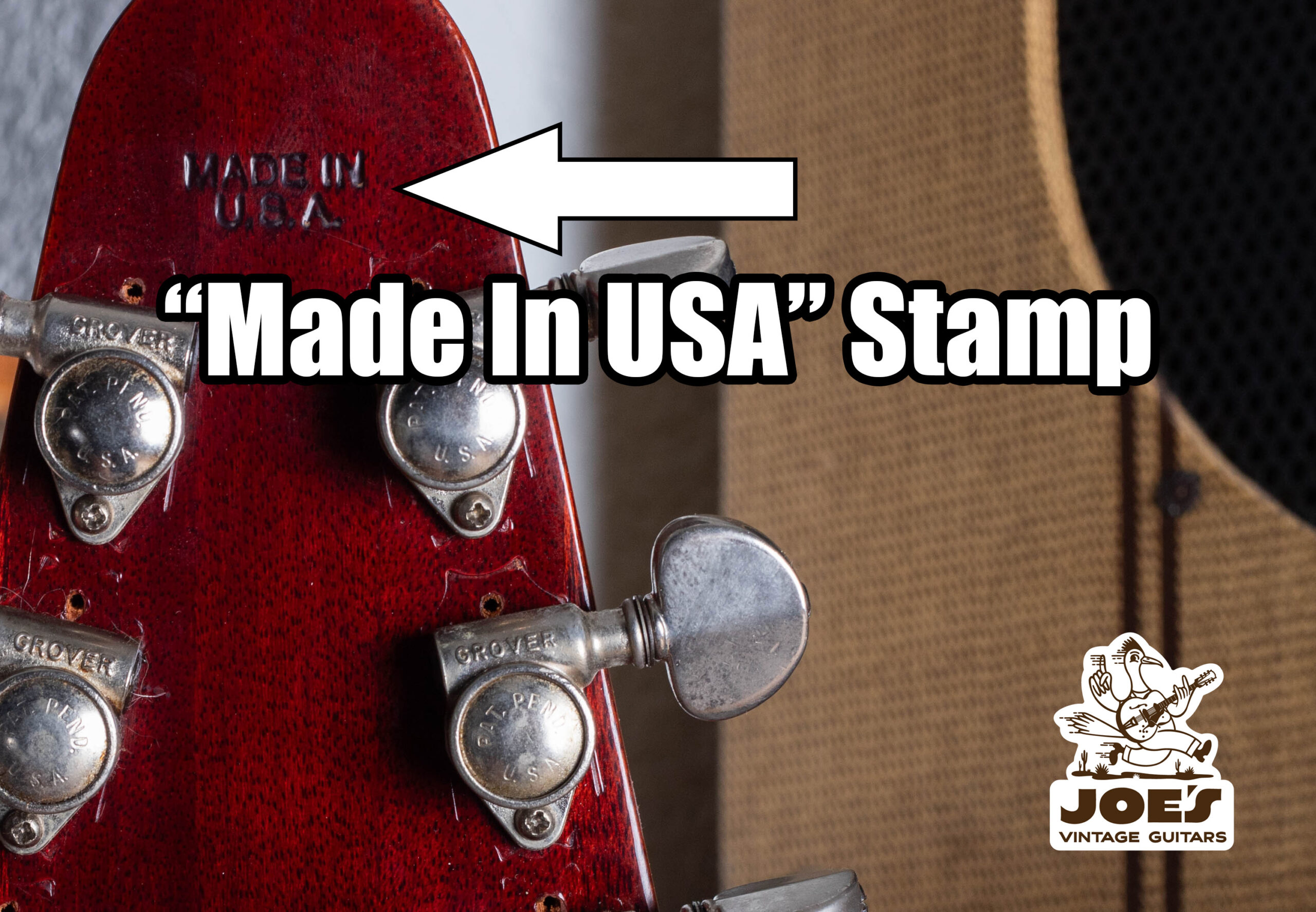
Quick Visual Identifiers for Early Norlin Gibsons (1970–1975) Look for the silkscreen decal logo rather than inlaid pearl, the "Made in USA" stamp below the serial number, and the volute at the rear of the headstock. On many Les Paul models from this period you'll also find a three-piece maple neck and a pancake-style layered body construction. These physical features together confirm early Norlin production and should always be cross-referenced alongside the serial number.
This photo shows the gold waterslide decal serial number on the back of the headstock — the format used from 1975 through 1977. Notice how the number sits on top of the finish rather than being stamped into it. After decades of play wear these decals can show signs of lifting or fading at the edges, which is completely normal and expected on a genuine instrument from this period.
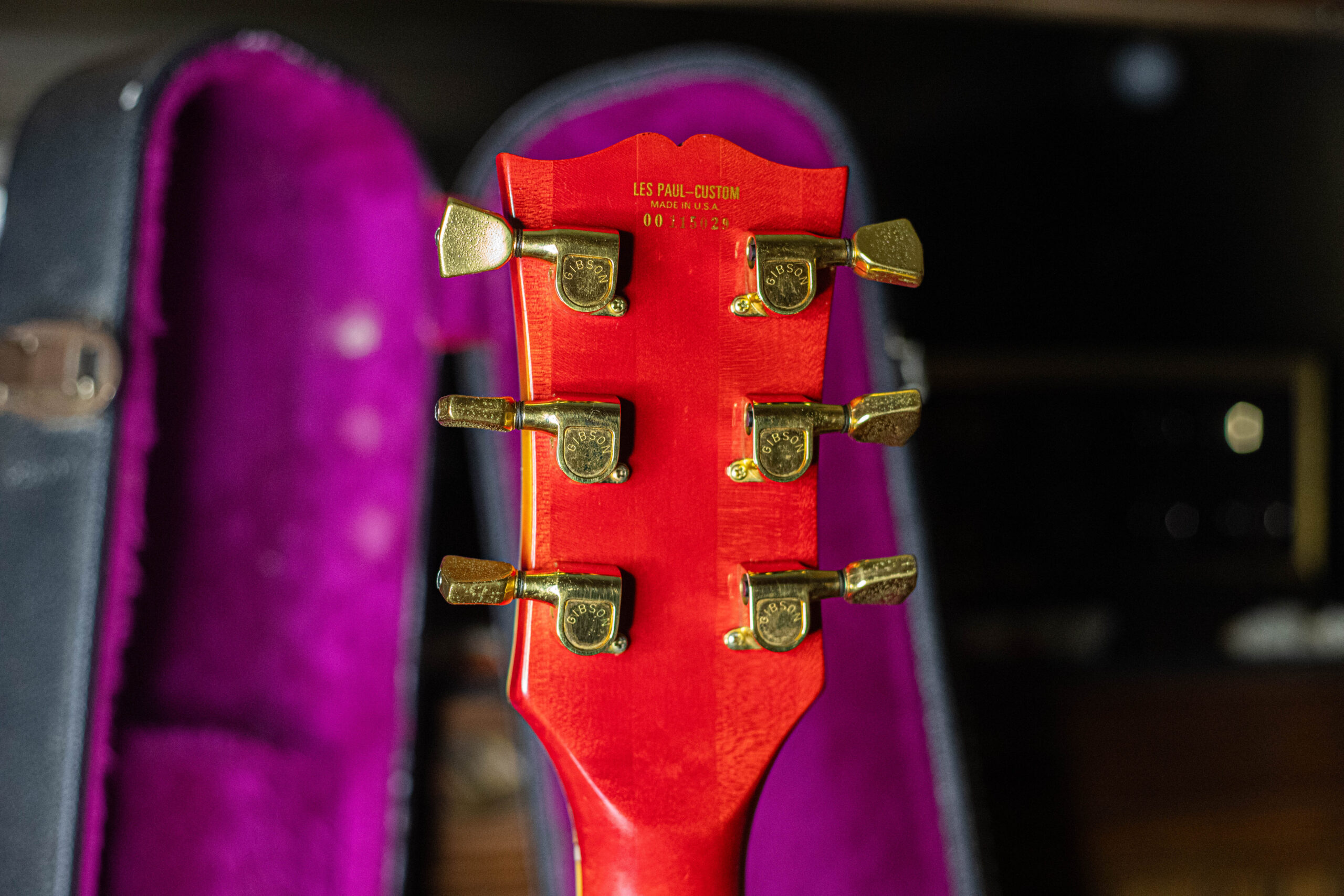
How to Spot a Decal Serial Number Unlike the deep ink stamps used before and after this period, the 1975–1977 decal serial numbers sit on top of the finish as a gold transfer. Look closely at the back of the headstock — if the number appears to float on the surface rather than being pressed into the wood, and has a slightly gold or metallic quality, you have one of these transitional instruments. The modern eight-digit stamped system — covered in the next section — replaced this format partway through 1977.
Gibson Serial Numbers 1977 to Present: The Modern Eight & Nine-Digit System
In 1977 Gibson introduced the eight-digit serial number system that — with minor variations — remains in use on every Gibson built today. Whether you’re trying to date a 1980s Les Paul Standard, a 1990s SG, or a guitar that came out of the Nashville factory last year, this is the system that applies. It’s one of the most logical serialization formats Gibson ever used, and once you understand the structure it takes about ten seconds to date any modern Gibson accurately.
The key is knowing that the first and fifth digits together give you the last two digits of the production year, and the second, third, and fourth digits tell you the day of the year the guitar was stamped. The remaining three or four digits are a sequential production number indicating how many instruments were completed that day — which is why some Gibson serial numbers are eight digits and others are nine.
One exception worth knowing: for a brief period in the 2010s, Gibson experimented with a format where the first two digits of the serial number simply represented the year of manufacture. If your Gibson falls into this window and you can’t make the standard system work, don’t worry — Gibson also stamped the actual year of manufacture directly on the back of the headstock beneath the “Made in USA” stamp on every instrument where this alternate format was used. The decoder graphic below covers the standard system that applies to the vast majority of Gibsons made from 1977 to today.
How to Read a Modern Gibson Serial Number (1977–Present)
First and fifth digits = last two digits of production year · Digits 2–4 = day of year · Remaining digits = factory & production sequence
Serial 90318XXX = Made in 1998, Day 031 = January 31st
Serial 90318XXXX = Made in 1998, Day 031 = January 31st
What About the Remaining Digits? The digits after the day of year indicate which Gibson factory the instrument was built in and its sequential production number for that day. For the purposes of dating your guitar, these don't matter — the year and day of year are all you need. If you're curious about factory provenance, the general rule is that lower ending numbers point to Kalamazoo production (pre-1985) and higher numbers to Nashville, with Bozeman acoustics using a 900+ range from 1989 onward.
The 1994 Centennial Exception — Don't Let "94" Fool You In 1994 Gibson celebrated the 100th anniversary of Orville Gibson founding his business in 1894. For most of that year Gibson abandoned the standard first-and-fifth-digit system entirely and simply began every serial number with 94 — making these the most commonly misread Gibsons of the modern era. If your serial starts with 94 and the decoder isn't giving you a clean result, you almost certainly have a 1994 Centennial instrument. Look for a "100th Anniversary" banner inlay at the 12th fret or a commemorative coin on the back of the headstock to confirm.
The 2010s Exception — When Gibson Stamped the Year Directly For a brief period in the 2010s Gibson used an alternate format where the first two digits of the serial number simply represented the production year rather than following the split digit system above. If your modern Gibson serial number doesn't decode cleanly using the standard method, this may be why. The good news is that Gibson also stamped the actual year of manufacture directly onto the back of the headstock beneath the "Made in USA" stamp on every instrument where this format was used — making these among the easiest Gibsons of all to date. If you see a four-digit year stamped below "Made in USA," that's your date.
This System Is Still in Use Today The eight and nine-digit system introduced in 1977 remains Gibson's active serialization method on instruments rolling out of the Nashville factory right now. If you have a brand new Gibson and want to confirm its production date, the same decoder above applies — first and fifth digits give you the year, digits two through four give you the day, and the rest is your production sequence number.
How to Date a Les Paul Classic With an Ink Stamp Serial Number
For much of its production, The Les Paul Classic used a unique ink-stamped serial number system that runs from 1989 through 2014 and differs significantly from both the vintage 1950s ink stamp system and the modern eight-digit Gibson serial format. On examples made between 1989 and 1999, the first digit is the last digit of the production year, followed by a space, and then three or four digits indicating the guitar’s place in production for that year — giving you either a four or five digit total. The earliest examples from 1989 carry only four digits total. From 2000 through 2014 the format changed to six digits with no space — the first two digits are the last two digits of the production year, followed by four production rank digits. A serial reading 071234 for example was made in 2007 and was the 1,234th instrument completed that year. No “Made in USA” stamp appears below the serial on most examples, though Gibson added it beginning in 2007. Starting in 2007, Gibson transition Les Paul Classic guitars back to haveing the standard “first and fifth” serial number format.
The Les Paul Classic uses an ink-stamped serial number on the back of the headstock that can easily be mistaken for a vintage 1950s stamp at first glance — but look closely and the font is different. Gibson used several different fonts on the Classic over its production run, but none of them match the authentic vintage ink stamp font used on original 1950s solid body instruments. No "Made in USA" stamp appears below the serial on most examples, which is itself a dating clue.
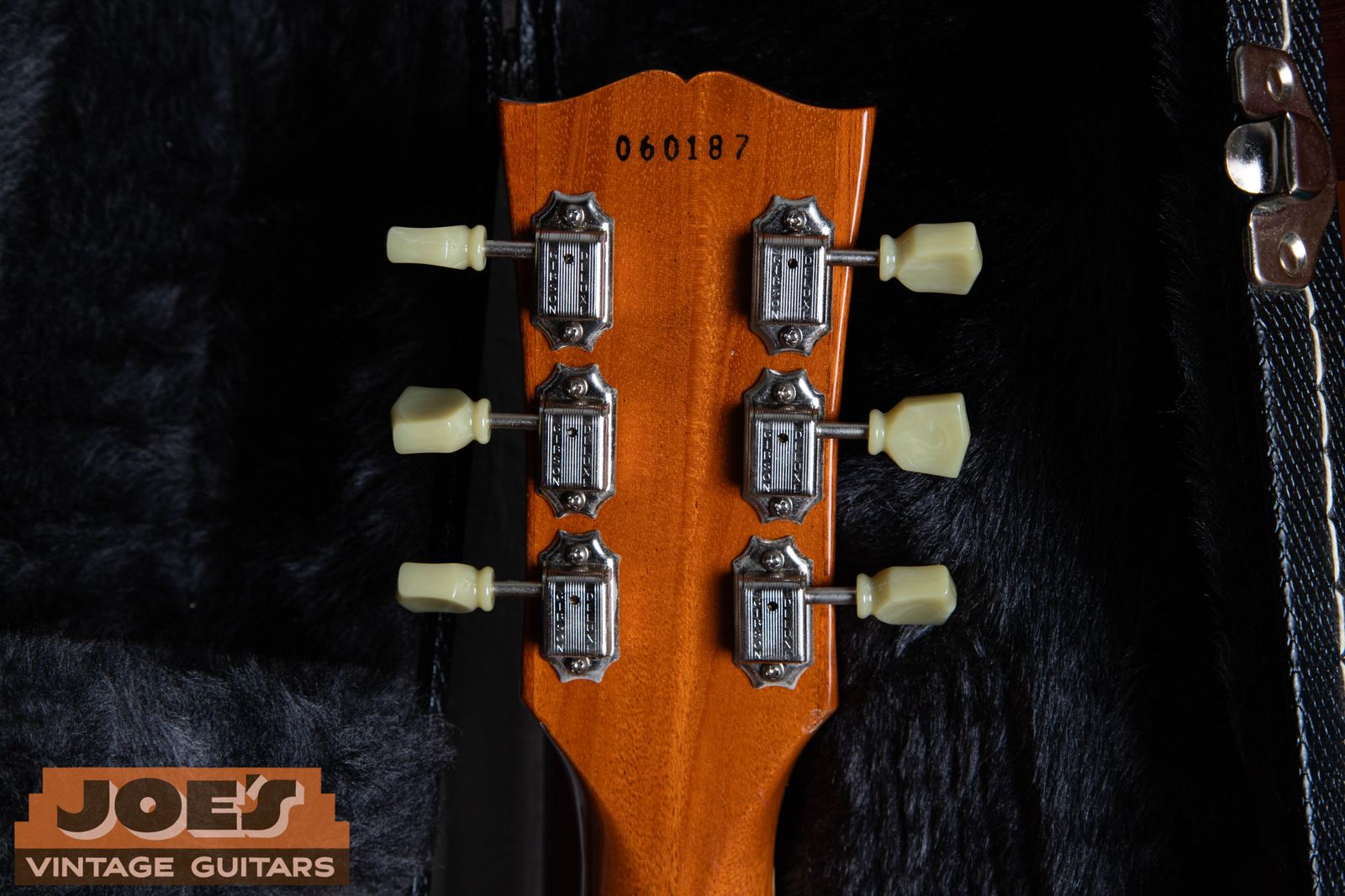
How to Read a Gibson Les Paul Classic Serial Number
1989–1999 use a single year digit · 2000–2014 use two year digits · A space follows the year digit(s) on 4 and 5-digit serials
Example: 9 123 = Made in 1999, unit 123 · Note the space after the year digit
Example: 9 1234 = Made in 1999, unit 1,234 · Note the space after the year digit
Example: 071234 = Made in 2007, unit 1,234 · No space on 6-digit serials
No "Made in USA" Stamp — Until 2007 Unlike standard modern Gibsons, the Les Paul Classic was produced without a "Made in USA" stamp below the serial number for most of its run. This was an intentional design choice to enhance the vintage aesthetic of the reissue-style headstock stamp. Beginning in 2007, Gibson added the "Made in USA" stamp to the back of the headstock on Les Paul Classics — so if your Classic has the stamp, it was made between 2007 and 2014.
Don't Confuse the Classic Stamp with a Vintage 1950s Ink Stamp The Les Paul Classic's headstock stamp is designed to evoke the look of the original 1950s solid body ink stamps — but the font is not the same. Gibson used several different typefaces on the Classic over its 25-year production run, and none of them match the authentic vintage stamp font. If you're trying to authenticate a guitar claimed to be an original 1950s Les Paul, the font itself is one of the first things to examine. An original 1952–1960 ink stamp has a distinctive character that is immediately different from the Classic's reissue-style stamp.
Gibson Custom Shop & Historic Reissue Serial Numbers
Gibson Custom Shop and Historic Reissue instruments use entirely different serialization formats from standard Gibson USA production — and to make things more complicated, different Custom Shop models use different formats from each other. A Gibson R9 Les Paul reissue is serialized differently from an SG reissue, which is serialized differently from a Custom Shop ES-335, which is serialized differently again from a carved-top archtop. If your Gibson has a Custom Shop serial number that doesn’t match anything in the standard modern decoder, this section is where you need to be.
Modern Custom Shop Models — The CS Prefix
Standard modern Gibson Custom Shop instruments — meaning Custom Shop builds that aren’t Historic Reissues of a specific vintage year — carry a CS prefix ink stamped on the back of the headstock. The CS prefix immediately identifies the instrument as Custom Shop production. The digit immediately following CS is the last digit of the production year, and the remaining three or four digits are the guitar’s sequential rank in that year’s Custom Shop production. A serial reading CS91234 was built in 1999 and was the 1,234th Custom Shop instrument completed that year.
Modern Gibson Custom Shop instruments carry a "CS" prefix ink stamped on the back of the headstock, immediately identifying them as Custom Shop production. The digits following CS tell you the production year and the guitar's place in that year's build sequence.
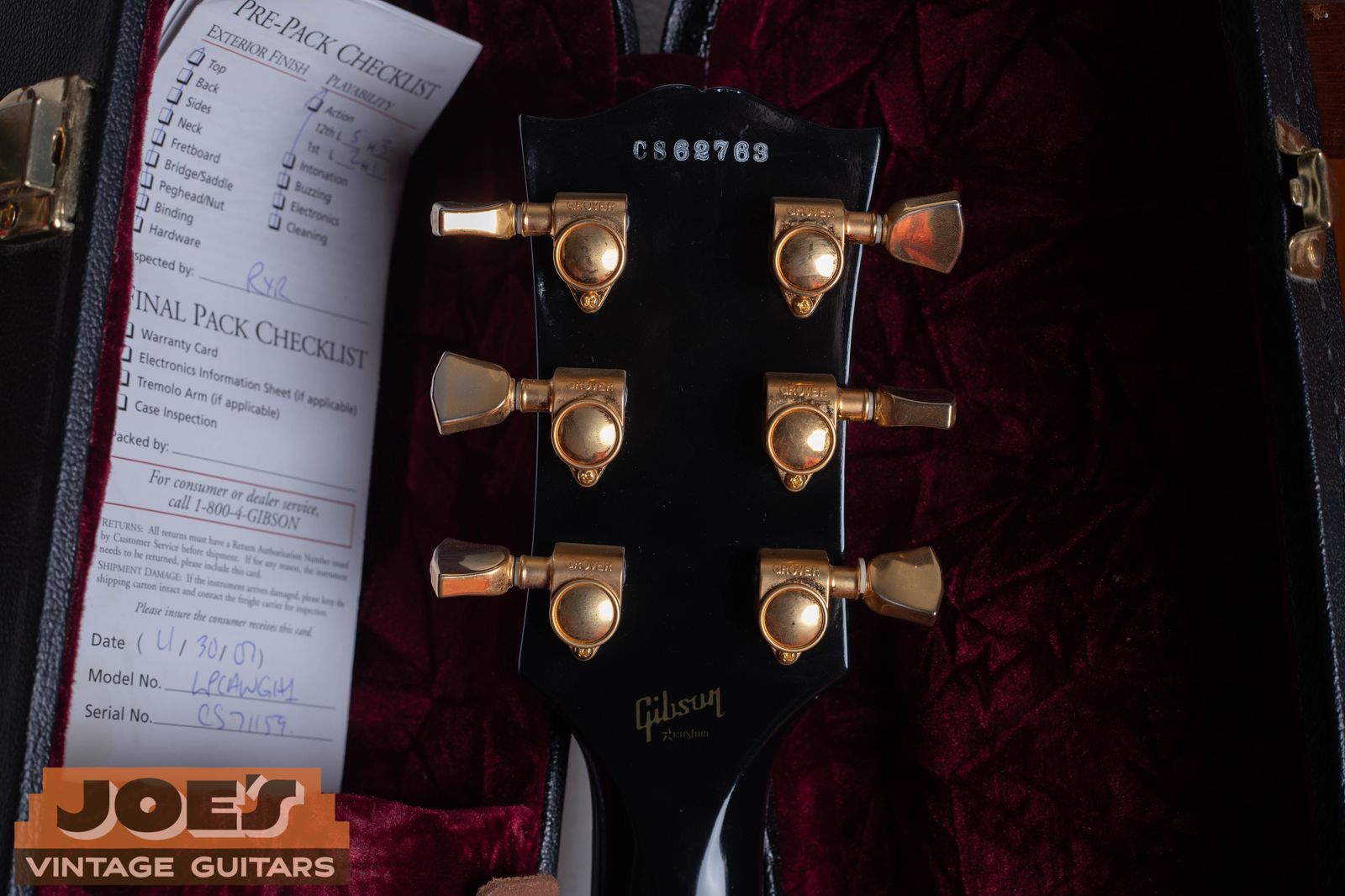
Modern Custom Shop — CS Prefix Format
CS prefix · Last digit of year · Production rank
Example: CS91234 = Custom Shop, made in 1999, unit 1,234
Historic Reissue Les Paul Models — Ink Stamp Format
Gibson’s Historic Reissue Les Paul guitars — the R4, R7, R8, R9, R0 and related models — use an ink-stamped serial number on the back of the headstock where the first digit indicates the vintage year being reissued, not the year the guitar was made. A serial beginning with 9 is a 1959 reissue. A serial beginning with 8 is a 1958 reissue. The second digit is the last digit of the actual production year, and the remaining three or four digits are the production rank. So a serial reading 991234 is a 1959 Les Paul reissue, built in 1999, and was the 1,234th Historic Reissue completed that year.
Les Paul Historic Reissues carry an ink-stamped serial number where the first digit is the model year being reissued — not the production year. A "9" prefix means it's a 1959 reissue, an "8" means a 1958 reissue, and so on. The second digit is the last digit of the actual year the guitar was made, followed by the production rank.
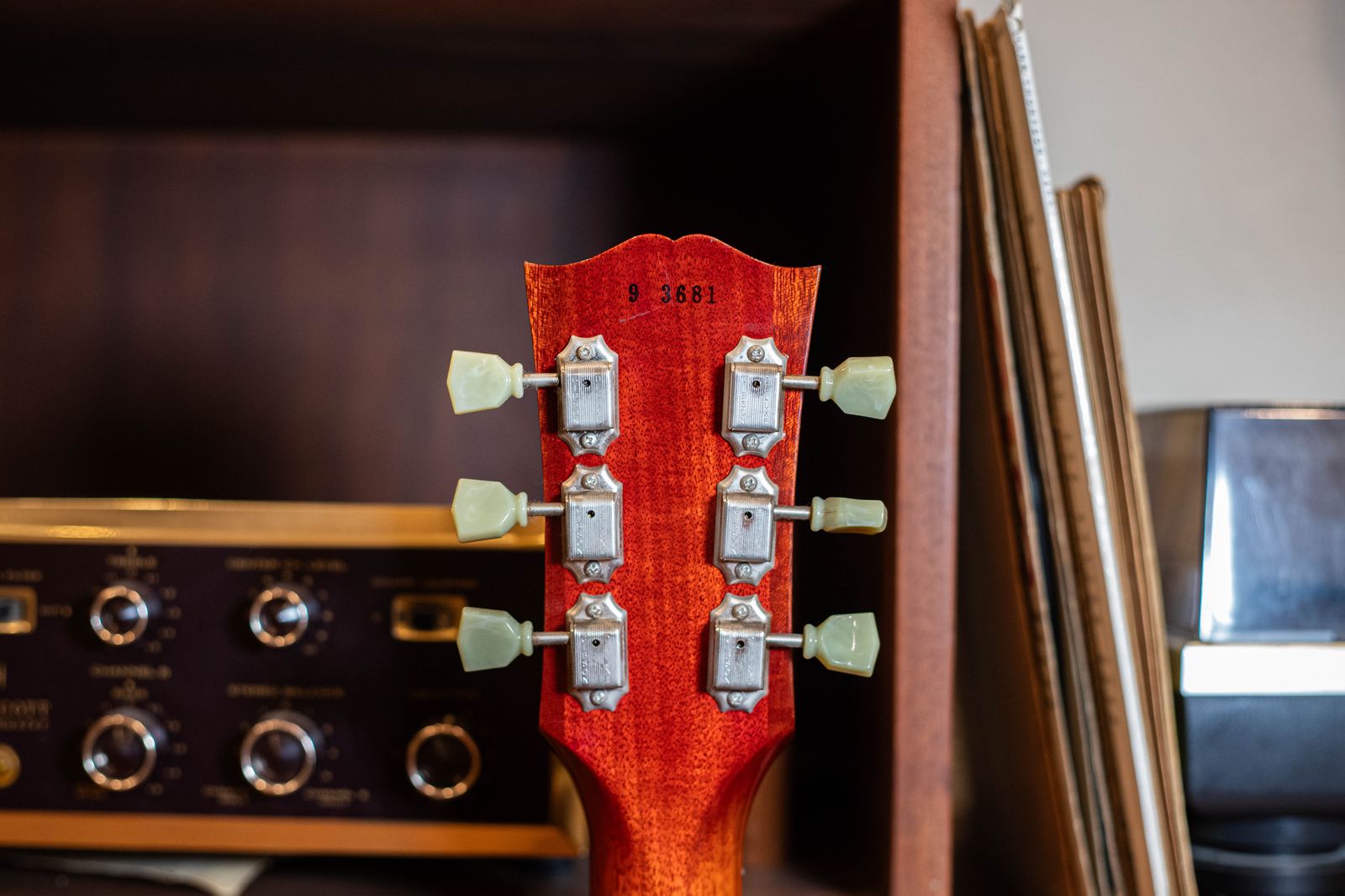
Historic Reissue Les Paul — Ink Stamp Format
First digit = model year reissued · Second digit = last digit of actual build year · Remaining = production rank
Example: 991234 = 1959 reissue, built in 1999, unit 1,234
Historic Reissue SG & Other Models — Impressed Serial Numbers
SG Historic Reissues, Firebird reissues, Flying V reissues, and several other Custom Shop models use an impressed serial number — physically pressed into the wood of the headstock rather than ink stamped. The format reverses the Les Paul reissue logic: the first digit is the last digit of the actual production year, the middle digits are the production rank, and the final digit is a model year code identifying which vintage year is being reissued. A 1 at the end means a 1961 SG Standard reissue, a 3 means a 1963 SG Custom, Special, or Junior, and so on. The model code table below covers every reissue code used in this format.
SG reissues and several other Custom Shop models use an impressed serial number physically pressed into the wood of the headstock rather than ink stamped. The format reverses the Les Paul reissue logic — the production year digit comes first, followed by the production rank, with the model year code at the end.
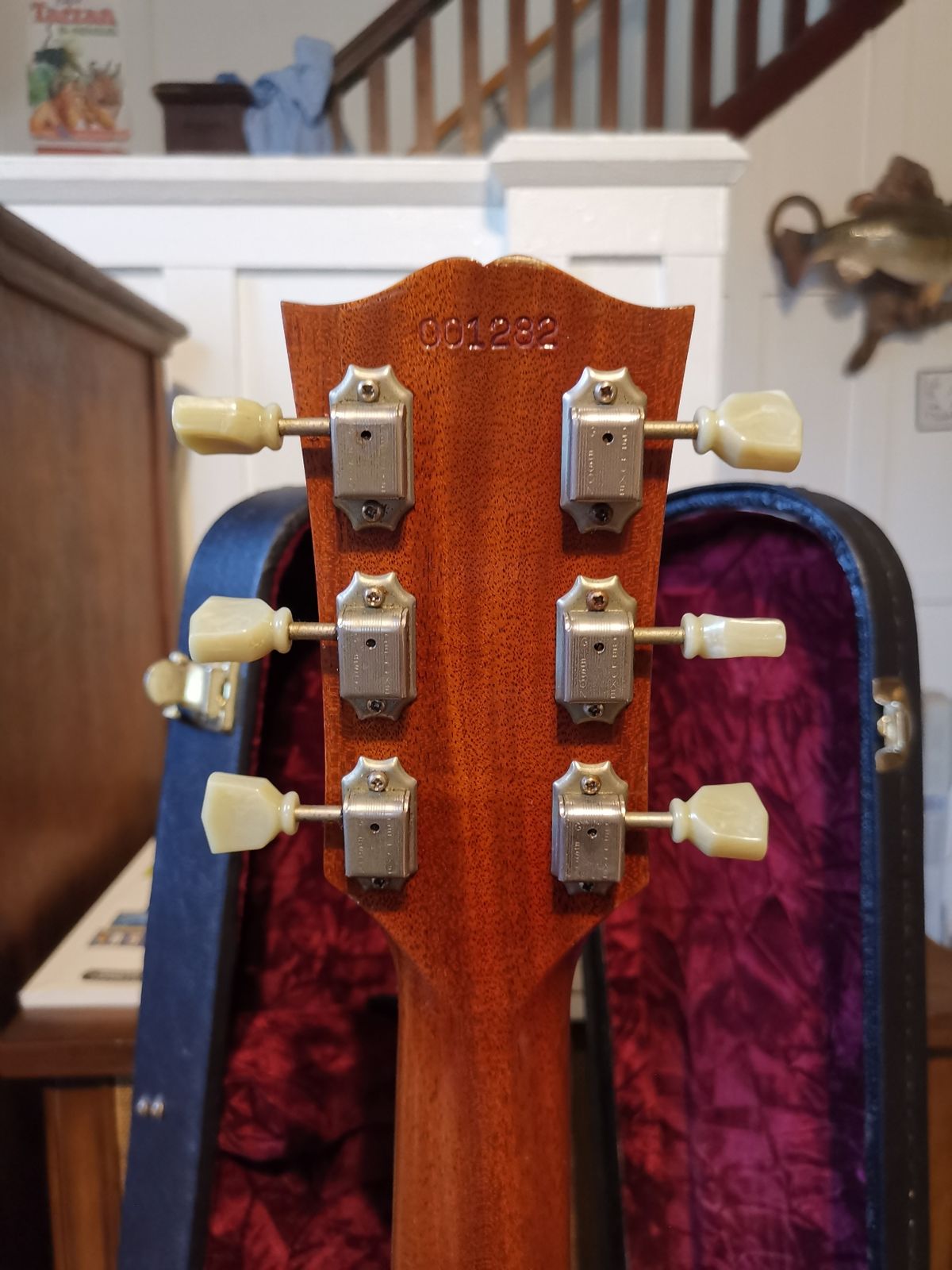
Historic Reissue SG & Other Models — Impressed Format
First digit = last digit of build year · Middle digits = production rank · Last digit = model year code
Example: 9RRRR3 = Built in 1999, unit RRRR, 1963 SG reissue
ES Reissues & Carved-Top Custom Shop Models
Gibson’s Custom Shop ES reissues and carved-top archtops use yet another format. The 1958 ES-335 reissue and 1959 ES model reissues carry their serial number on a label inside the f-hole with no headstock stamp — the label uses an A-prefix format where the digit following A indicates the model year being reissued. The 1961 and 1964 ES reissues carry both an impressed headstock stamp and a matching f-hole label stamp. Carved-top Custom Shop models such as the L-5 CES and Super 400 use the same split-year format as standard modern Gibsons — first and fifth digits give the production year, digits two through four give the day of the year — with the first digit reading 2 on all instruments made from 2000 onward.
ES Reissues & Carved-Top Custom Shop Models
ES models use f-hole label stamps · Some also have an impressed headstock stamp · Carved-top models use the modern split-year format
Format: 1YRRRR — Impressed on headstock and ink stamped on f-hole label
Format: A8YRRRR — F-hole label only, no headstock stamp
Format: A9YRRRR — F-hole label only, no headstock stamp
Format: YDDDYRRR — Same split-year logic as standard modern Gibsons · First digit is 2 from year 2000 onward
Always Identify the Model Before Decoding The biggest source of confusion with Custom Shop and Historic Reissue serials is that different models use completely different formats — and some use different locations entirely. Les Paul reissues are ink stamped on the headstock. SG and Flying V reissues are impressed into the headstock. ES models are stamped on the f-hole label with no headstock stamp. And carved-top models use the standard modern split-year format. Always identify the model first, then apply the correct decoding method above.
Dating Your Gibson By Physical Features — Beyond the Serial Number
A serial number is your starting point, not your finish line. On vintage Gibsons from the 1960s it may be nearly useless on its own, and even on instruments from other eras a serial number can be duplicated, replaced, or simply inconclusive. The physical features of the instrument — the headstock logo, the tuners, the knobs, the pickups, the hardware, the neck construction — tell a story that can’t be faked as easily and can date a Gibson with far greater precision than the serial number alone. Every section below covers a specific feature, what it looked like in each era, and exactly what to look for when you’re trying to pin down a production year. Used together, these features form a complete picture that experienced dealers, auction houses, and insurance appraisers rely on when a serial number isn’t enough.
Gibson Headstock Logo Evolution — A Complete Dating Guide
The Gibson headstock logo changed more times than most collectors realize, and each change was distinct enough to serve as a reliable dating tool in its own right. From the thin calligraphic ‘The Gibson’ script of 1908 through the wartime banner era, the postwar block logo transformations, and the Norlin silkscreen years, the logo on the front of the headstock can narrow a production date down to a window of just a few years without ever looking at the serial number. The timeline below covers every major logo variation in Gibson’s history — what it looked like, what years it was used, what makes each version distinctive, and what to watch for when authenticating a vintage instrument. Below is a comprehensive timeline of its evolution to help you in dating your instrument.
No Headstock Logo
Pre-Logo EraThe earliest Gibson instruments produced at the Kalamazoo factory carried no logo on the headstock at all. Brand identification during this period was handled entirely by the interior paper label. If you have a very early Gibson archtop or flat-top and find no headstock marking, this is completely normal and expected — the absence of a logo is itself a dating indicator pointing to the first years of the company.
"The Gibson" — Slanted Calligraphic Script
Early Script EraGibson introduced its first headstock logo in 1908 — an elegant, calligraphic script reading "The Gibson," with the definite article very much part of the brand identity. The lettering was thin, flowing, and unmistakably hand-lettered in style, inlaid into the headstock at a slanted angle. This is the rarest and most visually distinctive of all Gibson logo variations, appearing on early archtop instruments including the Style O and early L-series guitars. The slant of the logo on genuine examples from this period follows a consistent rightward lean that differs markedly from later interpretations.
"The Gibson" — Straightened Script
Straight Script EraBy the late 1920s Gibson standardized the placement of the headstock logo to run straight across rather than at a slant, while retaining the same thin calligraphic script and the "The Gibson" wording. This straightened version appears on the instruments from Gibson's prewar golden age — the early L-5, the Nick Lucas Special, and the early Advanced Jumbo and J-35 acoustics. The lettering remained fine and delicate, giving these instruments a refined, almost formal appearance that collectors strongly associate with the prewar era.
"Gibson" — Thin Script, No "The"
Thin Script EraIn the mid-1930s Gibson dropped "The" from the headstock logo, settling on simply "Gibson" — a step that brought the branding much closer to what collectors recognize today. The calligraphic script style was retained, but the lettering was still relatively thin compared to what would follow. This version appears on some of the most desirable prewar instruments in existence — the mid-1930s L-5, the Super 400, and the flat-top acoustics of the period. The thin script on these instruments has a graceful, almost fragile quality that is immediately distinguishable from the bolder versions that came later.
"Gibson" — Bold Script, Pre-War
Bold Script EraBy the late 1930s the calligraphic letterforms were thickened and strengthened, giving the script logo a bolder, more commanding presence on the headstock. This beefed-up version of the script appeared on the finest prewar Gibsons — the late 1930s L-5, the Super 400, and the J-200, which was introduced in 1937. The thicker letterforms gave these instruments a visual authority that matched their position as Gibson's flagship models. This is the last version of the script logo before the wartime disruptions that would bring the Banner era.
Post-Banner Plain Bold Script
Brief Transitional WindowWhen the banner was discontinued in 1946, Gibson returned to the plain bold script logo — the same thickened calligraphic lettering used in the late prewar years, now without the ribbon banner beneath it. This version was in use for roughly a year before the major block logo redesign of 1947. Instruments from this very short window carry the bold script but no banner, which can occasionally cause confusion — a 1946 Gibson acoustic with no banner is not missing its banner, it simply post-dates the banner era. These transitional instruments share the construction characteristics of the late banner years while already moving toward the postwar aesthetic.
Block Style Logo — Open "b" and "o", Curved "G"
First Modern Logo EraIn 1947 Gibson made the most radical logo change in the company's history, abandoning the calligraphic script entirely in favor of a bold block-style typeface. This was a deliberate post-war modernization — out with the elegant prewar script, in with something that felt contemporary and confident for a new era. The 1947 block logo has several features that distinguish it from the versions that would follow: the "G" has a notable inward curve, the "b" and "o" are open at the right side rather than fully enclosed, and the dot of the "i" is linked directly to the "G" rather than floating free. This version appears on the earliest Les Paul Goldtops, the ES-175, and the early postwar J-200 and L-5 models.
Slanted Block Logo — Separated Dot on "i"
Golden Era Block LogoBy 1951 two important refinements were made to the block logo. The lettering was given a slight rightward slant — a subtle but meaningful change that gave the logo a more dynamic feel — and the dot of the "i" was separated from the "G," floating independently above the letter. This is the logo that appears on the most valuable and collectible Gibsons ever made: the 1952–1960 Les Paul Standards including the iconic Sunburst models, the Les Paul Custom, the ES-335 from its 1958 introduction, the ES-345, the ES-355, and virtually every other instrument from Gibson's acknowledged golden age. The open "b" and "o" of the 1947 version were retained, giving the logo an open, airy quality that is immediately recognizable to collectors.
Squared Block Logo — Closed Letters, No Dot
Late 60s / Early Norlin TransitionIn 1967 Gibson made a significant revision to the block logo. The letterforms were squared off, giving the wordmark a more geometric, modern appearance. The "b" and "o" — which had been open on the right side since 1947 — were now closed off again, and the dot above the "i" disappeared entirely. This version of the logo spans the transition from independent Gibson ownership into the early Norlin era, appearing on late 1960s SGs, ES models, and Les Paul reissues of the period. The squarer, more utilitarian appearance of this logo is generally considered less desirable by collectors than the earlier versions, though it is historically significant as a transitional marker.
Squared Block Logo — Dot Reinstated
Mid Norlin EraIn 1972 the dot above the "i" was reinstated on the squared block logo. The "b" and "o" remained closed as they had been since 1967. This is the logo associated with the heart of the Norlin production period — the volute years, the three-piece maple neck Les Pauls, and the pancake body construction era. While Norlin-era instruments are often dismissed by collectors focused on vintage value, many of these guitars are excellent players and represent good value in today's market. The logo itself during this period was often executed as a silkscreen decal rather than a pearl inlay on many models, which is one of the easiest ways to identify a Norlin-era instrument at a glance.
Modern Gibson Logo — Current Version
Modern Era — 1981 to TodayIn 1981 Gibson introduced the logo that remains in use today, representing the end of a 73-year evolution from the original calligraphic script. The modern logo reopened the "b" and "o" — returning to the open letterforms of the 1947–1966 era — and introduced a new detail: the letter "n" is now connected at the top to the "o" that follows it. The dot above the "i" is present. This combination of features — open "b" and "o", connected "n" and "o", floating dot on the "i" — is unique to the modern logo and distinguishes it from every earlier version. The modern logo appears on instruments from the Henry Juszkiewicz era through the present day, including the full range of Gibson USA, Gibson Custom Shop, and Gibson Acoustic production.
Using the Logo to Authenticate a Vintage Gibson The headstock logo is one of the first things an experienced dealer examines when evaluating a vintage Gibson. Each era has a specific combination of features — letter spacing, open vs closed letterforms, dot position, inlay depth, and material — that must be consistent with the claimed production year. A logo that doesn't match the serial number era is an immediate red flag. On genuine vintage instruments the pearl shows natural aging, the inlay sits flush with the veneer, and the letterforms are consistent with known examples from that period. If you have questions about the authenticity of a Gibson logo, text photos to (602) 900-6635 for a free assessment.
Gibson Knob Styles By Year — A Visual Dating Guide
The control knobs on a Gibson electric guitar changed five distinct times between 1926 and 1975, and each style was used exclusively enough that the knob type alone can confirm or contradict a claimed production date. Bakelite knobs point to pre-1946 production. Gold speed knobs with no numbers indicate the earliest postwar instruments from 1946 onward. Bonnet knobs in black or gold place an instrument firmly in the 1955–1960 golden era — and their presence on a Les Paul is one of the strongest visual indicators of a genuine late-1950s instrument. Top hat reflector knobs with their distinctive metallic insert are exclusive to 1960–1967, covering the SG transition years and the Firebird era. Witch hat knobs with gold or silver tops indicate 1967–1975 production. After 1975 Gibson’s knob usage became inconsistent across models and knob style can no longer be relied upon as a dating tool — but for anything built before that cutoff, the knob is one of the first things an experienced dealer looks at.
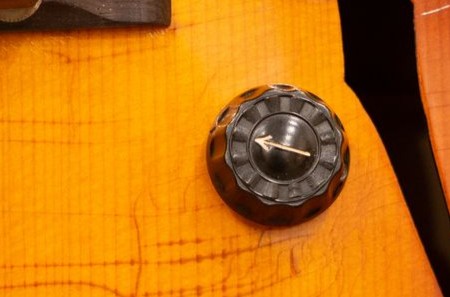
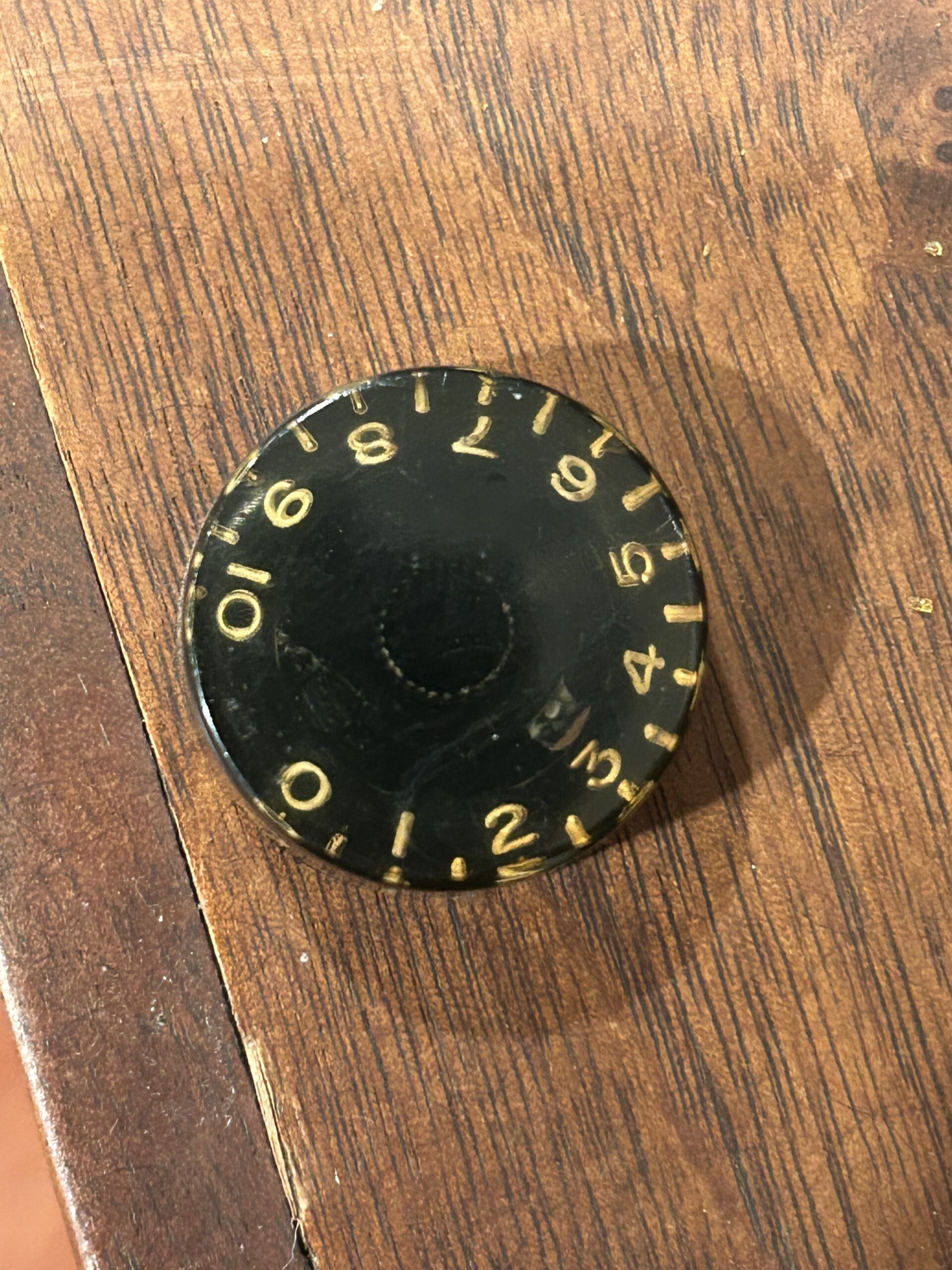
Bakelite Knobs
Gibson's earliest electric instruments used knobs made from Bakelite — one of the first synthetic plastics, widely used in consumer electronics and instrument manufacturing through the 1930s and into the 1940s. Bakelite knobs have a distinctive appearance and feel that differs from later plastics: they tend to have a slightly waxy surface, a heavier feel than modern knobs, and often show a characteristic aging pattern where the material develops a brownish or amber cast over time even if originally black.
Bakelite knobs on a vintage Gibson are a strong indicator of pre-1946 production on electric models. The material was phased out as newer, more consistent plastics became available in the postwar period.
Speed Knobs
After the war, Gibson transitioned to a new knob style that collectors refer to as "speed knobs" — a low-profile, slightly domed design with a flat top and a shape similar in profile to the speed knobs that would return in the modern era. These first appeared on postwar Gibson electrics beginning around 1946 and remained the standard through 1955.
The earliest postwar speed knobs have smooth tops with no numbers — a detail that can help narrow down production to the first few years of this era. By the early 1950s, numbers 1 through 10 began appearing on the knob surface. The Les Paul Custom, introduced in 1954, is a notable exception — it used black speed knobs throughout its run in this era, while the standard Les Paul Goldtop and most other models used gold versions.
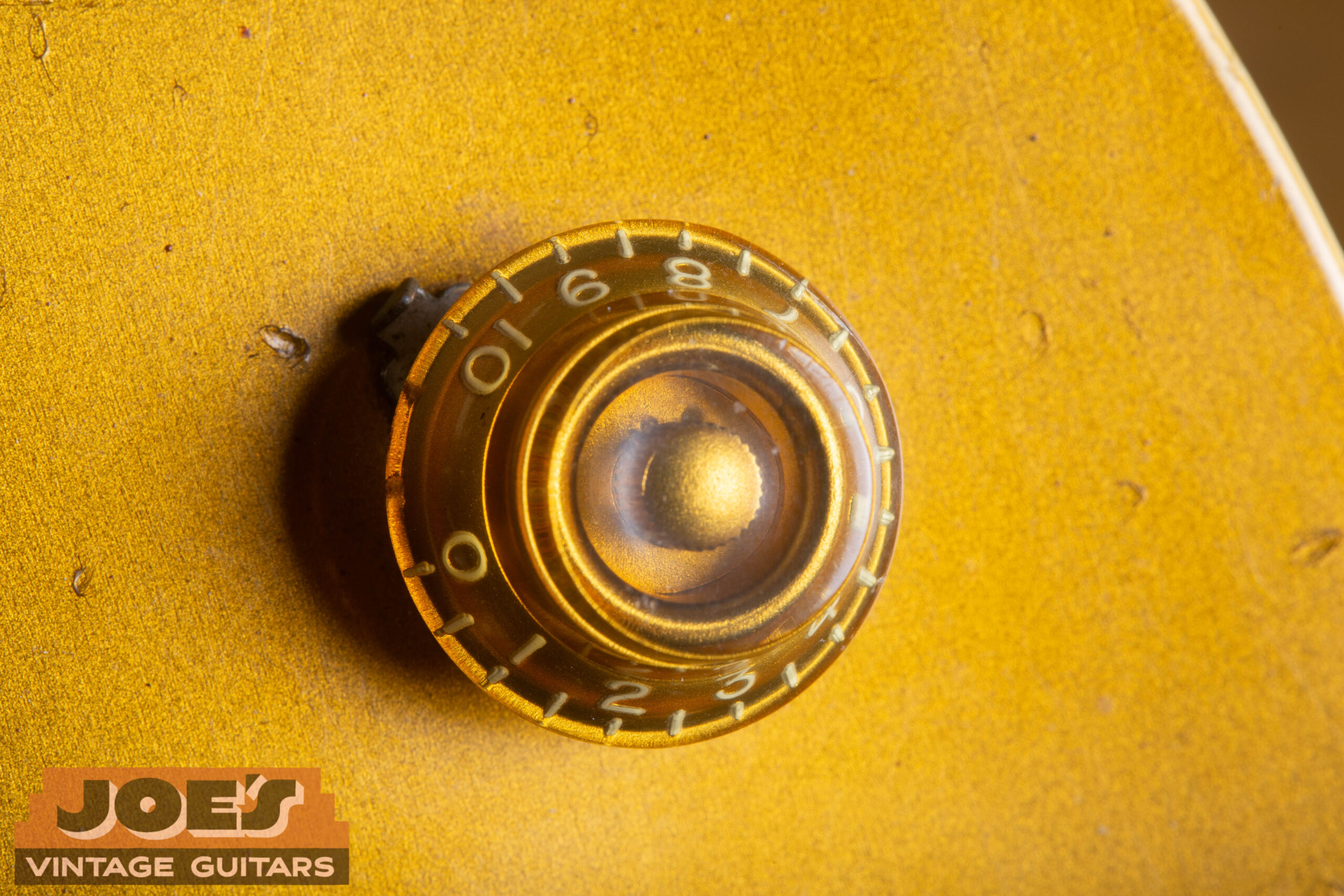
Bonnet Knobs
In 1955 Gibson introduced what collectors call the "bonnet knob" — a distinctive dome-shaped design that sits higher than the speed knob and has a rounded, bonnet-like profile. These are among the most visually recognizable knobs in all of vintage guitar collecting and are closely associated with the golden era Les Paul Standards, including the iconic Sunburst models from 1958 to 1960.
Bonnet knobs came in both black and gold versions. Gold bonnet knobs are the version most associated with the late 1950s Les Paul Standard, while black bonnets appeared on certain other models during the same period. The transition away from bonnet knobs happened partway through 1960 when Gibson began switching to the top hat style, meaning some 1960 instruments will have bonnet knobs and others will have top hats depending on exactly when in the year they were built — a useful detail when trying to pin down a transitional instrument.
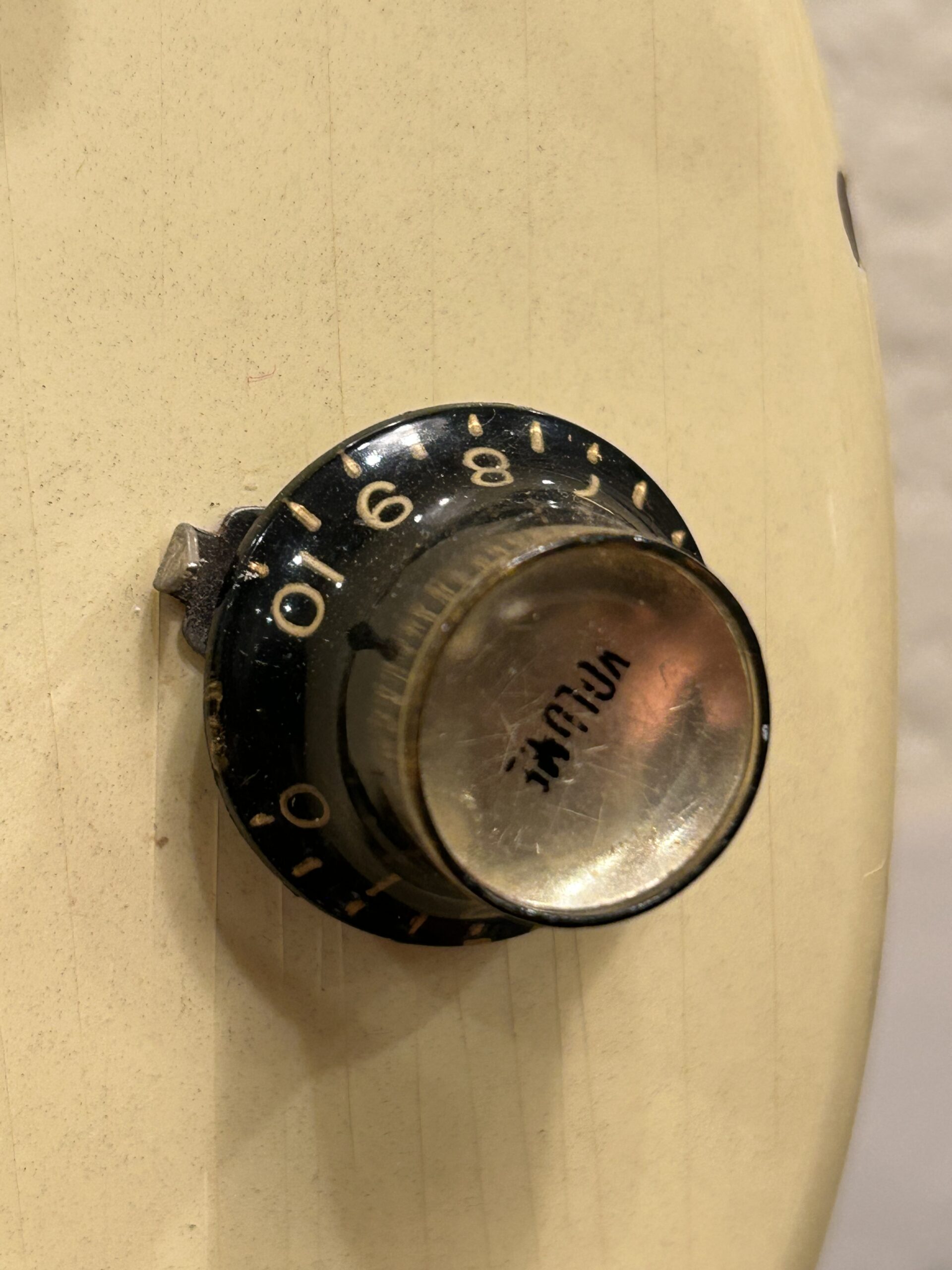
Top Hat / Reflector Knobs
From 1960 through 1967, Gibson used what collectors call "top hat" or "reflector" knobs — a taller design with a wider, flat brim and a metallic reflector insert on the top. These are the knobs associated with the earliest SG models, the late-transitional ES-335 production, and the Firebird series. Both black and gold versions were produced, with gold top hats appearing on higher-end models.
The reflector insert — a small circular metallic disc set into the top of the knob — gives these knobs their alternative "reflector knob" name and is the single most identifiable visual feature. The top hat profile is taller and more architectural than the bonnet that preceded it, and distinctly different from the witch hat shape that followed.
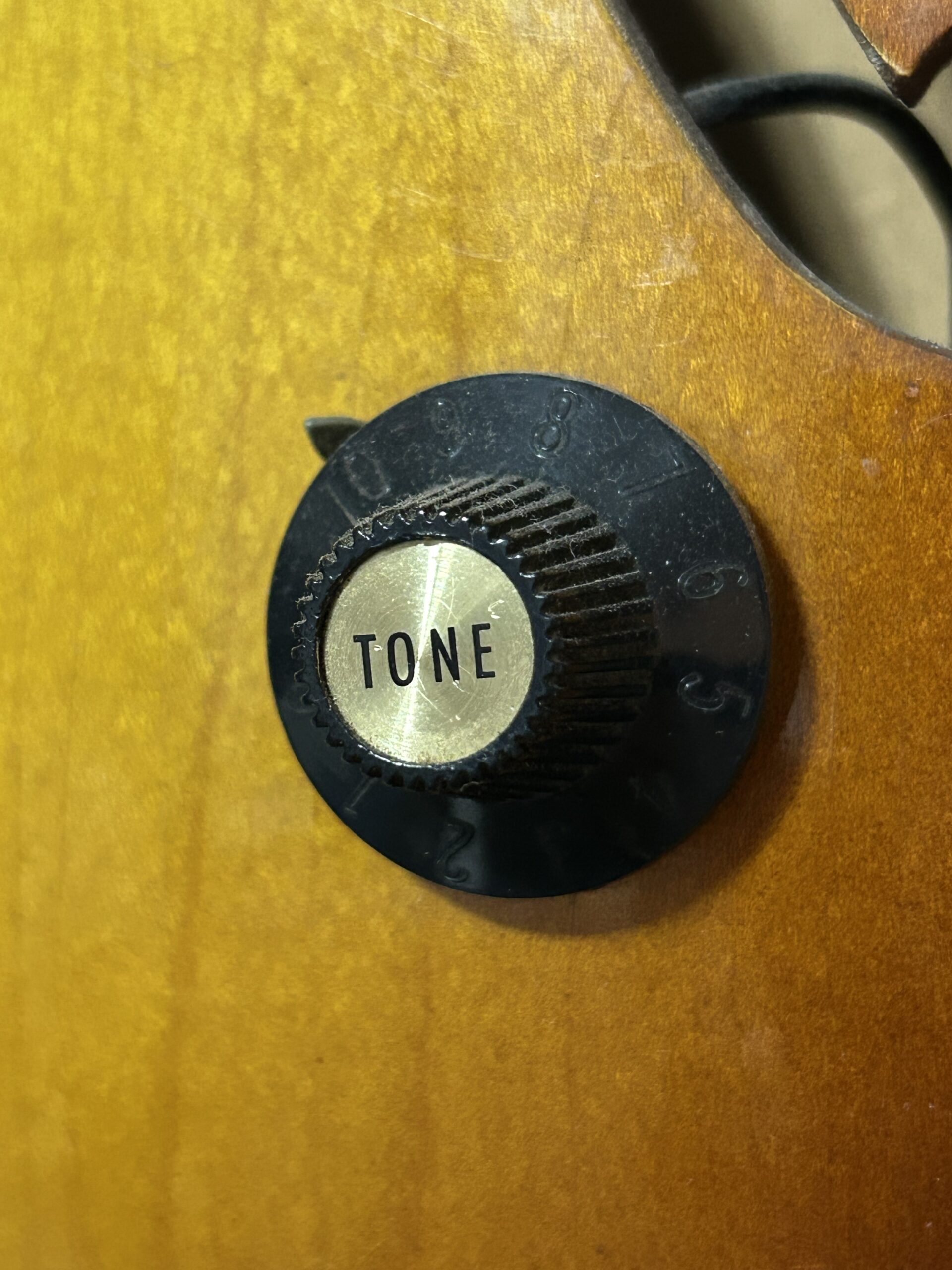
Witch Hat Knobs
From 1967 through approximately 1975, Gibson used the style collectors call "witch hat" knobs — named for their tall, tapered profile that comes to a rounded point at the top, resembling a witch's hat in silhouette. These appeared across the full range of Gibson electric models during the late 1960s and into the early Norlin era.
Witch hat knobs can have either a gold or silver colored top cap, and this detail can sometimes help narrow production within the era — gold tops tend to appear on earlier and higher-end examples while silver tops are more common on later and mid-range production. The witch hat shape is one of the most distinctive in Gibson's history and is immediately recognizable to anyone familiar with late-1960s and early-1970s Gibson electrics.
Post-1975 — Not Reliable for Dating
After 1975 Gibson began mixing knob styles inconsistently across its model range, and knob type alone cannot be used to date a post-1975 instrument. Speed knobs returned on many models, but different styles appeared simultaneously on different models within the same year and were sometimes swapped between production runs without announcement. Replacement knobs are also extremely common on instruments of this era.
For post-1975 Gibsons, the serial number and the physical feature dating guides for neck construction, hardware, and logo are far more reliable than the knob style. Treat any knob observation on a post-1975 Gibson as supporting evidence at best, not a primary dating tool.
Knobs Are Easy to Replace — Always Cross-Reference Knobs are among the most commonly replaced parts on vintage Gibsons. An instrument with incorrect knobs for its era isn't necessarily inauthentic — the original knobs may simply have been lost or swapped over decades of use. Always cross-reference the knob style against the serial number, pot codes, logo, and other physical features before drawing conclusions. Conversely, correct-era knobs on a guitar being sold as vintage are a positive sign but not proof of authenticity on their own.
Gibson Tuner Identification — Dating Your Gibson By Its Tuning Machines
The tuning machines on a vintage Gibson are one of the most precise and underutilized dating tools available — precise enough that the difference between a single line and a double line of text stamped on a tuner cover can confirm whether an instrument was built before or after 1964. Gibson used Kluson tuners as standard equipment on its electric models from the early 1950s through the early 1970s, and Kluson changed their cover stamping twice during that window — giving collectors a reliable three-stage timeline within the broader Kluson era. The transition from ‘Kluson Deluxe’ to ‘Gibson Deluxe’ stamping around 1969 adds a fourth marker. Combined with the button style — single-ring before 1960, double-ring from 1960 onward — the tuners alone can narrow a production date to a window of just a few years on most golden era instruments. On high-end models, the transition from gold Kluson waffle-backs to gold Grover Rotomatics around 1958 is an additional spec-level detail that confirms original hardware and top-tier configuration. This guide covers individual tuners only — strip tuners used on certain Gibson models are not included here.
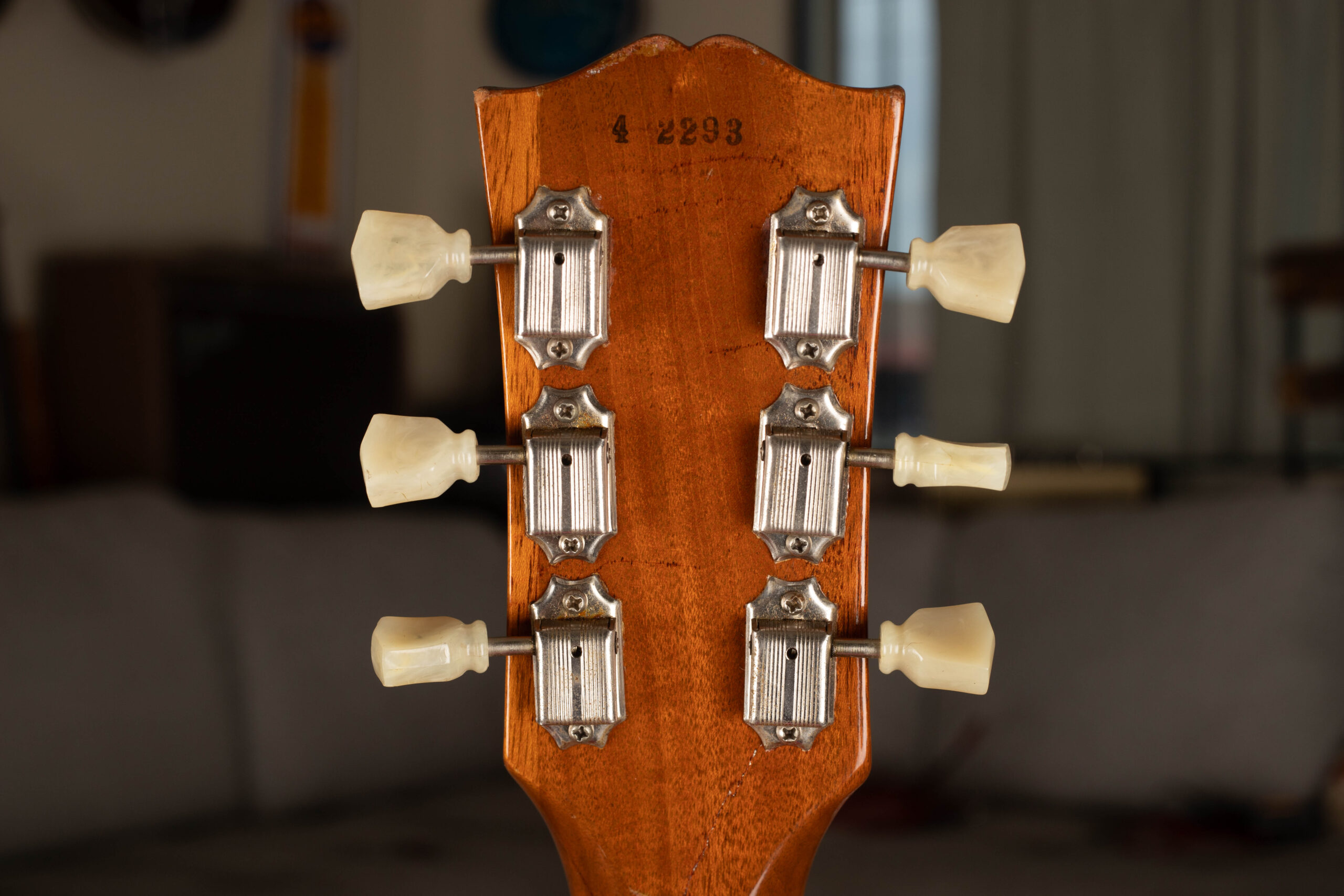
Kluson Deluxe — No Line
The earliest individual Kluson tuners used on Gibson solid body electrics had a plain tulip-shaped plastic button and a smooth metal cover with no text stamped on it — collectors refer to these as "no-line" Klusons. These appear on the earliest Les Paul Goldtops, the original Les Paul Custom, and other Gibson electrics from the first years of solid body production through approximately 1956.
The absence of any stamping on the tuner cover is the single identifying feature of this variant. A no-line Kluson on a claimed early-1950s Gibson is a strong corroborating detail that the instrument has its original tuners and dates to the correct period.
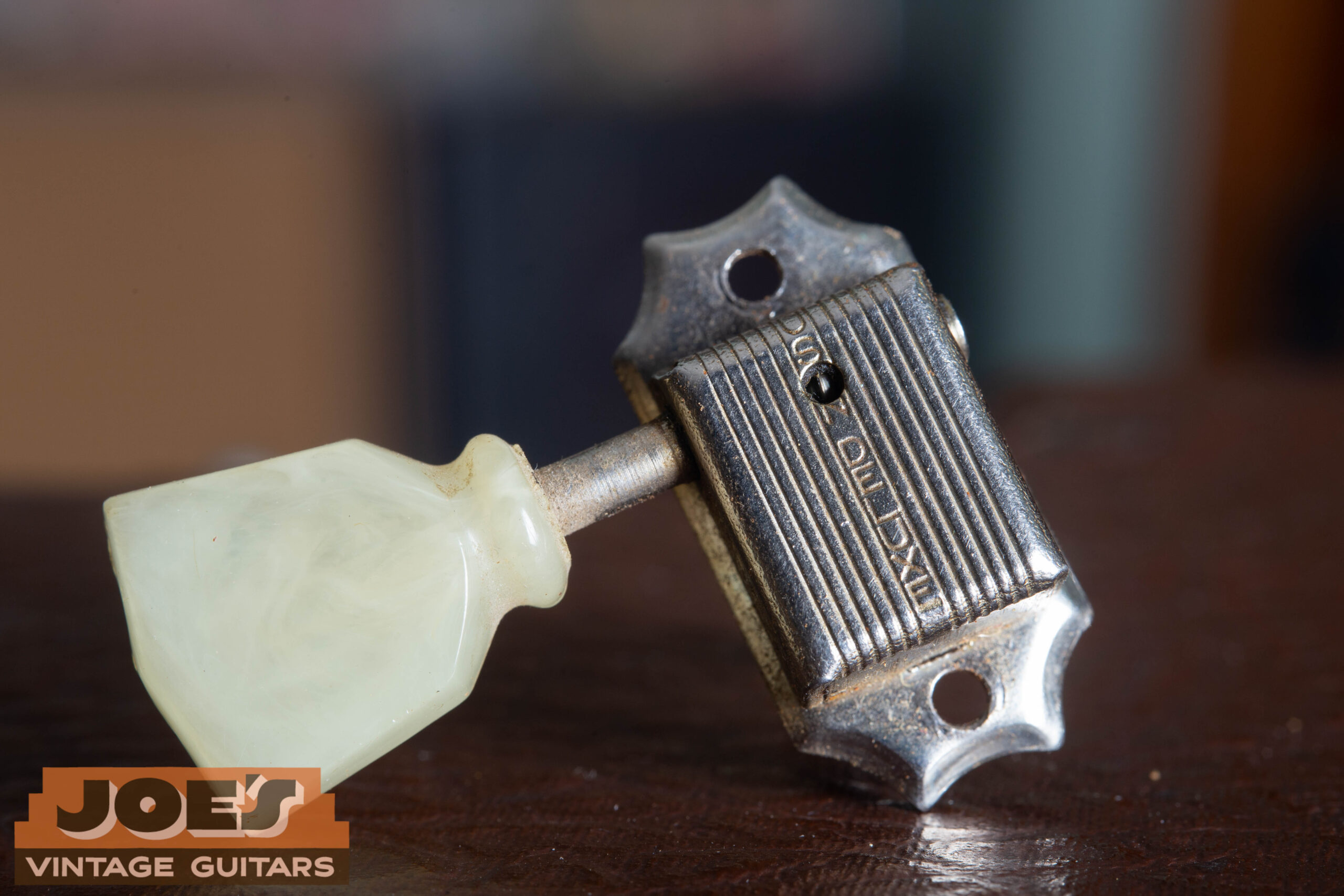
Kluson Deluxe — Single Line
Around 1956 Kluson began stamping a single line of text — "KLUSON DELUXE" — on the metal tuner cover. This single-line variant is the tuner associated with the most desirable Gibsons ever made: the 1956–1960 Les Paul Standards including the iconic Sunburst models, the original ES-335 from 1958, the ES-345, the ES-355, and the majority of golden era production across all models.
The single line of text runs along the center of the cover plate. The tulip-shaped plastic button remained standard during this period. Single-line Klusons are among the most studied and replicated vintage tuners in existence — originality on a golden era Gibson adds significant value and authenticity.
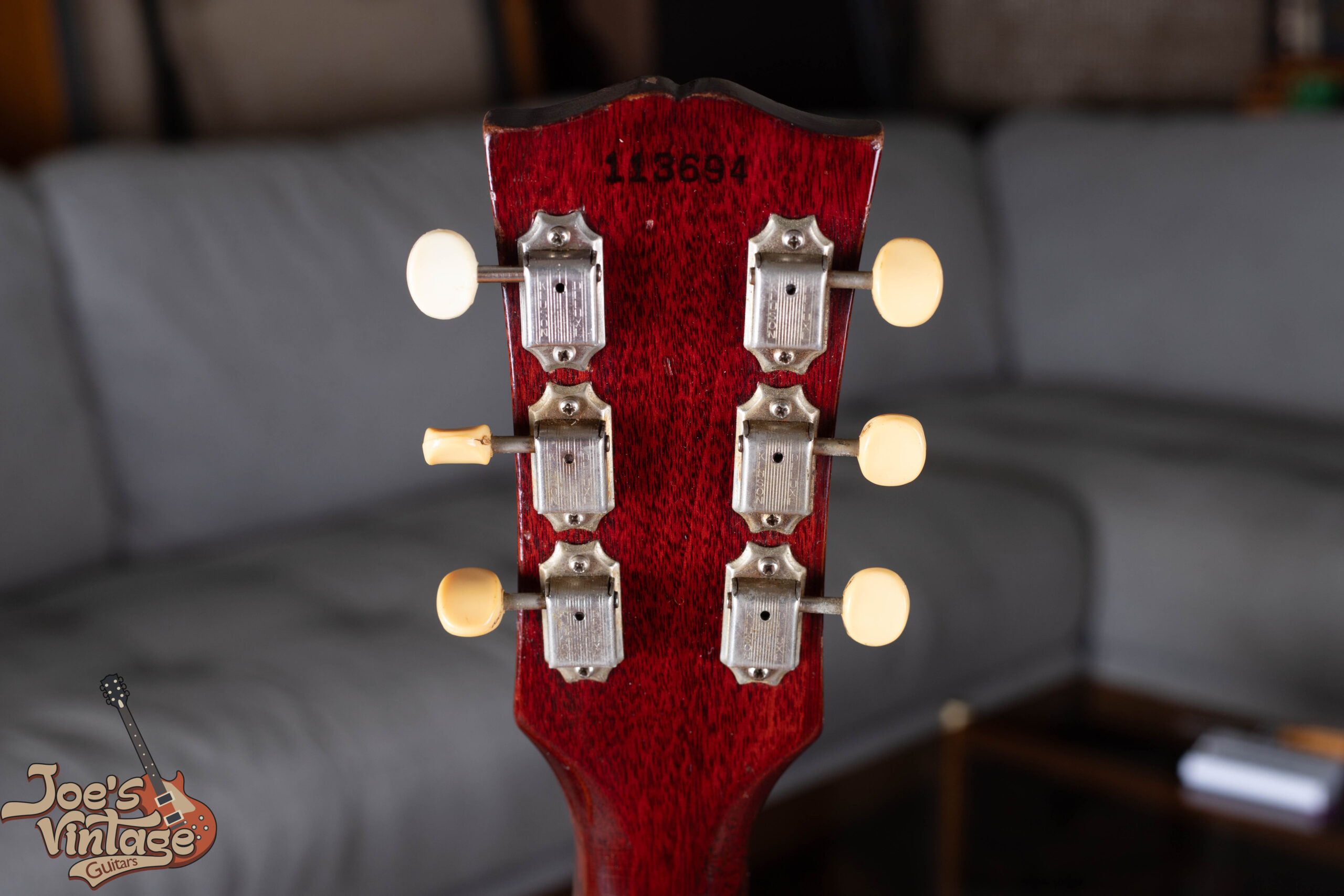
Kluson Deluxe — Double Line
Around 1964 Kluson added a second line of text to the tuner cover, creating the "double-line" variant that remained standard on Gibson electrics through approximately 1969. The double-line Kluson appears on mid-to-late 1960s SGs, ES models, and the transitional instruments of the CBS/Norlin era boundary.
The two lines of stamped text on the cover plate are immediately visible and distinguish this variant from the single-line version at a glance. The button style also began transitioning during this period — double-ring buttons started replacing single-ring buttons around 1960 and are commonly seen on double-line Kluson-equipped instruments. See the button section below for more detail.
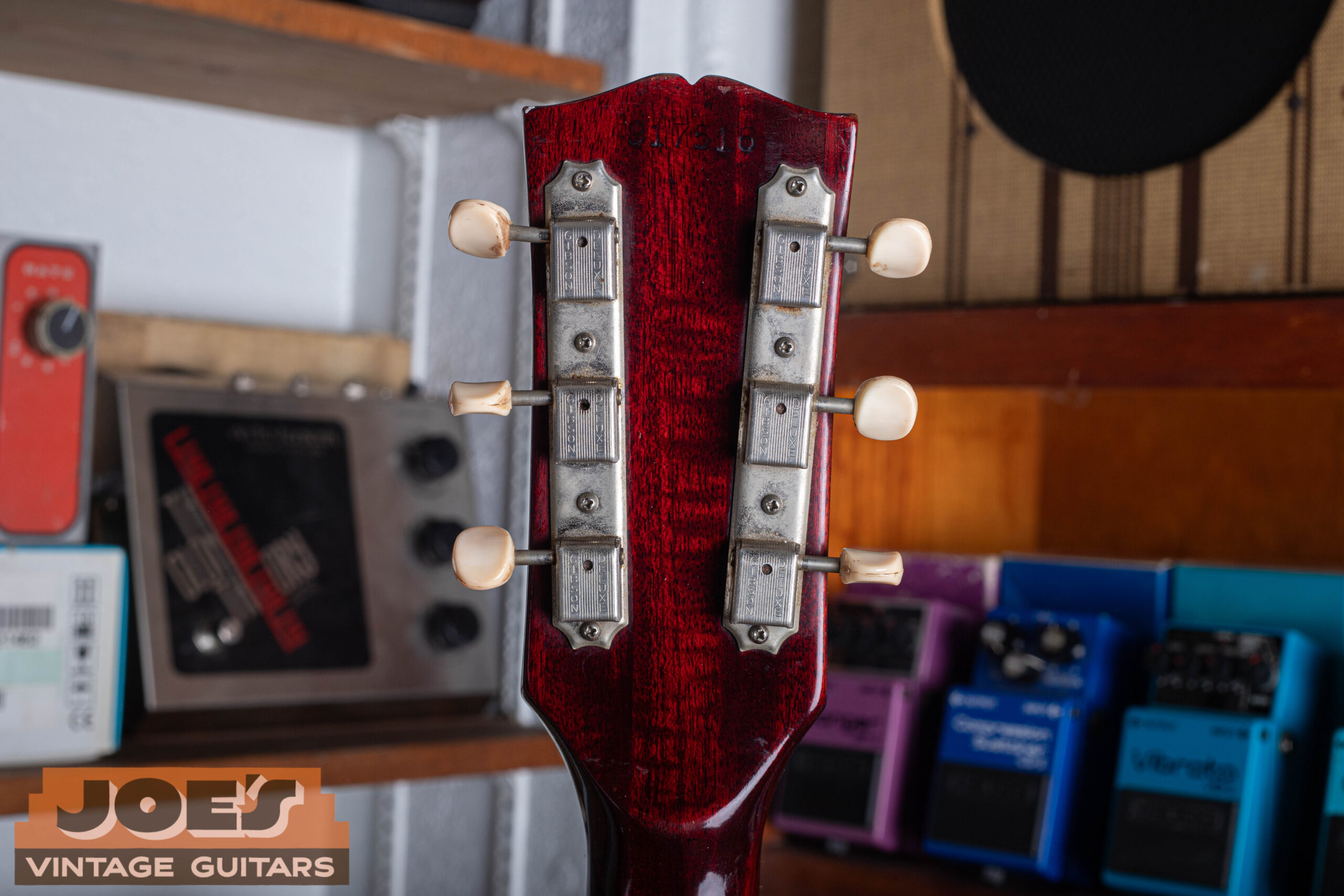
Gibson Deluxe — Kluson-Made, Gibson Branded
Around 1969 Gibson began having Kluson manufacture tuners stamped with "GIBSON DELUXE" on the cover rather than "KLUSON DELUXE." The mechanism and construction are essentially the same as the double-line Klusons that preceded them, but the branding change is an important and precise dating marker. Gibson Deluxe stamped tuners appear on instruments from the early Norlin transition period through approximately 1974.
This is one of the more underappreciated dating details on late-1960s and early-1970s Gibsons. A cover stamped "GIBSON DELUXE" places the instrument firmly after 1969, while "KLUSON DELUXE" — single or double line — places it before. On instruments where the serial number spans this boundary, the tuner branding can be decisive.
Kluson Waffle-Back Tuners — Gold
Gold Kluson waffle-back tuners — named for the distinctive grid-textured pattern on the back plate of each tuner — appeared on high-end Gibson electrics in the 1950s, most notably on the ES-5 Switchmaster and the early Les Paul Custom. The waffle-back texture is immediately distinguishable from the smooth back plates of the standard Kluson variants.
By the late 1950s, most high-end Gibson models transitioned to gold Grover tuners. However, waffle-back Klusons saw a notable resurgence from approximately 1968 through 1974, appearing again on the Les Paul Custom and SG Custom during the early Norlin period. If you see waffle-back gold Klusons on a Les Paul Custom or SG Custom, the instrument most likely dates to either the early 1950s or the 1968–1974 window — and other dating details will determine which.
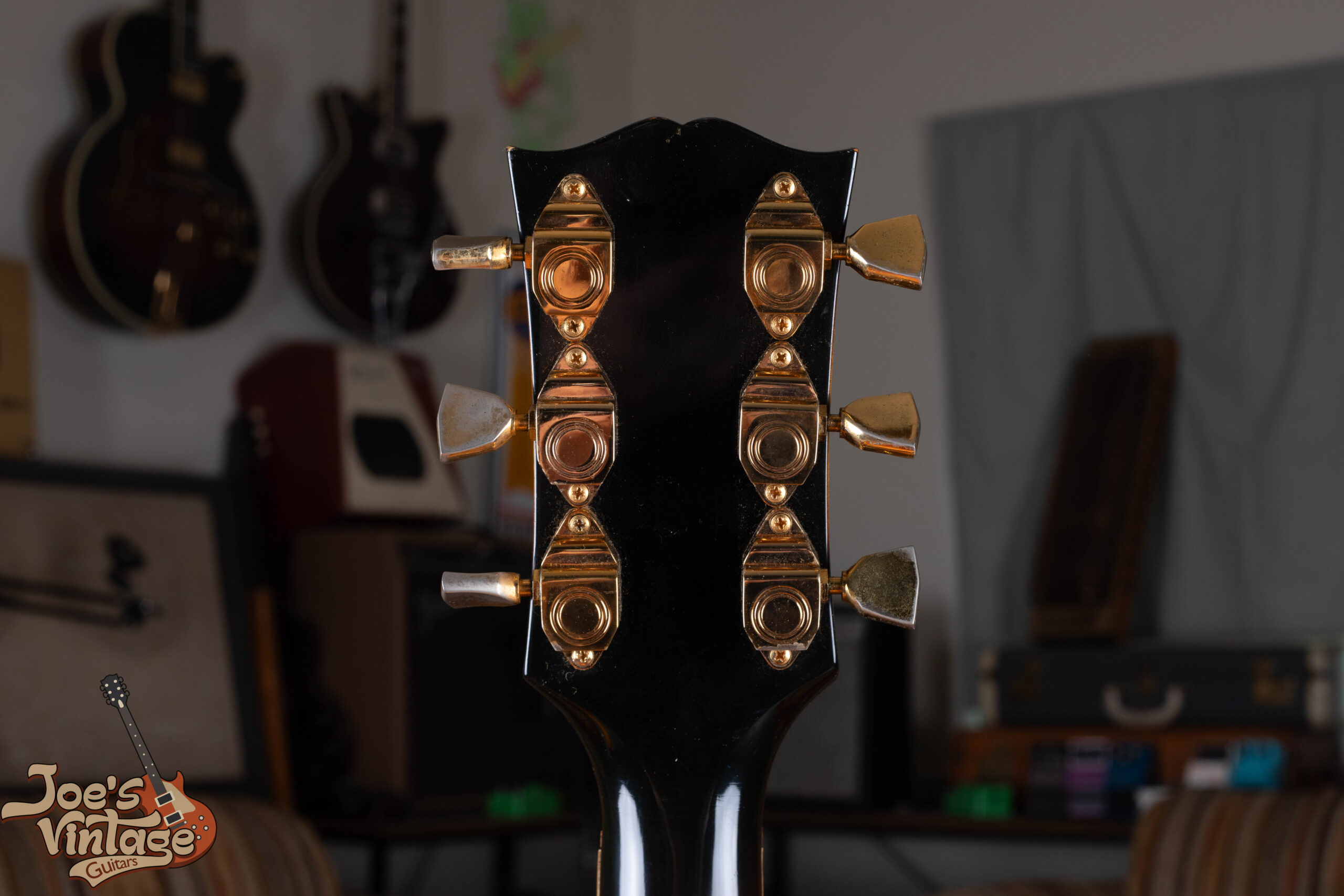
Kluson Sealfast Tuners — Gold
The Kluson Sealfast is a premium enclosed-gear tuner used primarily on Gibson's high-end archtop models — the L-5 CES, the Super 400 CES, and other top-of-the-line instruments. The Sealfast design fully encloses the gear mechanism, providing better protection from dust and debris than open-back tuners, and the gold plating is consistent with the premium specification of the instruments they were fitted to.
Sealfast tuners are a strong identifier of the top-tier archtop models and help distinguish a genuine high-end Gibson archtop from a mid-range instrument. Their presence is not a universal Gibson dating tool but is highly specific to the premium archtop category.
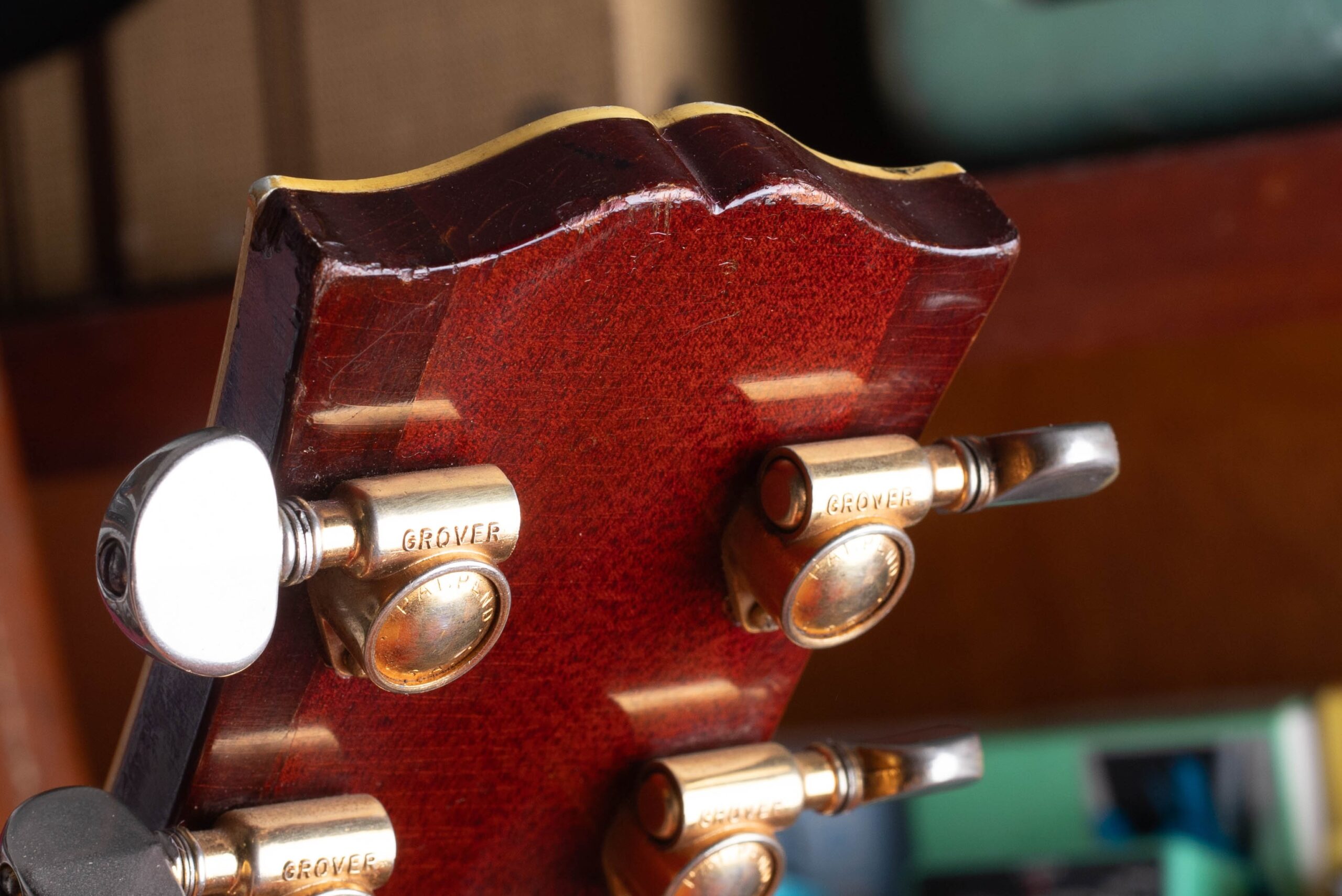
Gold Grover Rotomatic Tuners
From around 1958, Gibson began fitting gold Grover Rotomatic tuners on its higher-end electric models as an upgrade over the gold Kluson waffle-back. The Grover Rotomatic is an enclosed, self-lubricating tuner with a distinctive round housing and a higher gear ratio than the Kluson, making it more stable and precise for the era. Gold Grovers became the standard premium tuner on models like the ES-355, the top-spec ES-345, and certain high-end versions of other models.
Gold Grovers from 1958 onward are a spec-confirmation detail on high-end models rather than a universal Gibson dating tool — their presence on the correct model confirms top-level specification and original hardware, while their absence on a claimed high-end example from this era is worth investigating.
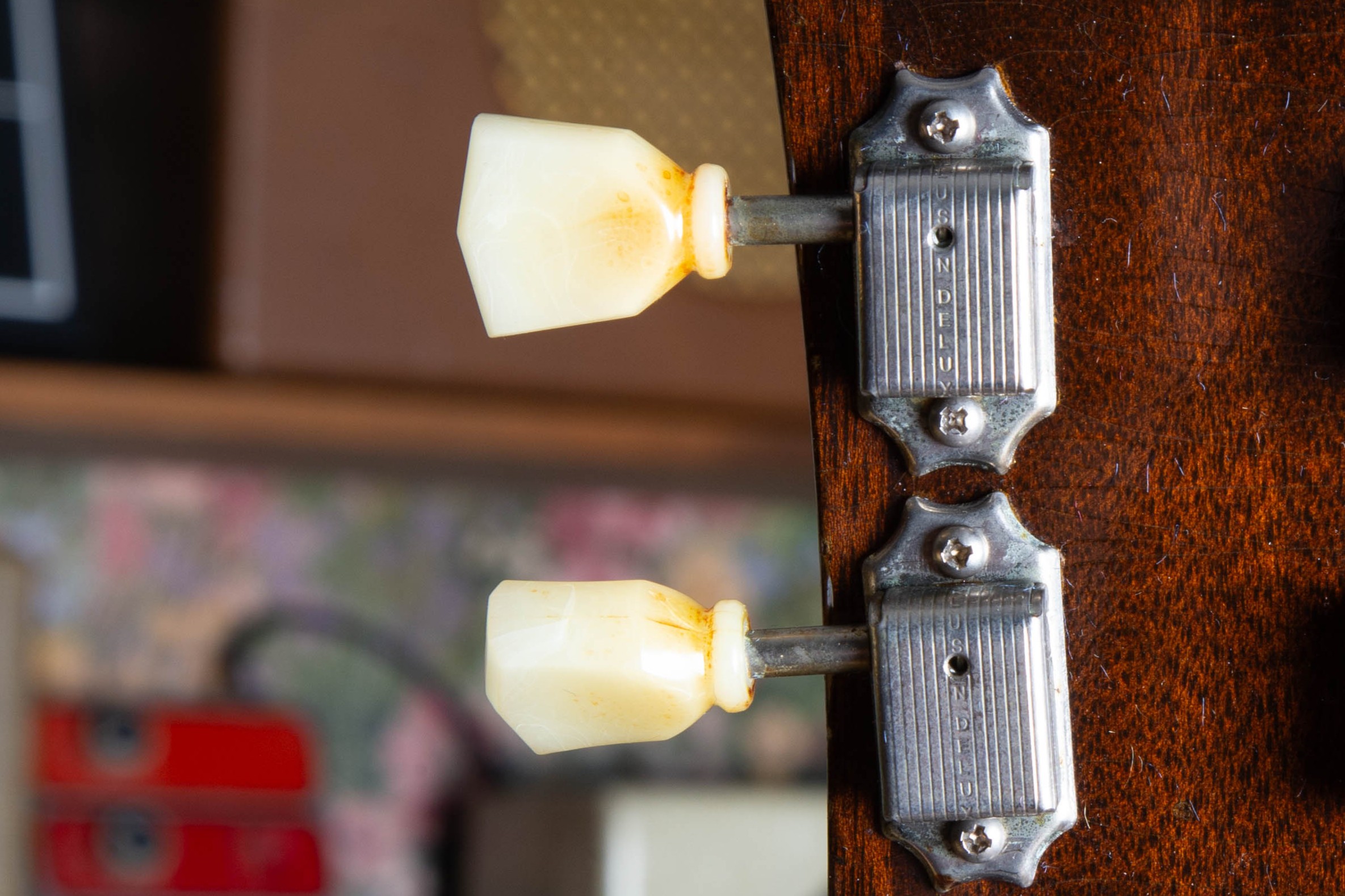
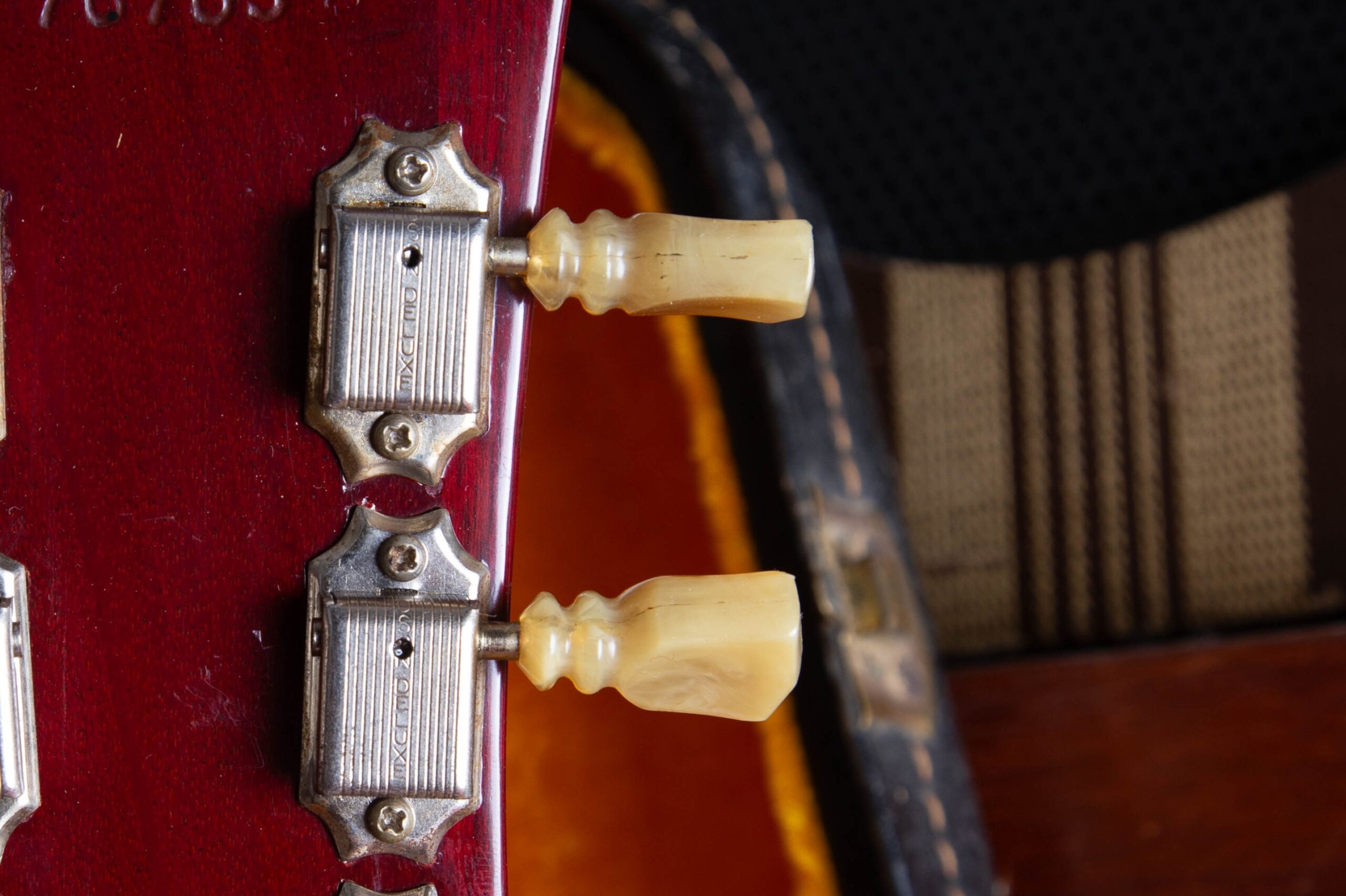
Button Style as a Cross-Reference Tool The single vs double ring button transition happened around 1960 and applies across all Kluson-equipped models regardless of the cover line variant. A guitar with single-line Klusons and double-ring buttons dates to the 1960–1964 overlap window. A guitar with single-line Klusons and single-ring buttons dates to 1956–1959. This combination of cover text and button style together is one of the most precise free dating tools available on golden era Gibsons.
This Guide Covers Individual Tuners Only — Not Strip Tuners Gibson also used strip-style tuners on certain models throughout its history. This guide covers only the individual tuner variants used on the most commonly collected models — the solid body electrics and semi-hollow instruments of the golden and transitional eras. Strip tuners are not covered here. Additionally, tuners are one of the most commonly replaced parts on vintage instruments — always verify originality by checking for wear patterns consistent with the instrument's age, original screw holes, and finish checking around the mounting points.
Gibson Pot Codes — How to Date a Gibson Using Potentiometer Date Codes
Potentiometer date codes — pot codes — are the single most reliable dating tool available on vintage Gibsons from the 1960s, and they are essential reading on any instrument where the serial number is ambiguous or inconclusive. Every potentiometer used in a Gibson guitar carries a stamped code on its casing that identifies the manufacturer and the exact week and year the component was made. On most guitars these codes are readable with a flashlight and some careful maneuvering inside the control cavity. On Gibson instruments specifically however, the pots are mounted in a way that frequently puts the stamped side of the casing facing inward — meaning the code is on the side of the pot rather than the back, and may be completely invisible without partially or fully removing the potentiometer from the cavity. Desoldering and removing pots to read the codes is not recommended for anyone without soldering experience — a cold solder joint or damaged component on a valuable vintage instrument can affect both tone and value. If you’re not comfortable with the process, a qualified technician or an experienced vintage dealer can read the codes for you. The most common manufacturer code you’ll encounter on a Gibson is 137, representing Chicago Telephone Supply — CTS — the standard Gibson supplier since the 1950s. The remaining digits tell you the year and the week of manufacture, and when all the pots in an instrument agree on the same date, that’s as close to a definitive production window as vintage guitar dating gets.
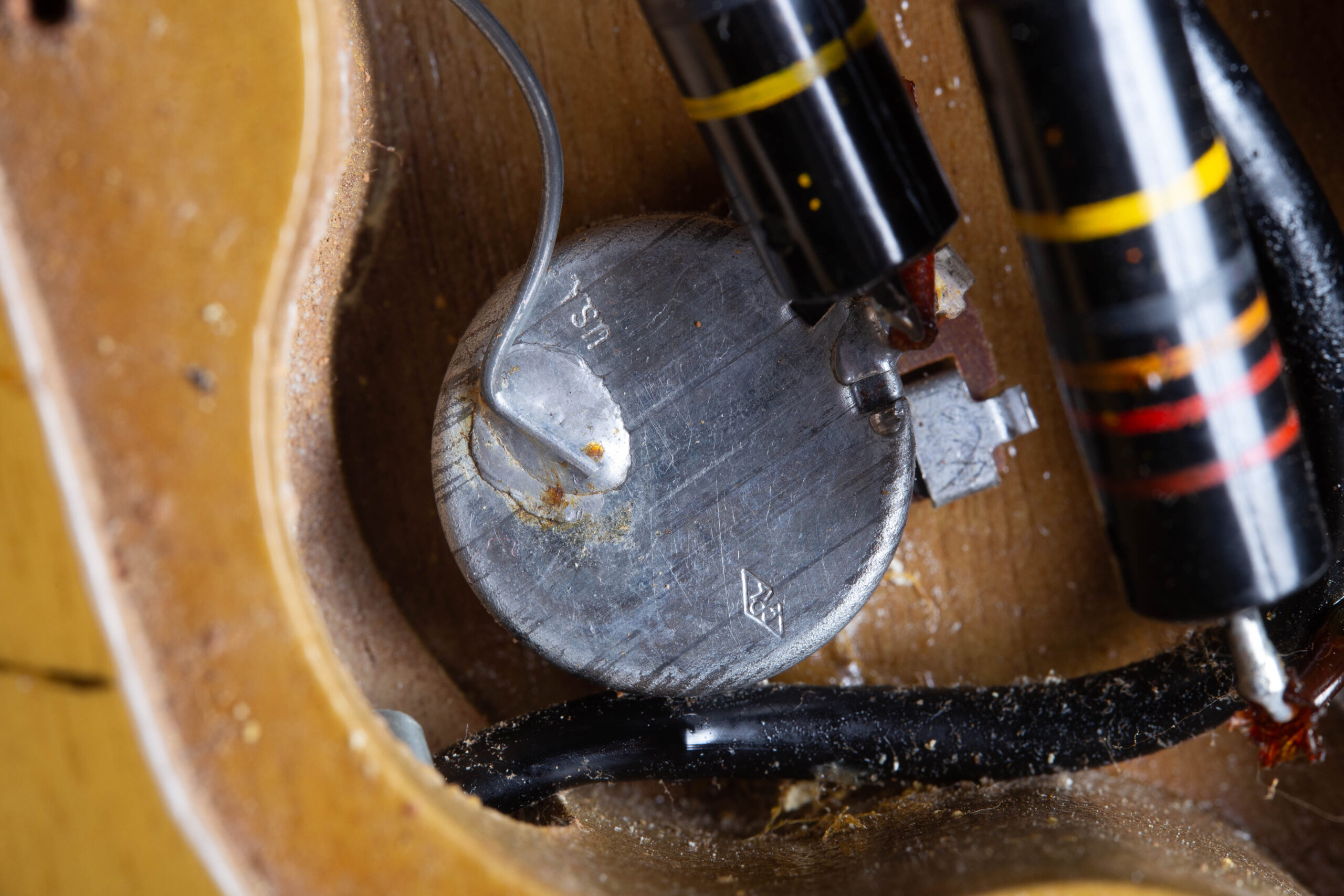
How to Read a Gibson Pot Code
First 3 digits = manufacturer code · Remaining digits = year and week of manufacture
Example: 1377519 = CTS, made in 1975, week 19
Example: 137402 = CTS, made in 1954, week 02
Where to Find the Code on a Gibson Pot codes are stamped on the side or back of the pot casing. On most guitars this is relatively easy to access, but Gibson's specific cavity routing and mounting style means the pots are often positioned with the stamped side facing inward or downward — making the code difficult to read without removing the control cover or pickguard entirely. Solder joints on the pot terminals can also obscure the stamping. A flashlight and some patience are usually required. On Les Paul models specifically, the codes are on the side of the pot and can be nearly impossible to read without removing the cavity cover.
Pot Codes Date the Component — Not the Guitar A pot code tells you when that specific potentiometer was manufactured at the factory — not when the guitar was shipped or sold. Gibson typically used pots within a few months to a year of their manufacture date, so a pot dated to early 1959 on a guitar with a 1959 serial number is a strong corroborating detail. However, pots can sit in inventory for longer periods, and replacement pots are common on vintage instruments. The pot code is best used as a verification tool — if the pot predates the claimed production year, something is wrong. If it matches or slightly precedes it, that is a positive sign of originality.
The Most Reliable Dating Tool on 1960s Gibsons Because Gibson's serial numbers from 1961 to 1970 were reused so extensively, pot codes are often the single most reliable dating method for instruments from this era. A guitar with a serial number that could be 1965 or 1968 can frequently be pinned down to one or the other by the pot date codes — and when all four pots in a Les Paul or ES model agree on the same date within a few weeks of each other, that is strong evidence of original, unmodified electronics and a reliable production date.
The Gibson Volute — A One-Second Dating Check on Norlin Era Instruments
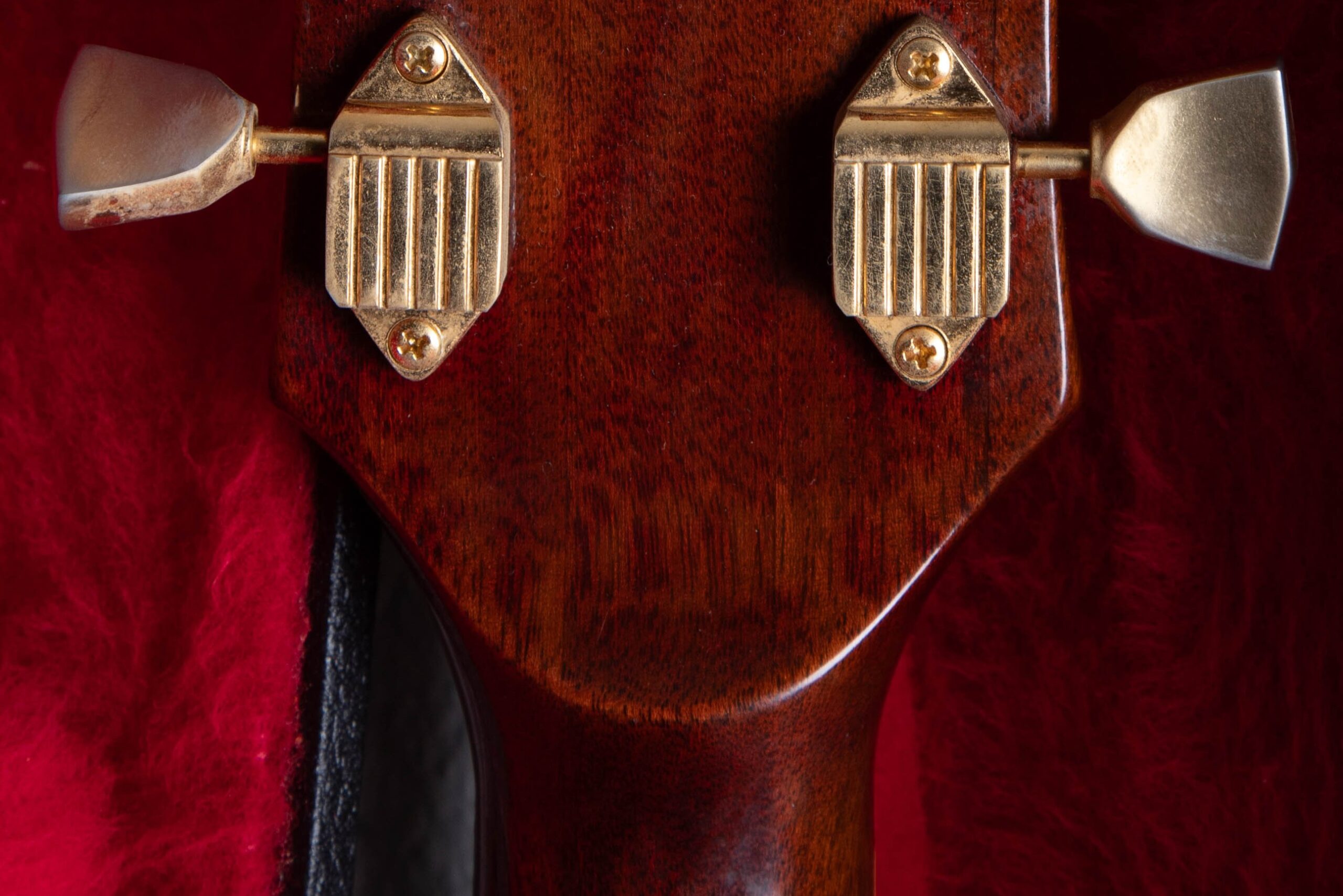
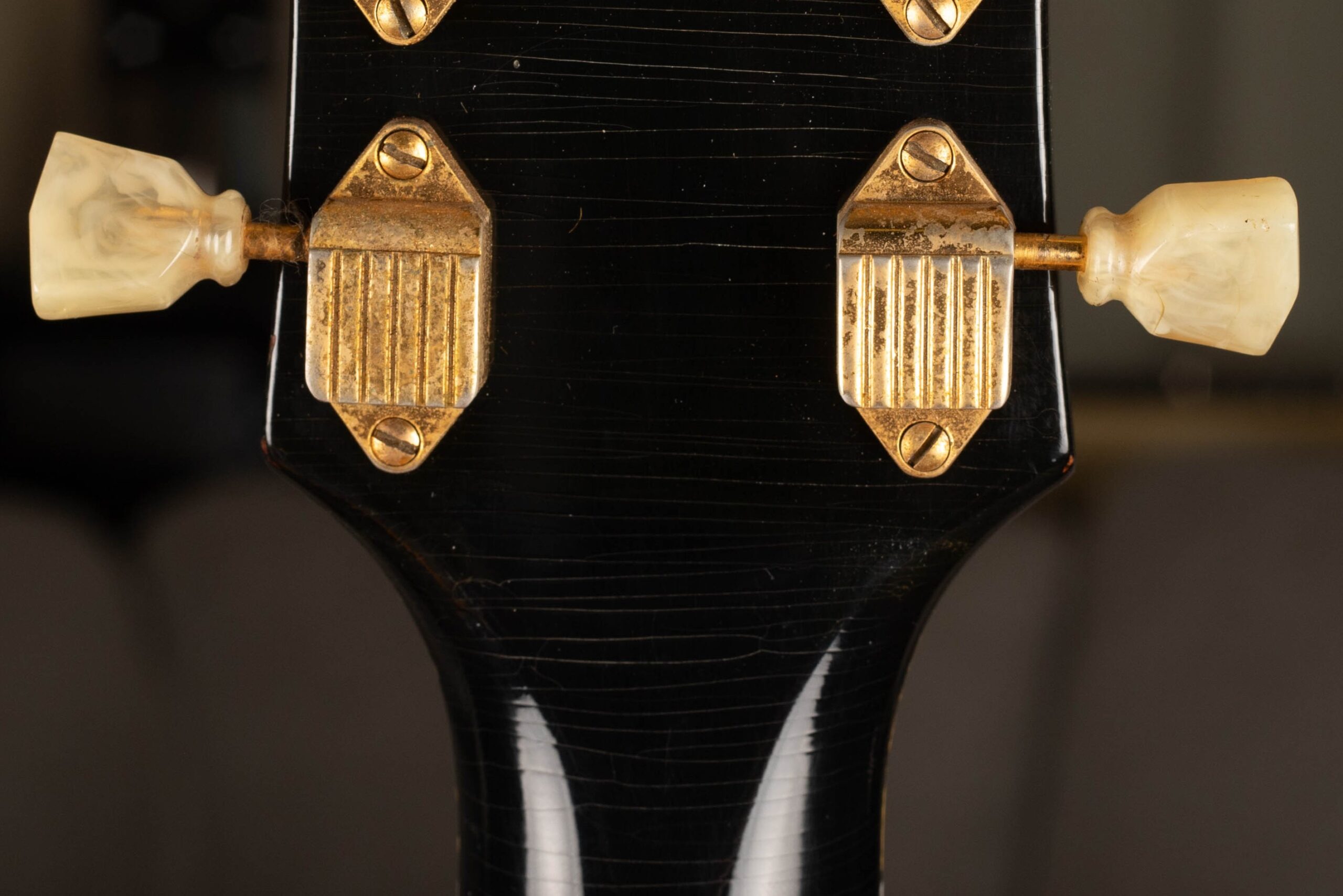
The volute is one of the fastest and most unambiguous dating indicators on any vintage Gibson electric. It requires no tools, no disassembly, and no specialist knowledge to identify — you simply turn the guitar over and look at the back of the neck where it meets the headstock. If a raised ridge of wood is present at that junction, the instrument was built between 1969 and 1981. If the transition is smooth, the instrument either predates 1969 or postdates 1981. Gibson introduced the volute as a structural reinforcement against headstock breaks — a known weakness of the angled Gibson headstock design — and it appeared across the entire electric model range from its introduction through to its discontinuation in the early 1980s. What is less widely known is that the volute is not just a binary present-or-absent indicator. It started as a subtle, almost imperceptible bump in 1969 and grew progressively larger through the early and mid 1970s, reaching its most pronounced size during the mid Norlin period. To an experienced eye, the size and profile of the volute can narrow a production date to within a few years inside the 1969–1981 window. Because the volute is associated with the Norlin era — a period of reduced collectibility relative to the golden era instruments that preceded it — some instruments have had their volutes removed to make them appear to be earlier production. Any irregularity in the finish or contour at the headstock joint on a claimed pre-1969 Gibson warrants close inspection.
The Gibson Volute — What It Is and Why It Matters
The volute is a raised ridge of wood on the back of the neck at the point where it transitions into the headstock. Gibson introduced it around 1969 as a structural reinforcement designed to reduce headstock breaks — a known vulnerability on Gibson's angled headstock design, where the grain of the wood runs at an angle that makes the headstock joint susceptible to cracking under impact. The volute adds mass and material at this stress point, providing a stronger transition between the neck and headstock.
From a dating perspective, the volute is one of the simplest and fastest visual checks available on a vintage Gibson. If the back of the neck shows a smooth, uninterrupted transition from neck to headstock, the instrument either predates 1969 or postdates 1981. If a raised ridge is present, the instrument falls within the 1969–1981 window. This single observation can immediately confirm or rule out a claimed production date without touching a single screw.
Volute Size Progression — An Additional Dating Indicator
The volute did not appear fully formed in 1969 — it started as a relatively subtle bump and grew progressively larger through the early and mid 1970s, reaching its most pronounced size by the mid-to-late Norlin period. To the trained eye, the size of the volute itself is an additional dating indicator within the 1969–1981 window. A small, barely-there volute points to the earliest years of this era, while a large, aggressive volute is characteristic of mid-1970s production. This is a nuanced detail that requires familiarity with the range of examples, but experienced dealers and collectors use it routinely to narrow dates within the volute era.
Volute Removal — A Red Flag on Pre-1969 Claims Because the volute is associated with the less desirable Norlin era, some instruments have had their volutes sanded or carved away in an attempt to make them appear to be earlier, more valuable pre-1969 production. If you are examining a guitar claimed to be pre-1969 and the back of the neck shows any irregularity in the finish, an unusual contour, or a finish thickness inconsistency at the headstock joint, this is worth investigating carefully. A removed volute will usually show subtle evidence of the work under close inspection or under a blacklight.
Gibson Neck Construction — One-Piece Mahogany, Three-Piece Mahogany, and Three-Piece Maple
The construction of the neck is one of the most telling physical indicators of where a Gibson falls in its production history — and one of the most significant factors in how collectors and players evaluate an instrument’s desirability. From the very beginning of Gibson’s electric guitar production through approximately 1969, every Gibson electric neck was carved from a single uninterrupted piece of mahogany. No glue joints, no laminations, no center strips — just a single piece of warm, resonant wood running from the nut to the heel. This is the construction found on every golden era Les Paul, every original ES-335, every early SG, and every other instrument from the most collectible period in Gibson’s history. Around 1969, as Norlin assumed ownership, Gibson began transitioning to a three-piece laminated mahogany construction — two outer sections with a glued center strip — a change driven by material efficiency rather than tonal consideration. By approximately 1975 the material changed again, this time to three-piece maple, which produces a noticeably brighter and harder tonal character that many players find at odds with the warm, vocal quality associated with the best vintage Gibsons. Neither transition happened overnight — both were gradual and overlapping across different models — so neck construction is most useful as a confirming detail rather than a standalone dating tool. That said, a one-piece mahogany neck on a claimed pre-1969 instrument is one of the strongest single indicators of correct-era construction available.
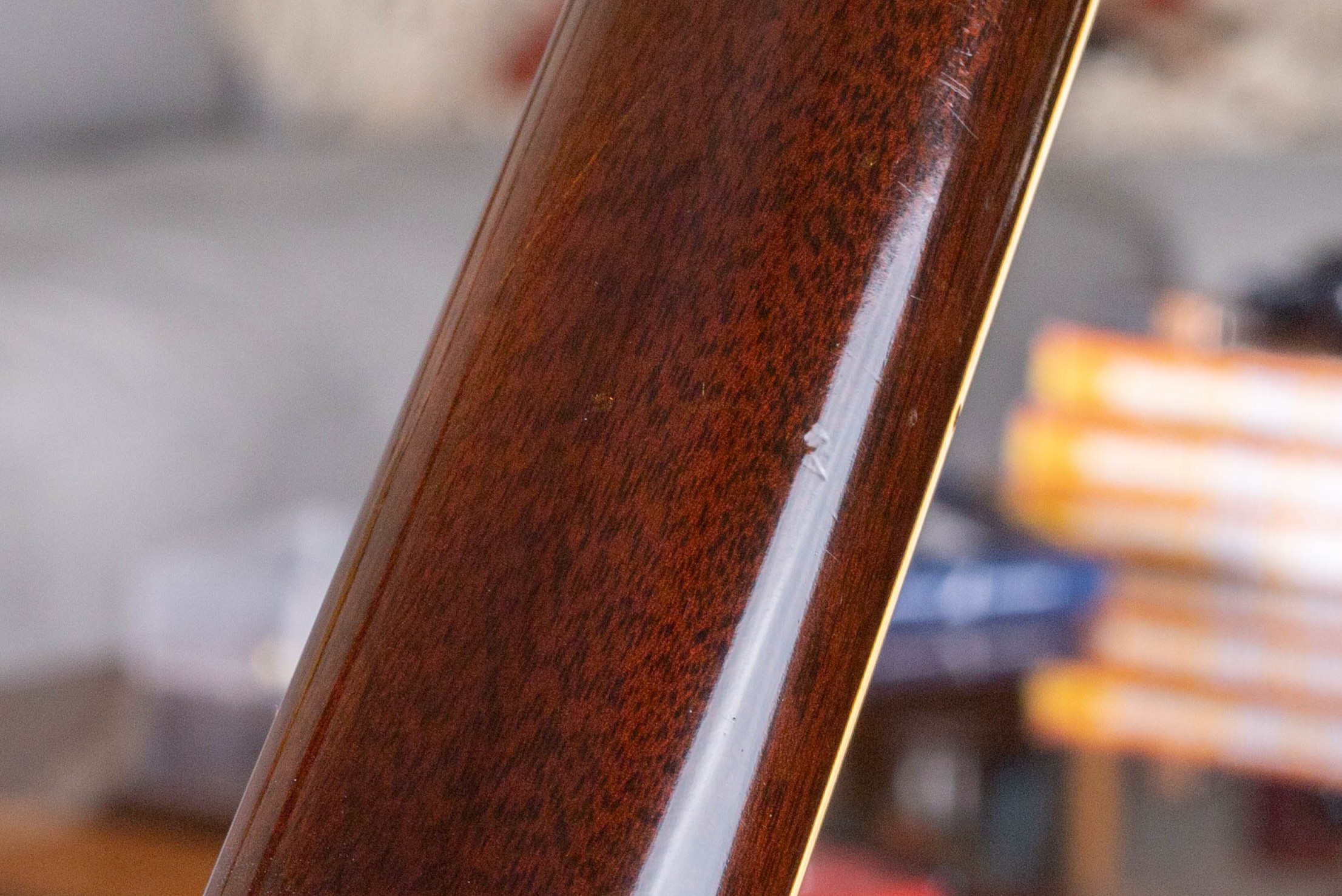
One-Piece Mahogany Neck
From Gibson's earliest electric models through approximately 1969, every Gibson electric neck was carved from a single piece of mahogany — no glue joints, no laminations, no center strips. The one-piece mahogany neck is the construction method associated with every golden era Gibson ever made: the Les Paul Standards, the original ES-335, the early SGs, the Firebirds, and every other collectable instrument from the pre-Norlin period.
Among collectors and players, the one-piece mahogany neck is strongly preferred — both for tonal reasons and for its association with the most desirable instruments Gibson ever produced. Mahogany is a warm, resonant tonewood with a natural compression in the upper midrange that many players feel contributes directly to the singing sustain and vocal quality of the best vintage Gibsons. A one-piece neck has no glue joints to potentially affect resonance or introduce inconsistencies, and the grain runs continuously through the full length of the neck without interruption.
Identifying a one-piece mahogany neck is straightforward — look at the back of the neck in a raking light. There will be no visible seam, center strip, or glue line running the length of the neck. The grain will flow continuously from nut to heel without interruption.
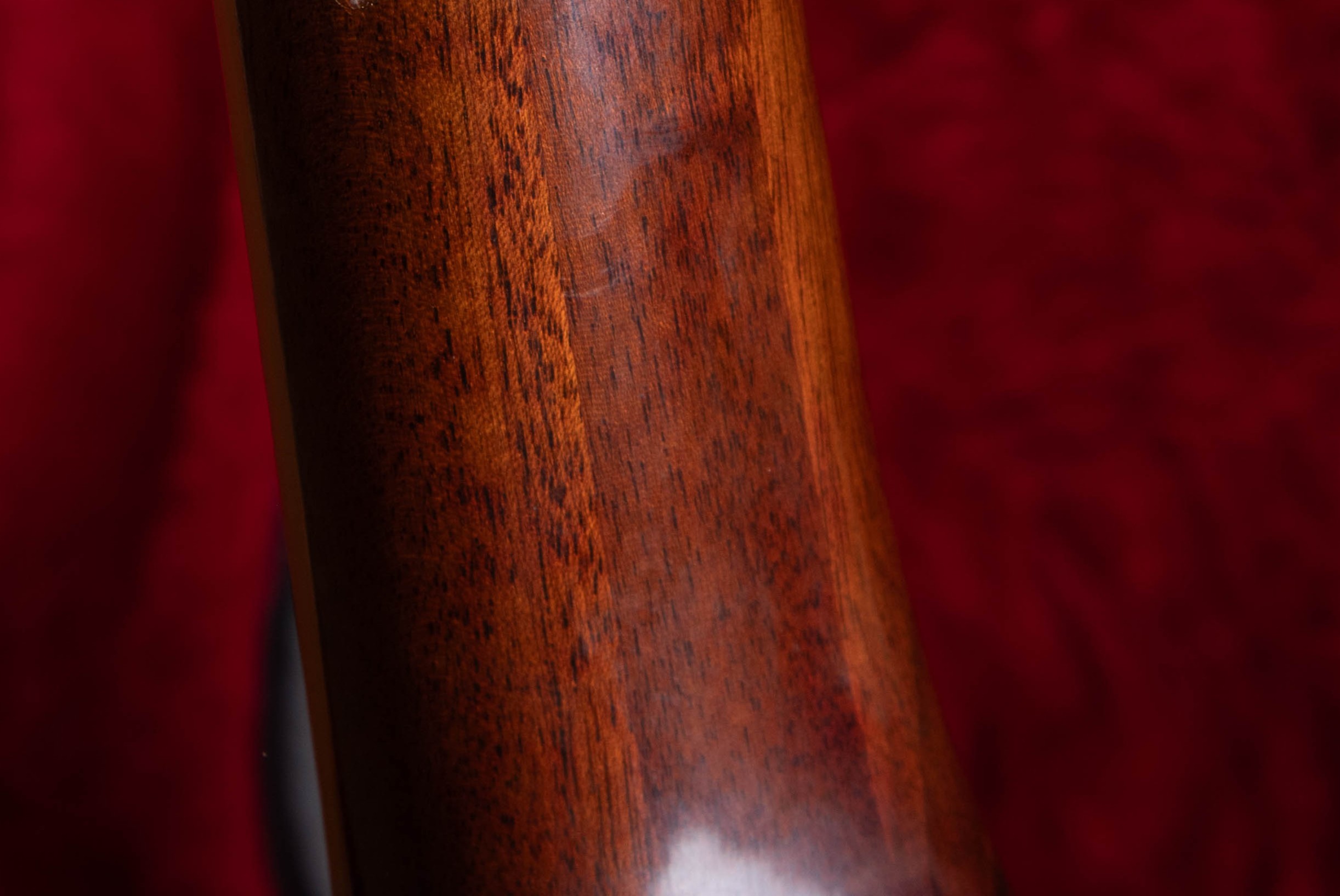
Three-Piece Mahogany Neck
Around 1969, as Gibson transitioned into the Norlin ownership period, the factory began moving away from one-piece mahogany necks toward a three-piece laminated construction. The three-piece mahogany neck is built from two outer sections of mahogany with a center strip glued between them — a construction method that allowed Gibson to make more efficient use of available mahogany stock and reduce waste from irregularly shaped blanks.
The transition was not immediate or uniform — some instruments from the 1969–1972 period still have one-piece necks while others from the same years have three-piece construction, making this a transitional window where neck construction alone is not always conclusive. By the early 1970s however, three-piece mahogany had become the standard construction method across the range.
Three-piece mahogany necks are identifiable by the two thin glue lines running the length of the back of the neck — one on each side of a center strip. In a raking light these seams are usually clearly visible. The tonal character of three-piece mahogany is broadly similar to one-piece, and many players find the sonic difference negligible in practice, though collectors consistently value one-piece construction more highly.
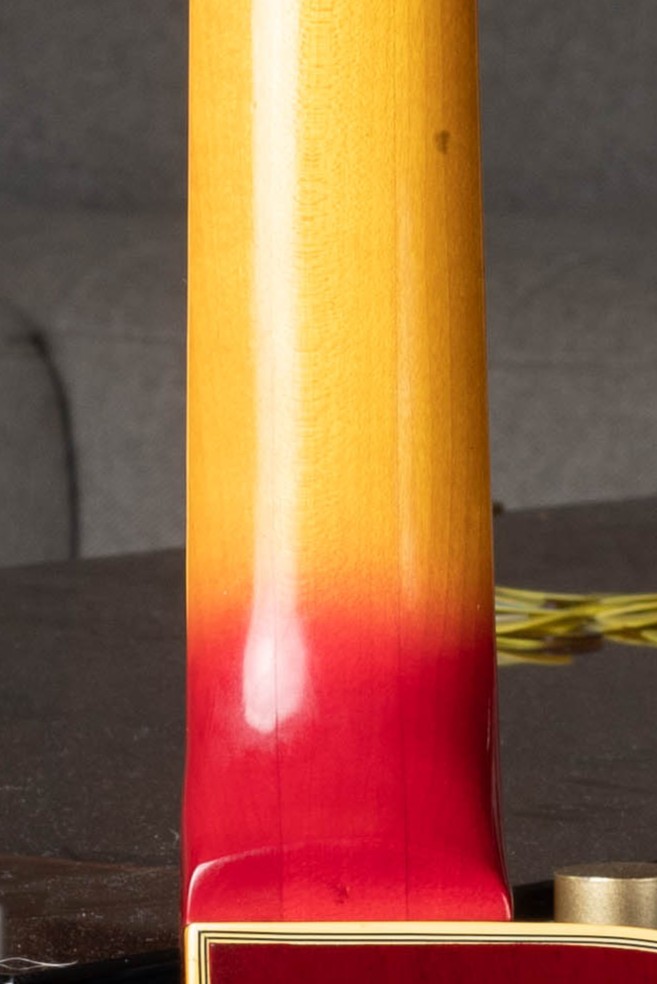
Three-Piece Maple Neck
Around 1975, Gibson began transitioning from three-piece mahogany to three-piece maple on many of its electric models — a change that represents the most significant neck material departure in the company's history up to that point. As with the earlier mahogany transition, the switch was gradual rather than immediate, and some models made the change earlier or later than others within this general window.
Maple is a significantly brighter, harder, and denser tonewood than mahogany. On a guitar body it adds clarity and snap to the attack — which is why it works well as a Les Paul top — but as a neck material on an already-bright instrument it can push the overall character in a direction that many players find harsh or glassy compared to the warmth of mahogany. This is one of the most commonly cited tonal criticisms of mid-to-late Norlin era Gibsons, alongside the three-piece construction itself. Players who prefer the darker, more vocal character of vintage Gibsons consistently favor mahogany necks.
Three-piece maple necks are easy to identify — the lighter color of maple compared to mahogany is usually immediately visible on an unfinished or lightly finished neck, and the two glue lines of the three-piece construction are present as on the mahogany version. On instruments with thick opaque finishes, the glue lines are still typically visible in a raking light.
Transitions Were Gradual — Always Cross-Reference Neither the 1969 nor the 1975 neck construction transitions happened overnight. Gibson worked through existing stock and introduced new materials gradually across different models at different times. An instrument from 1969–1972 could legitimately have either a one-piece or three-piece mahogany neck, and instruments from 1973–1976 may have either three-piece mahogany or three-piece maple depending on the model and the specific production batch. Neck construction is most reliable as a dating tool when it confirms other indicators — serial number, pot codes, volute, logo, and hardware — rather than being used in isolation.
Neck Replacements Are Common — Verify Originality Broken headstocks are one of the most common repairs on vintage Gibsons, and a significant number of instruments on the market have had neck replacements at some point in their history. A neck that does not match the expected construction for the instrument's claimed production year is a red flag worth investigating. Check for finish discontinuities at the neck joint, inconsistent aging between the neck and body, and any evidence of the original finish having been disturbed at the heel. A replaced neck does not necessarily make an instrument worthless, but it must be disclosed and reflected in the price.
Gibson Bridge and Hardware Dating — ABR-1, Nashville Bridge, Nickel and Chrome
The hardware on a vintage Gibson tells a surprisingly precise story — and on instruments from the 1950s through the mid 1970s, three specific hardware details can each independently confirm or contradict a claimed production date. The first is the bridge. Gibson’s ABR-1 Tune-O-Matic was introduced in 1954 and remained the standard bridge for twenty years, but it changed in one important way around mid to late 1962 — a thin retaining wire was added along the back of the saddles to prevent them falling out when strings were removed. No wire means pre-1962. Wire means post-1962. Around 1974 Gibson began transitioning to the larger Nashville Tune-O-Matic bridge, which became standard by 1975 and is identifiable by the threaded metal inserts pressed into the body that the bridge posts screw into — a small but unmistakable detail visible at the base of each post where it meets the body surface. The second detail is hardware finish. From the beginning of Gibson’s electric production through 1965, all standard hardware was nickel plated — a warmer, slightly greyer finish that develops a characteristic yellowish tarnish with age. In 1965 Gibson switched to chrome, which is brighter, cooler, and far more resistant to tarnishing. Aged nickel and chrome look noticeably different in natural light, and the presence of genuine aged nickel patina on a claimed pre-1965 Gibson is one of the strongest visual indicators of original, unmodified hardware. As with all physical dating details, hardware is most useful as a cross-reference tool — replacement bridges and hardware are extremely common on vintage instruments, and the absence of correct-era hardware does not automatically indicate misrepresentation.
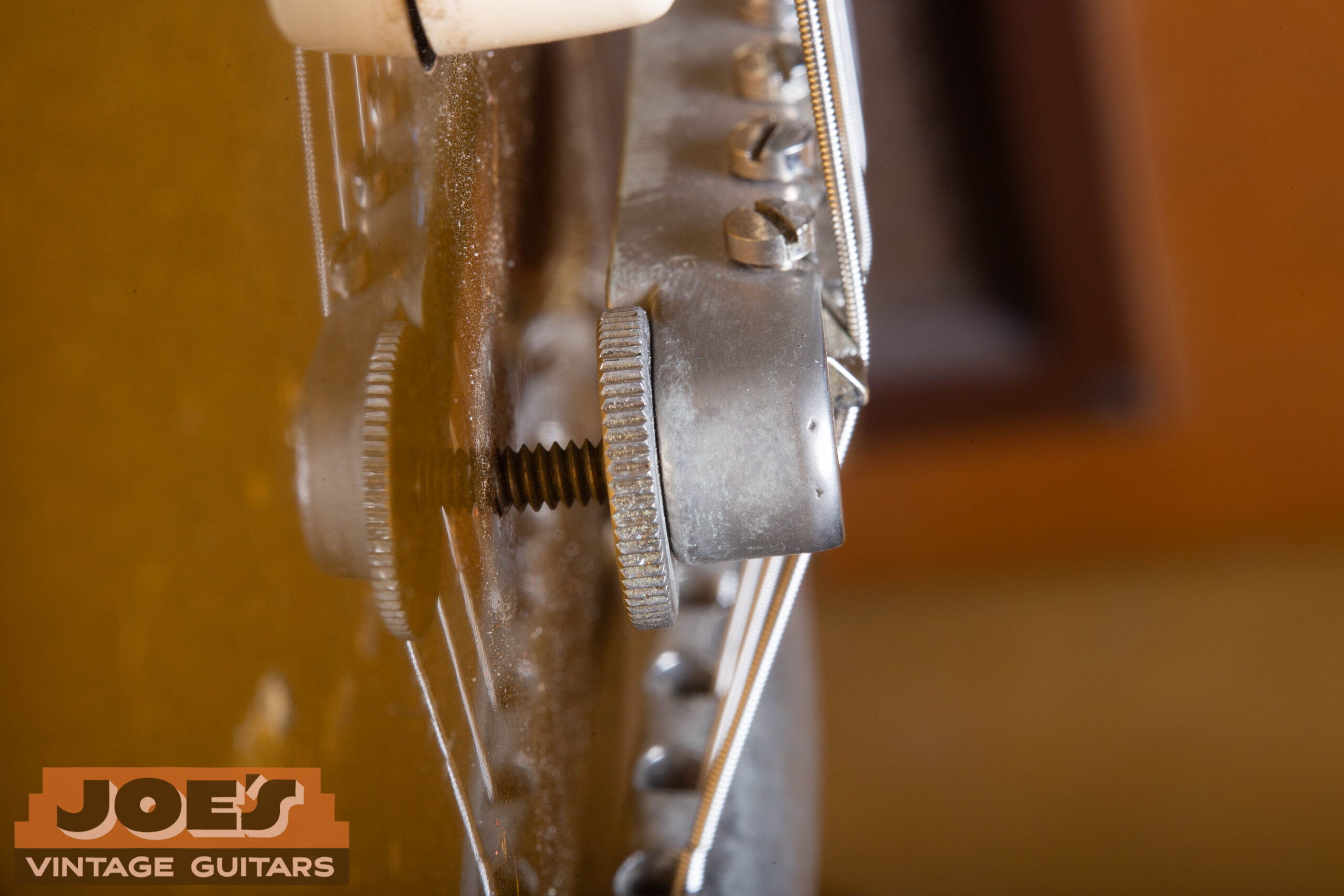
ABR-1 Tune-O-Matic — No Retaining Wire
The ABR-1 Tune-O-Matic bridge was introduced by Gibson in 1954 and became the standard bridge on the Les Paul, ES series, and the majority of Gibson's electric models from that point onward. The original design had no retaining wire — the individual saddles sat in the bridge base held only by string tension, and could fall out if the strings were removed. This no-wire version is the bridge found on all of the most valuable golden era Gibsons: the Les Paul Standards from 1958 to 1960, the original ES-335 from 1958, and every other top-tier instrument from the first eight years of ABR-1 production.
The absence of a retaining wire is the single identifying feature of this variant. Look across the top of the bridge at the saddles — if there is no wire running along the back edge holding the saddles in place, you are looking at a pre-1962 ABR-1. This is one of the most precise and reliable dating details available on golden era instruments.
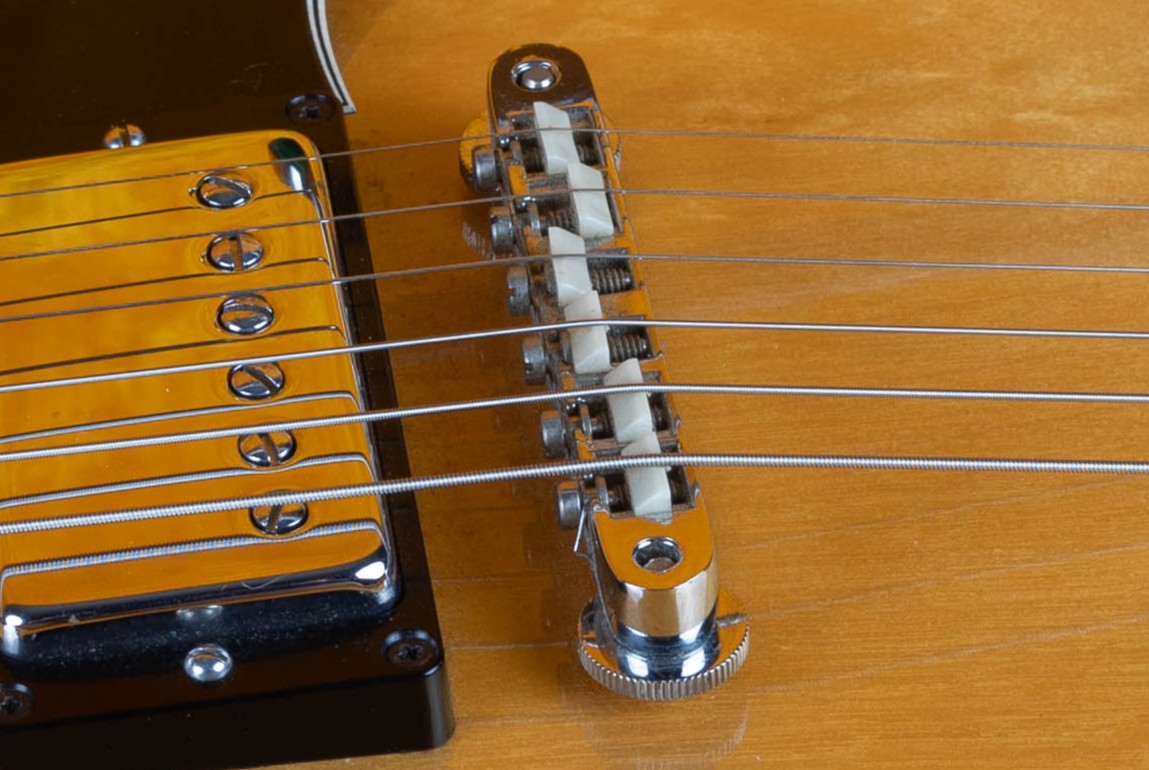
ABR-1 Tune-O-Matic — With Retaining Wire
Around mid to late 1962, Gibson added a thin retaining wire to the ABR-1 bridge, running along the back edge of the saddles to prevent them from falling out when strings were removed. This practical modification created a clear and reliable dividing line that collectors use constantly — a wired ABR-1 means the bridge, and almost certainly the instrument, postdates mid-1962.
The wired ABR-1 remained the standard Gibson bridge through 1974, covering the full range of mid-1960s production — the SGs, the transitional ES models, the Firebirds — as well as the early Norlin years. The bridge design itself remained otherwise unchanged from the original no-wire version, and the two are dimensionally identical. The wire is thin and can be easy to miss on a dirty or corroded bridge, so clean the bridge carefully before drawing conclusions.
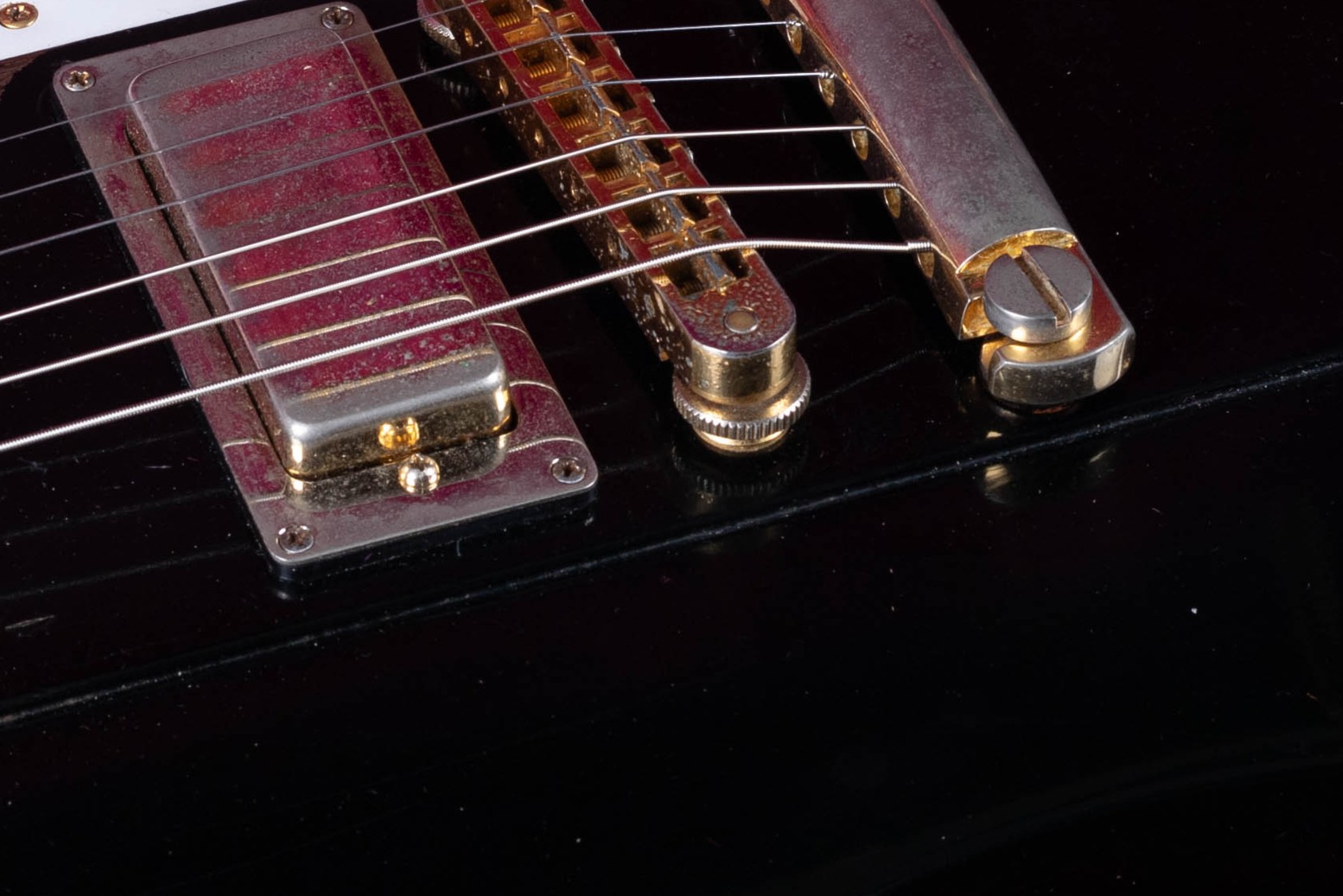
Nashville Tune-O-Matic Bridge
Around 1974 Gibson began transitioning to a new, larger Tune-O-Matic design that collectors refer to as the Nashville bridge — named for Gibson's Nashville facility where it was developed. The transition was gradual through 1974 and the Nashville bridge became the standard across the range by 1975. It is larger and more substantial than the ABR-1, with wider spacing between the post studs and a different saddle design.
The single most important identifying feature of the Nashville bridge is the threaded metal inserts that the post studs screw into — small cylindrical metal bushings pressed into the body that the bridge posts thread into from above. On the ABR-1, the posts anchor directly into the wood or into simple thumb wheels. Look carefully at the base of each bridge post where it meets the body — if you can see a metal collar or bushing surrounding the post at the body surface, you are looking at a Nashville bridge. This detail is easy to miss on a photograph and requires close inspection in person, but it is the definitive identifying feature that distinguishes the Nashville from the ABR-1 at a glance once you know what to look for.
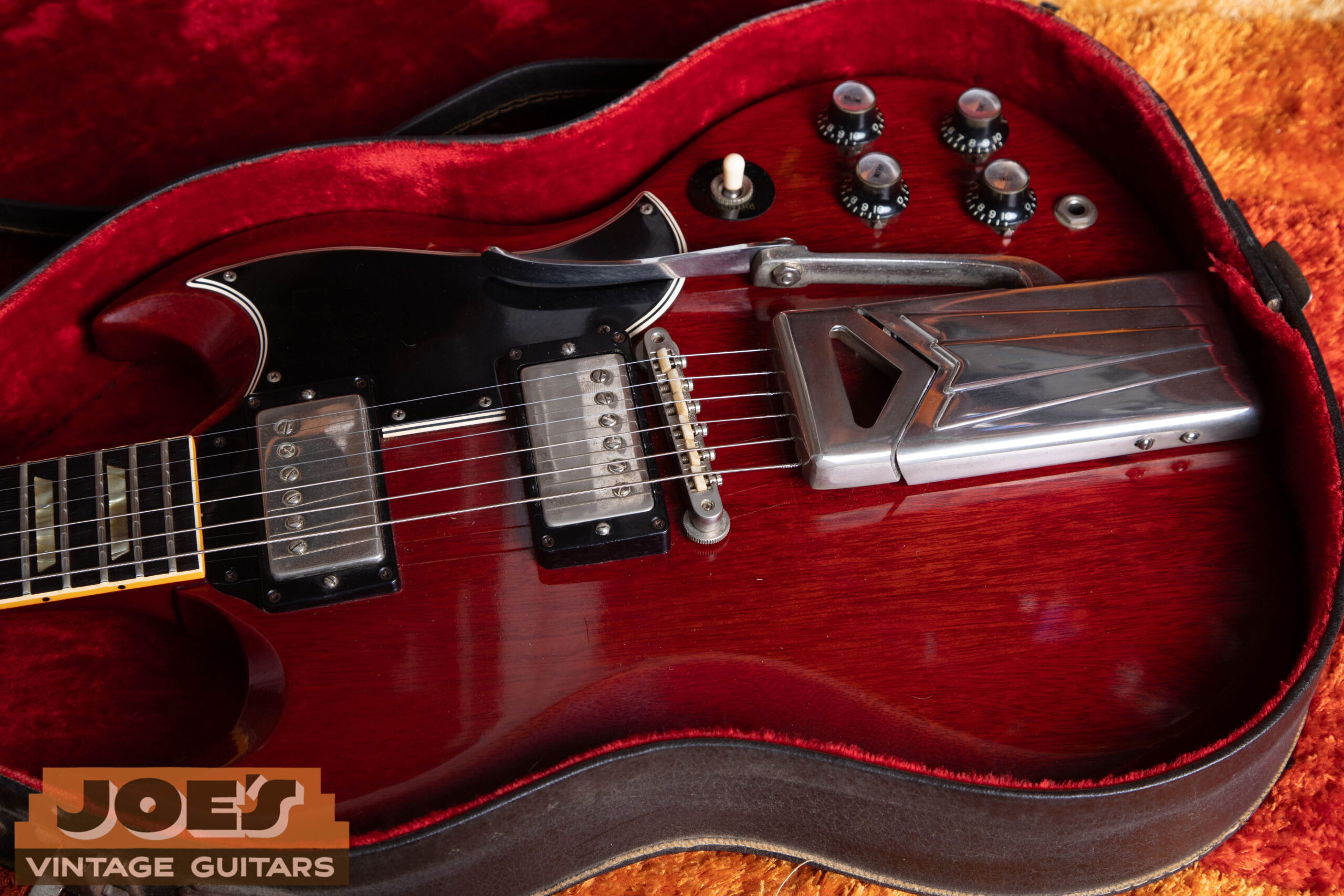
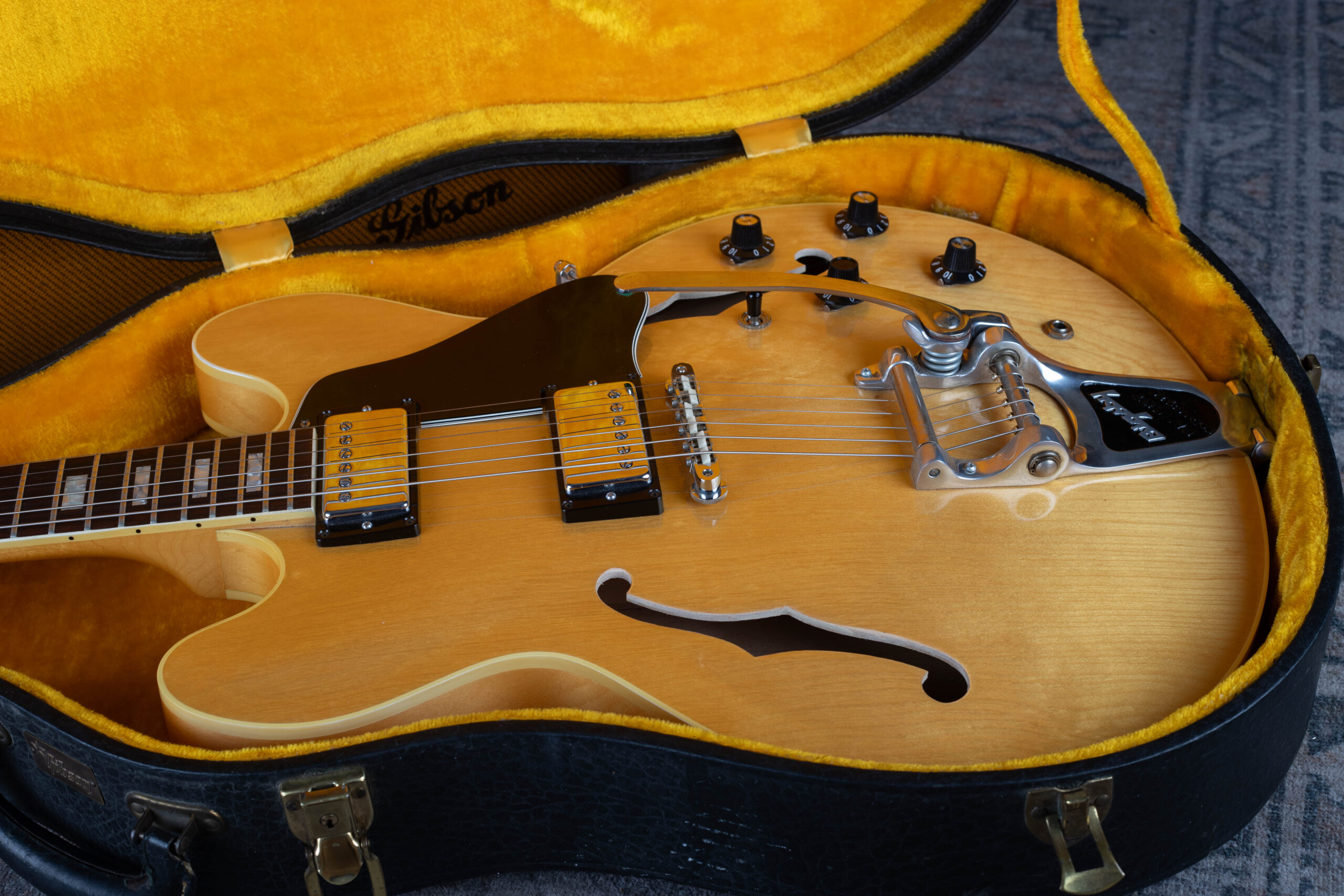
Nickel vs Chrome — The 1965 Transition
From the introduction of Gibson's electric models through 1965, all standard hardware — bridges, tailpieces, tuner covers, pickup covers, and control hardware — was finished in nickel. Nickel has a warmer, slightly greyer tone than chrome, and ages distinctively over time, developing a soft tarnish with yellowish or brownish undertones that collectors often refer to as "aged nickel" or "nickel patina." This aged appearance is highly desirable on vintage instruments and is one of the visual signatures of a genuine pre-1965 Gibson.
In 1965 Gibson switched to chrome-plated hardware across its standard electric range. Chrome is brighter, cooler in tone, and significantly more resistant to tarnishing than nickel — which means that on most post-1965 Gibsons, the hardware retains its bright silver appearance even after decades. The visual difference between well-aged nickel and chrome is usually immediately apparent: nickel looks warmer and more muted, chrome looks bright and reflective. On instruments where the hardware has been polished or cleaned, the distinction can be harder to make, but chrome will never develop the characteristic warm tarnish of aged nickel regardless of age.
Hardware Replacement Is Extremely Common Bridges, tailpieces, and tuner covers are among the most frequently replaced parts on vintage Gibsons — through normal wear, damage, upgrades, and attempted improvements over decades of use. A Nashville bridge on a claimed pre-1974 instrument, or chrome hardware on a claimed pre-1965 guitar, does not automatically mean the instrument is misrepresented — the original hardware may simply have been replaced at some point. Always look for evidence of original hardware such as matching screw holes, finish shadowing where original parts sat, and patina patterns consistent with the instrument's age. Conversely, correct original hardware in unpolished condition with appropriate aging is one of the strongest indicators of an unmolested vintage instrument.
Gibson Case Identification — Dating and Authenticating Your Gibson By Its Original Case
A matching original case is one of the most overlooked authentication and dating tools in vintage Gibson collecting. Cases were manufactured by specific suppliers during specific windows, and the combination of exterior material, interior color, hardware, and construction details can independently confirm a production era with a precision that rivals the serial number itself. The most important case supplier for golden era Gibsons was Lifton, whose “Faultless” cases accompanied instruments from the 1940s through the early 1960s. The most celebrated of these is the brown exterior, pink interior “California Girl” — the standard case for late 1950s Les Paul Bursts and Goldtops, identifiable by the “Built Like a Fortress” badge on the interior, and a case whose presence with a correct instrument adds meaningful provenance. Earlier instruments may carry Geib cases — including the distinctive pre-war Red Line with its black Keratol exterior and red border, or the mid-1930s tweed case that matches the company’s amplifiers of the same period — or Harptone cases identifiable by the two raised diamond shapes on the interior pocket lid. Stone cases, which closely resemble Lifton cases but have lighter hardware, accompanied late 1950s ES models. The transitional black exterior, yellow interior Lifton case marks the 1961–1963 window when Gibson was moving from the Les Paul to the SG. By the late 1970s the utilitarian rectangular “chainsaw” case had replaced everything that came before it, and its boxy shape is as much a Norlin era identifier as the three-piece maple neck or the volute. Cases are separated from instruments constantly over decades — their absence is common and unremarkable. But when an original matching case is present, it tells a story worth knowing.
Geib "Red Line" Case
Black Keratol exterior with a thin red line border running around the case edge and deep red or purple plush interior. The defining pre-war Gibson case, used through the 1930s and into the 1940s. High value among pre-war collectors and a strong indicator of correct-era provenance on any instrument from this period.
Geib Tweed Case
Vertical-striped airplane cloth covering — the same tweed material used on early Gibson tube amplifiers — making the case and amp instantly recognizable as belonging to the same era. Used in the mid-1930s and closely associated with the broader pre-war Gibson aesthetic.
Harptone "Double Diamond" Case
Identified by two raised diamond shapes on the interior pocket lid — a distinctive construction detail that makes Harptone cases immediately recognizable. High quality build used primarily on top-tier acoustic models. The double diamond lid detail is the single fastest way to identify a Harptone case from across a room.
Stone Case Co.
The Stone case closely mimics the Lifton in exterior appearance but features different, lighter hardware. Used on late 1950s ES models — ES-335, ES-345, ES-355 — and easily confused with Lifton cases at a glance. Hardware weight and construction details are the primary distinguishing factors for collectors who need to tell them apart.
Brown / Pink — "California Girl"
The legendary "California Girl" case — standard equipment with the late 1950s Les Paul Bursts and Goldtops and among the most recognizable and coveted vintage guitar cases in existence. Look for the "Built Like a Fortress" badge on the interior. A matching California Girl case with a late 1950s Les Paul Standard is a significant value and authenticity indicator.
Brown / Green
Used in the early to mid 1950s primarily on mid-tier instruments — the J-45 and similar acoustics — as well as archtops and semi-hollow electrics including the ES-175 and L-7. Not a top-tier case but a correct and desirable original case for the models it accompanied.
Black / Yellow — Transitional
The transitional case style used from 1961 through approximately 1963 — the period when Gibson was moving from the Les Paul to the SG body style. The shift from brown to black exterior and the yellow interior marks the end of the classic Lifton era and the beginning of the modern case aesthetic. Correct for early SG models and late transitional Les Paul/SG instruments.
The "Chainsaw" Case
From approximately 1977 through 1988, Gibson shipped its electric models in what collectors call the "chainsaw" case — named for the distinctive rectangular, boxy shape with sharp squared-off corners and a utilitarian black exterior that looks more industrial than the cases that preceded it. The chainsaw case is a solid, functional hardshell case but it lacks the character and collectibility of the earlier Lifton and Geib cases. It is firmly associated with the late Norlin and early post-Norlin period and its presence on an instrument confirms production within this window. Interior colors varied — red and black are the most common. The chainsaw case is not particularly sought after by collectors but its presence with a correct-era instrument is a sign of an unmodified, original-case example.
Cases as Dating and Authenticity Tools A matching original case adds meaningful context to a vintage Gibson — it confirms the instrument has remained in its original configuration and provides an additional independent dating reference. However, cases were separated from instruments constantly over decades of use, and the absence of an original case is extremely common and does not reflect on the instrument itself. Conversely, a case being sold as original that does not match the expected type for the claimed production year is worth questioning. A California Girl case with a claimed 1965 SG, for example, would be unusual and warrant investigation.
This Is Not a Comprehensive Case Guide Gibson cases are a deep and specialized collecting area in their own right. This guide covers the primary case types associated with the most commonly collected Gibson electrics and acoustics — there are many additional variants, regional differences, and model-specific cases not covered here. If case provenance is critical to a purchase decision, specialist resources dedicated specifically to vintage Gibson cases will provide more complete information.
Dating Gibson Guitars by Model — Les Paul, ES-335 & SG
Serial numbers will get you close — but on the most collectible Gibson models, the specific year of manufacture can mean a dramatic difference in value, and a serial number alone is rarely enough to confirm it. Gibson changed the pickups, hardware, finishes, body shapes, and construction methods of its most important models multiple times across the 1950s, 1960s, and 1970s. Each of those changes happened at a specific point in time, and knowing what was correct for a given year is what separates a confident identification from an educated guess.
The sections below cover the three models where year-specific feature dating matters most — the Les Paul, the ES-335, and the SG. Each section is written to be useful whether you are completely new to vintage guitars or already familiar with the basics. Use the serial number tools above as your starting point, then use the model guides below to confirm and cross-reference what you find.
Gibson Les Paul — Dating by Model and Features
Covers: Les Paul Standard · Les Paul Custom · Les Paul Special · Les Paul Junior
If you are new to vintage guitars, here is the most important thing to understand before reading this section: the year a Gibson Les Paul was made can dramatically change what it is worth. We are not talking about a small difference — a Les Paul made in 1959 can be worth over $500,000, while a nearly identical-looking guitar made in 1961 might sell for a fraction of that. This is why getting the year right matters so much, and why serial numbers alone are often not enough. The physical features of the guitar — the pickups, the finish, the hardware, the neck shape — are what confirm the date. This section explains exactly what to look for, model by model, in plain language.
Gibson Les Paul Standard
The Les Paul Standard is the most collected and most studied electric guitar in history. Introduced in 1952 as the Goldtop and evolving through several distinct configurations before being temporarily retired in 1961, the Standard's value is extraordinarily sensitive to the year of manufacture. A correctly identified and authenticated example from 1958, 1959, or 1960 — the "Burst years" — represents the peak of Gibson's golden era and commands prices that rival fine art. Understanding how the guitar changed year by year is essential for anyone trying to date or value one.
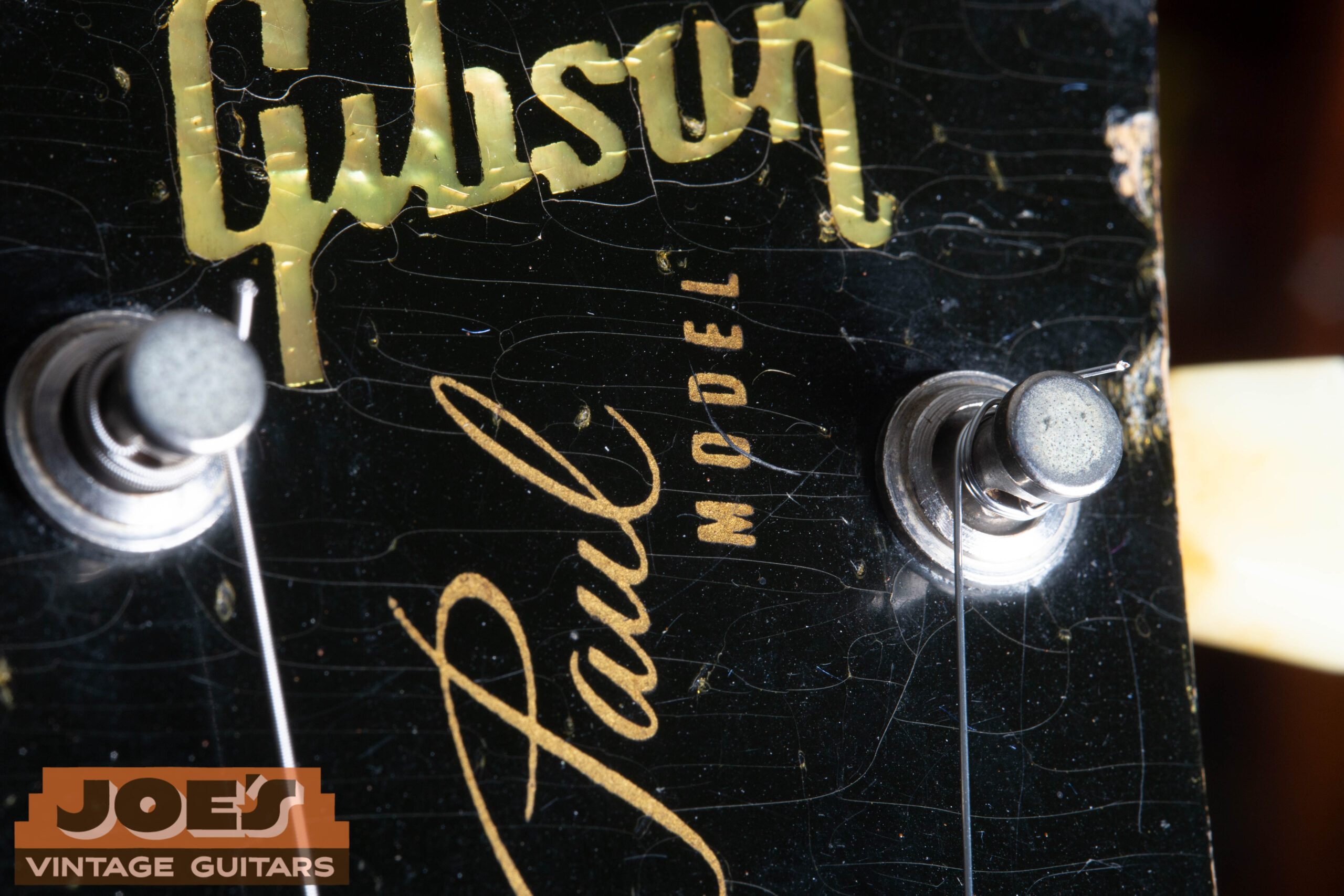
The Body Finish Timeline — Your First Dating Clue
The finish is the color and coating on the outside of the guitar body. Gibson changed the Les Paul Standard's finish several times, and because each finish was only used in specific years, the color of the guitar is one of the fastest ways to narrow down when it was made.
| Finish / Color | Years Used | What to Know |
|---|---|---|
| Gold (Goldtop) | 1952–1958 | Original Les Paul finish. Gold metallic paint over a carved maple top. Any Les Paul Standard with this finish was made between 1952 and 1958. |
| Cherry Sunburst | 1958–1960 | The most desirable finish in vintage guitar history. A sunburst that fades from dark cherry-red at the edges to a warm amber or honey color at the center, revealing the flame maple top beneath. Only made for three years. These are the "Bursts." |
| Cherry | 1961–1963 | When Gibson changed the body shape in 1961, Cherry became the primary finish on Les Paul Standard models during the transitional period. A solid, transparent red finish over the mahogany body. See the SG section for full dating details on this era. |
| Goldtop reintroduced | 1968 onward | The single-cutaway Les Paul body returned in 1968 with different construction, different hardware, and generally lower collectibility than the 1950s originals. |
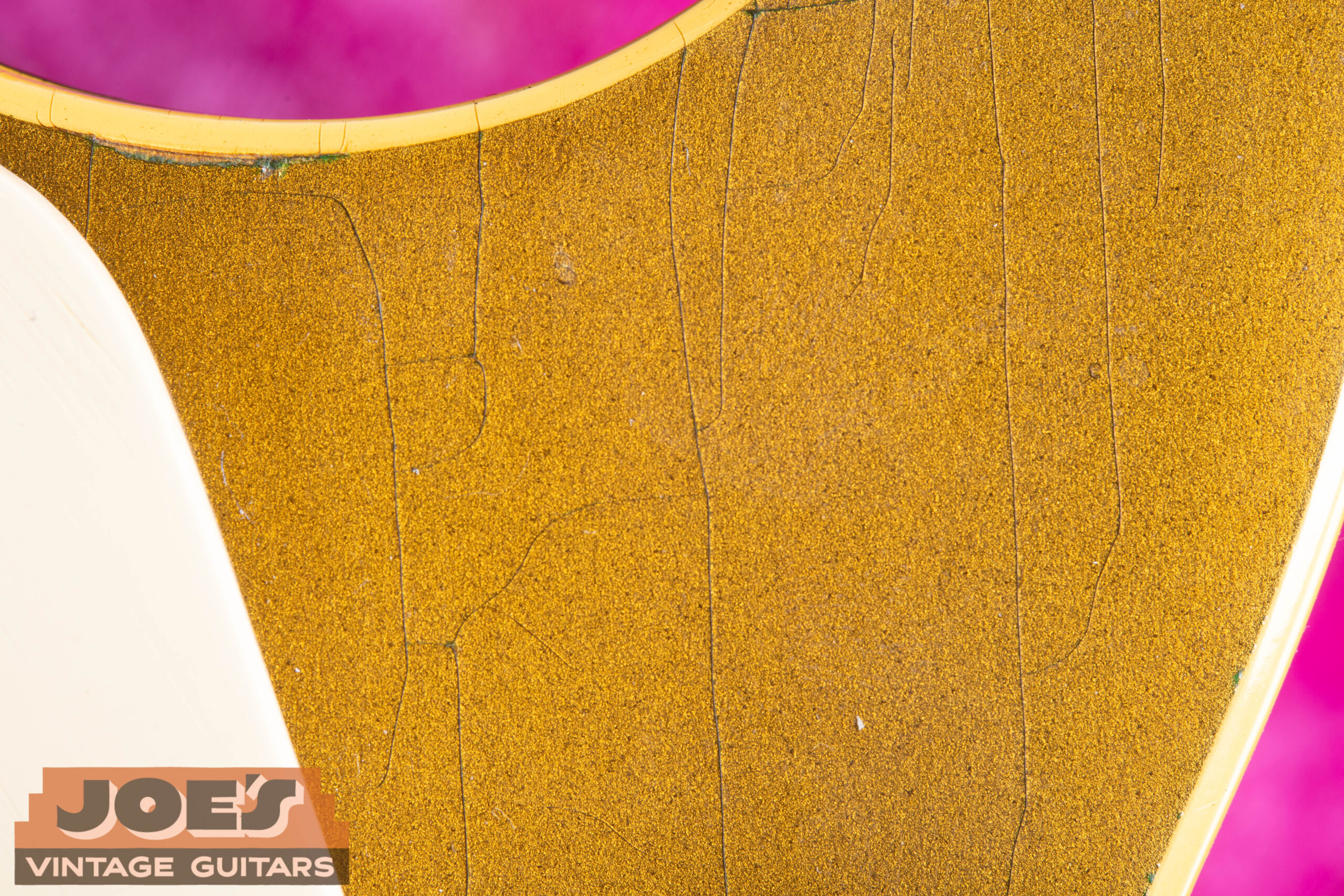
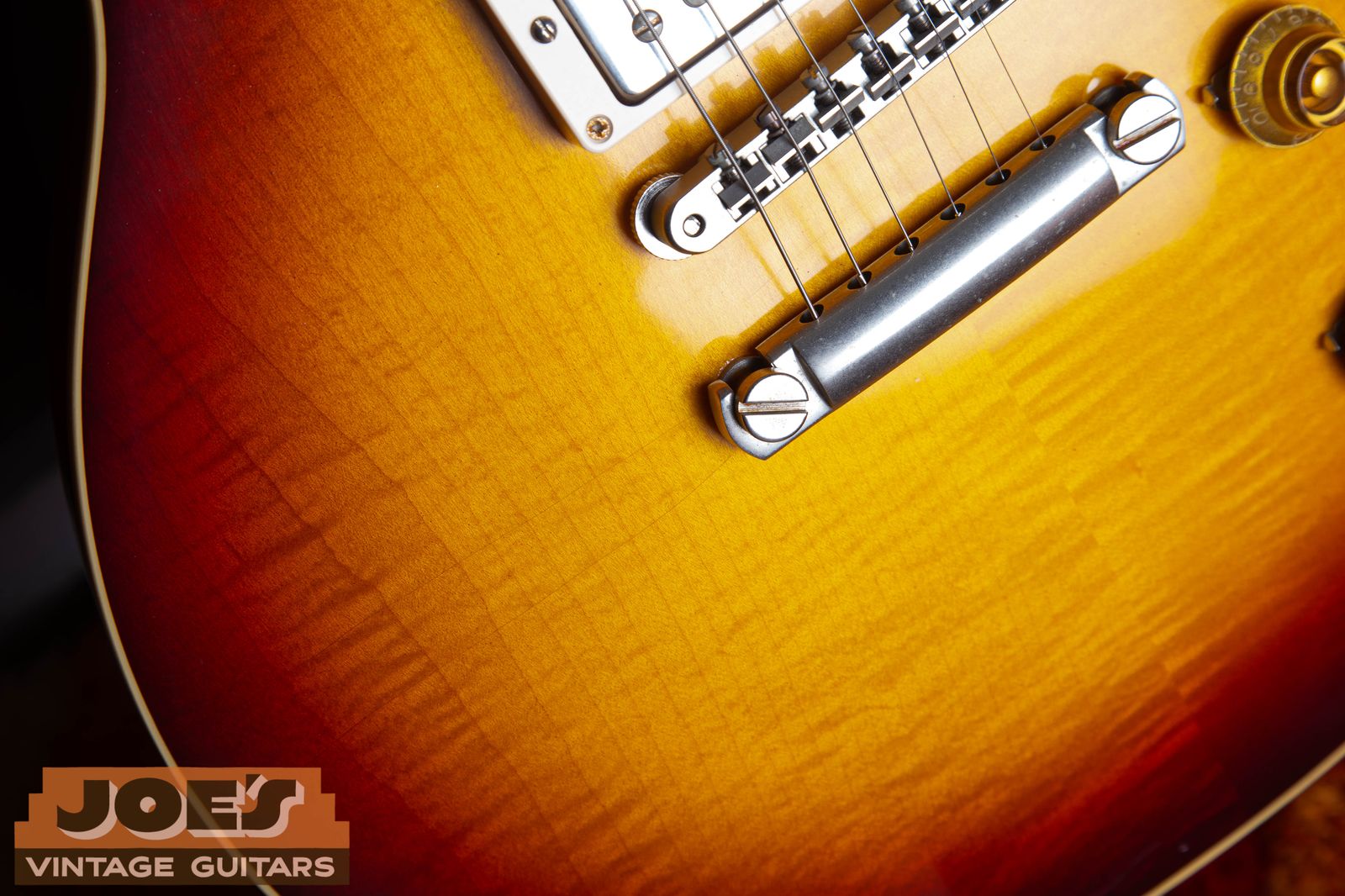
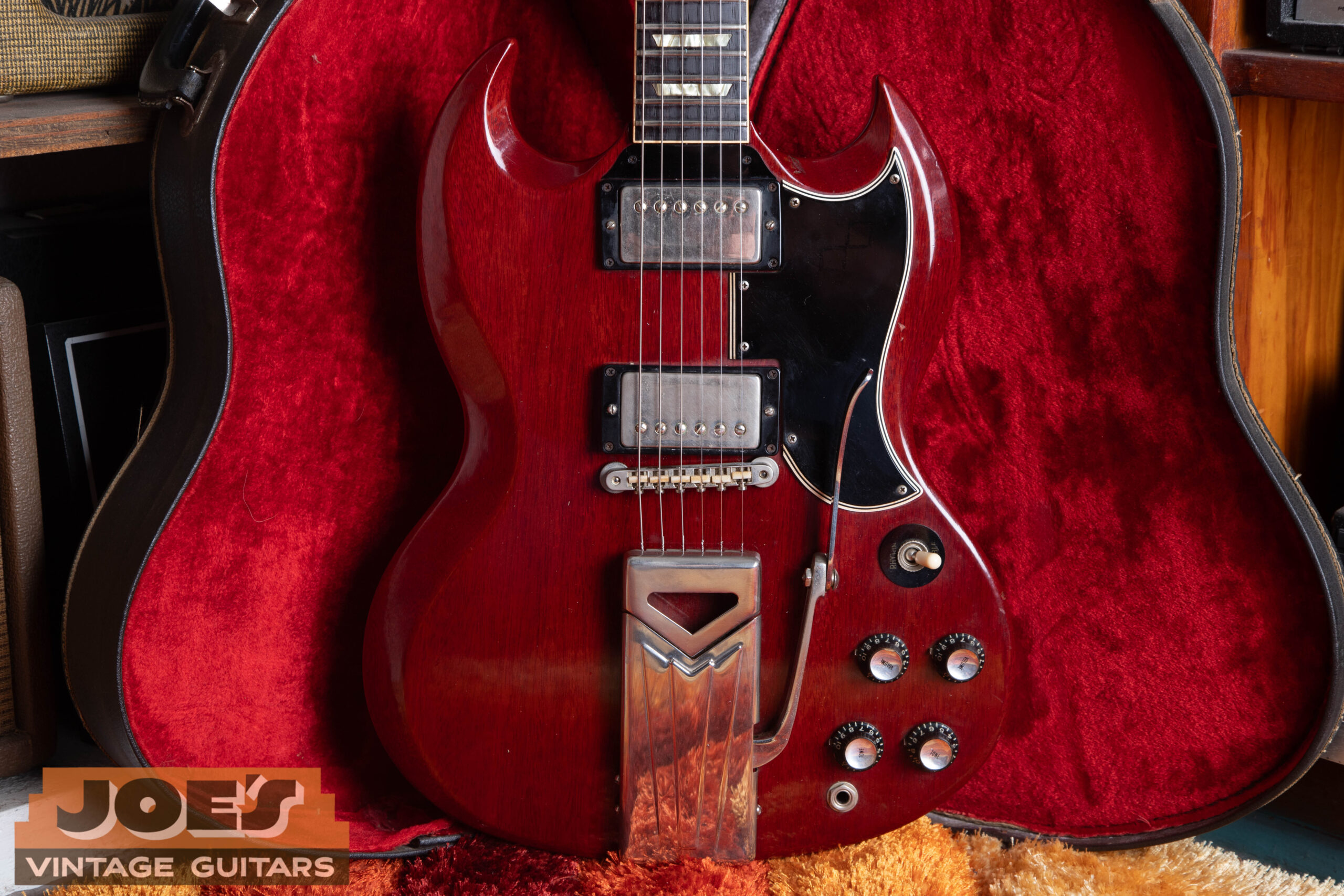
A Cherry Sunburst finish on a single-cutaway Les Paul Standard body dates the guitar exclusively to 1958, 1959, or 1960. There are no exceptions. If someone is selling a "1957 Sunburst Les Paul," that is incorrect — the Sunburst finish was not introduced until mid-1958.
Pickup Evolution — The Single Most Important Dating Detail
Pickups are the magnetic devices mounted under the strings that capture string vibration and convert it into an electrical signal. Gibson changed the pickup type on the Les Paul Standard twice during the 1950s and 1960s. Because each type was used in specific years only, identifying the pickup is one of the most precise dating tools available.
| Pickup Type | Years | How to Identify |
|---|---|---|
| P-90 (single coil) | 1952–1956 | Large rectangular plastic covers — black or cream. Often called "soapbar" P-90s on the Standard. A Les Paul with P-90 pickups was made between 1952 and 1956. |
| PAF Humbucker | 1957–1962 | Two coils under a single cover — black or cream plastic. Look on the bottom of the pickup for a small sticker reading "Patent Applied For." One of the most sought-after and most faked components in all of vintage guitar collecting. |
| Patent Number Humbucker | 1962–1965 | Visually identical to the PAF but the sticker on the base reads "Patent No. 2,737,842" instead of "Patent Applied For." Considered slightly less desirable than PAFs but tonally very similar. |
| T-Top Humbucker | 1965–1975 | Look inside the pickup at the bobbin — a raised letter "T" is molded into the plastic. Immediately identifies a mid-1960s to mid-1970s instrument. |
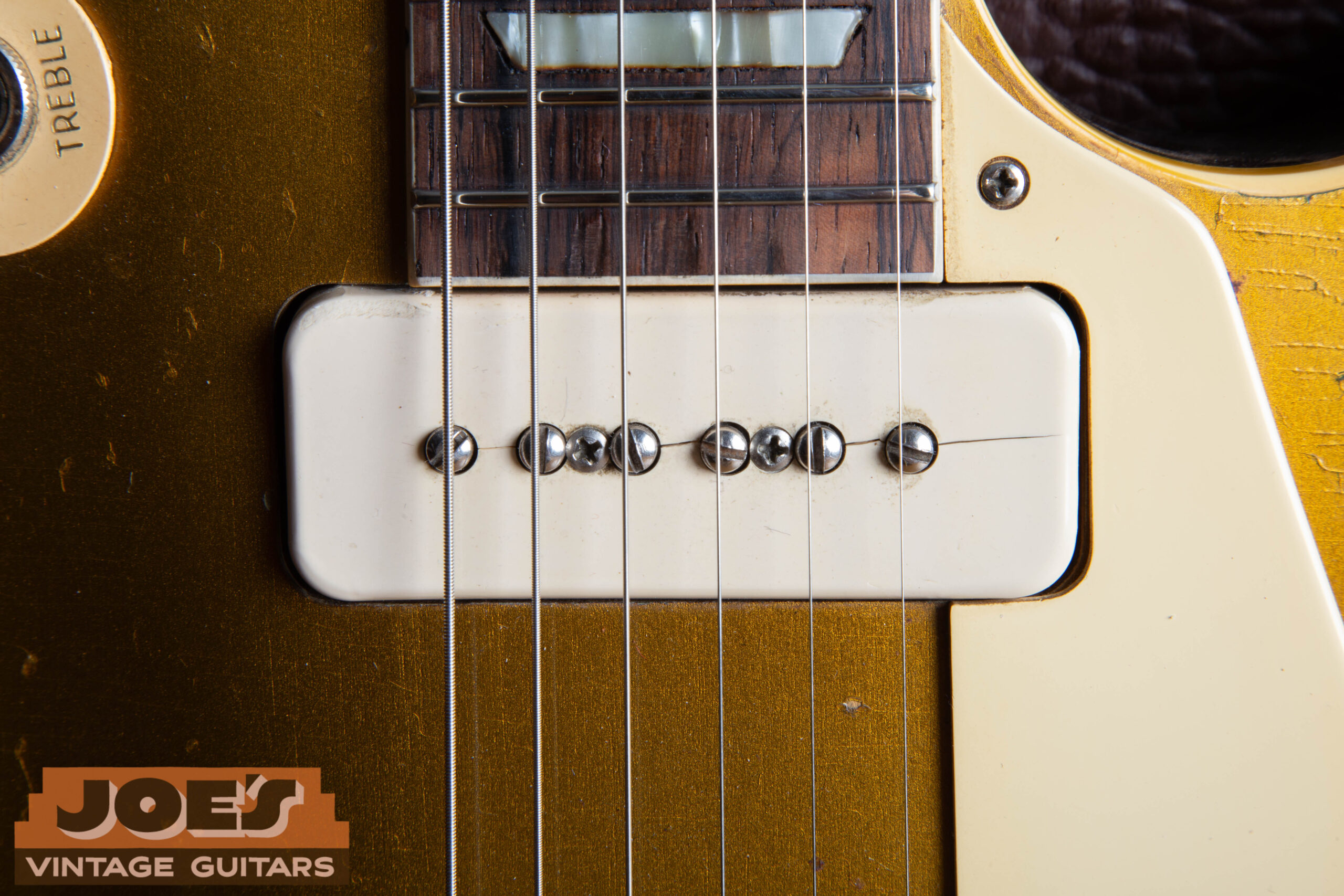
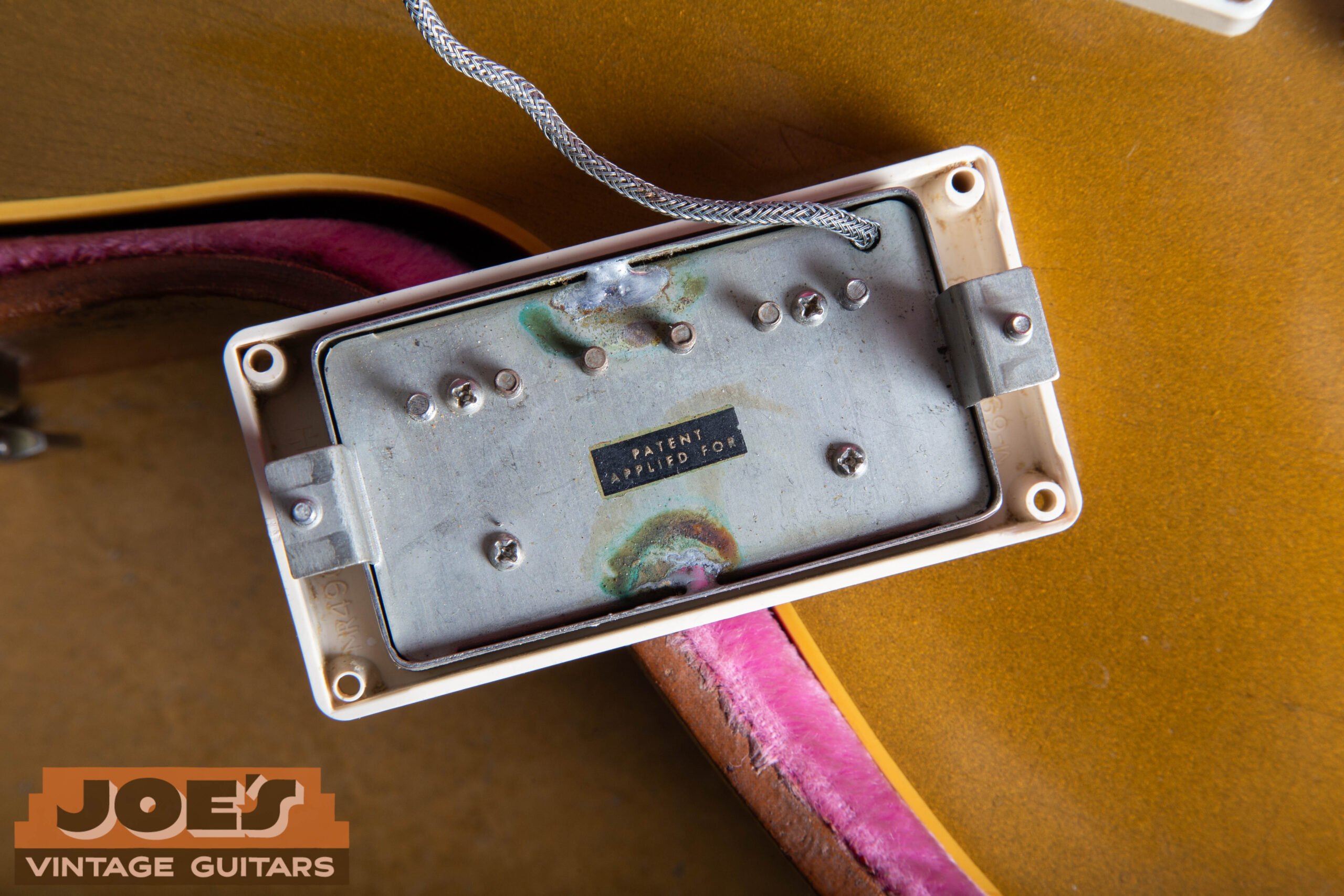
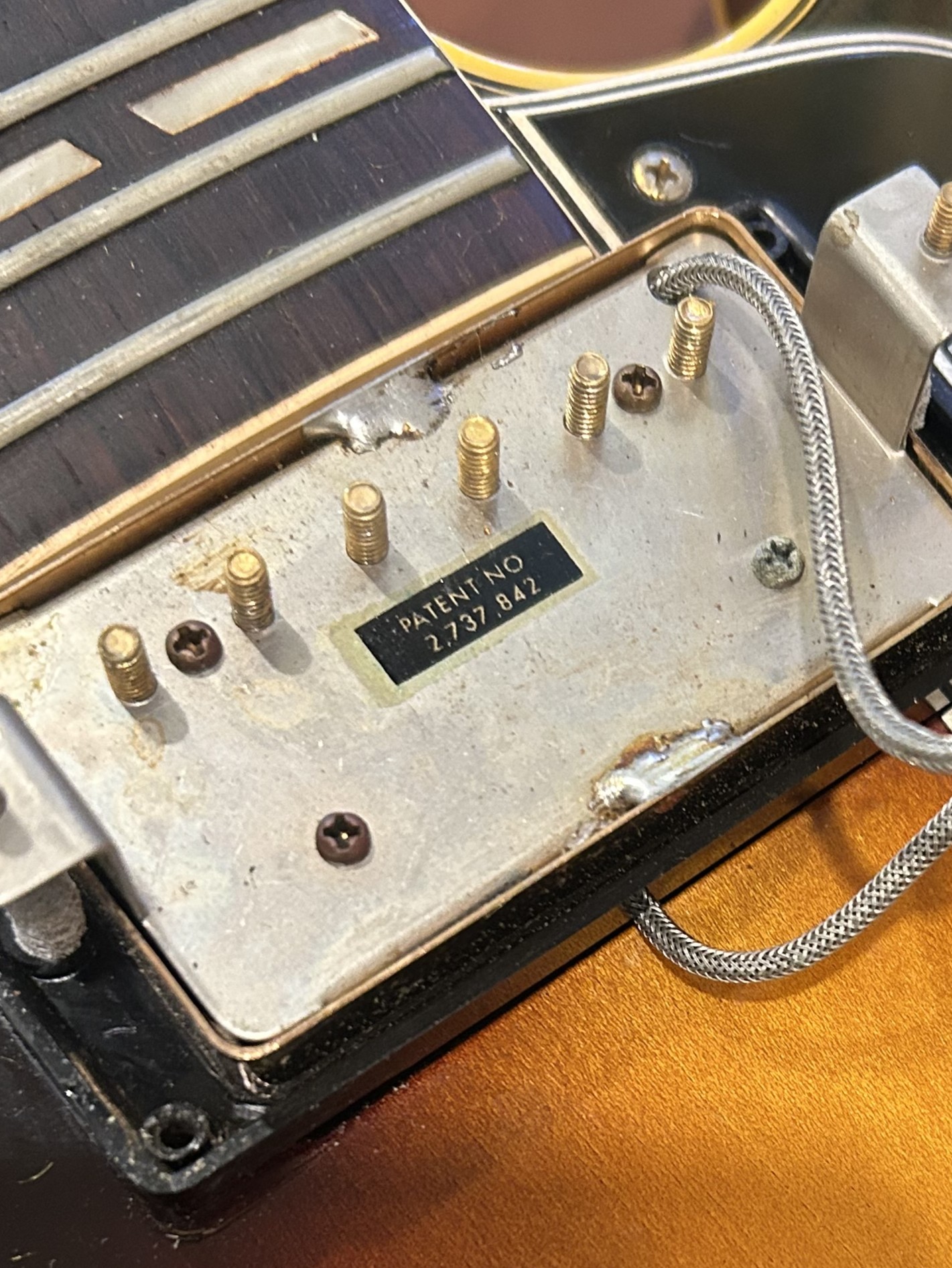
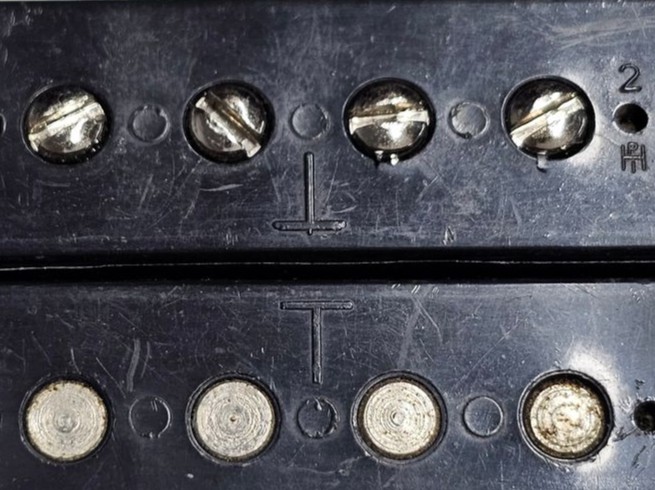
PAF humbuckers are among the most counterfeited components in the vintage guitar market. A fake PAF sticker is easy to make and hard to spot at a glance. On a genuine PAF, the sticker will show natural aging — slight yellowing or browning of the paper, adhesive bleed at the edges, and ink that has oxidized over 65+ years. A crisp, bright-white sticker with vivid ink is a red flag. Always verify with DC resistance readings (genuine PAFs typically measure between 7.5k and 8.5k ohms, with notable variation from pickup to pickup — that inconsistency is itself a sign of authenticity), bobbin construction, and wire gauge. If you are unsure, contact a specialist before making any purchase decision.
The Burst Years — Distinguishing 1958, 1959, and 1960
Within the three Cherry Sunburst years, specific details separate each production year from the others. These distinctions matter enormously — the difference between a confirmed 1959 and a confirmed 1960 can represent a significant value gap even between otherwise identical-looking instruments.
- Finish: Deeper, more orange-toned Cherry Sunburst. Often described as more "fiery" than later examples.
- Neck profile: Thickest of the three Burst years — a pronounced rounded "C." Many players consider this the most comfortable neck Gibson ever produced.
- Pickups: PAF humbuckers throughout.
- Hardware: No-wire ABR-1 bridge, aluminum stop bar, nickel plating.
- Serial number: Begins with 8 (ink stamp — first digit = last digit of year).
- Pickguard screws: Slotted head screws.
- Finish: Slightly more even, slightly redder Sunburst than 1958. Flame maple tops on many 1959 examples are exceptionally figured.
- Neck profile: Slimmer than 1958 but still substantial — noticeably different from the thick 1958 profile. The neck most associated with the peak Burst.
- Pickups: PAF humbuckers. Output generally slightly higher than 1958 examples.
- Hardware: No-wire ABR-1, aluminum stop bar, nickel plating.
- Serial number: Begins with 9.
- Production: Approximately 643 Sunburst Standards shipped in 1959 — genuine examples are genuinely rare.
- Finish: Tends toward a more transparent appearance. Some 1960 Bursts show a more orange hue due to dye lot variations.
- Neck profile: The thinnest of the three years — noticeably slimmer than both 1958 and 1959. The single most reliable physical detail for distinguishing a 1960 from earlier Bursts.
- Pickups: PAF humbuckers.
- Hardware: No-wire ABR-1, aluminum stop bar, nickel plating.
- Serial number: Begins with 0.
- Note: Last year of the original single-cut Standard before the body style change in 1961.
Hardware Configuration — Tailpieces and the ABR-1 Bridge
The tailpiece is the metal piece at the bottom end of the guitar body where the strings are anchored. Gibson used several different tailpiece designs on the Les Paul over the years. Because each design was used in a specific era, identifying the tailpiece type is a reliable indicator of when the guitar was made.
| Hardware | Years | Notes |
|---|---|---|
| Trapeze tailpiece (wrap-under) | 1952–1953 | The very first Les Paul tailpiece — strings loop underneath the bar and back up over the top. Found only on the earliest Goldtops. |
| Stud wrap-over bar | 1953–1955 | Strings wrap over the top of a combined bridge/tailpiece bar. Simple and effective but replaced by the two-piece ABR-1 system. |
| ABR-1 Tune-O-Matic + stop bar | 1955–1960 | The definitive golden era Les Paul configuration. A separate adjustable bridge paired with an aluminum stop bar tailpiece. The ABR-1 has no retaining wire on pre-1962 examples — see the bridge section above for details. |
| Sideways vibrola | 1961–1962 | A side-pull vibrato tailpiece found on early SG-body Les Pauls. The arm pulls the tailpiece sideways rather than up or down. Not found on the single-cut Standard. |
| Lyre vibrola | 1963–1966 | A vibrato tailpiece with a decorative lyre-shaped backplate. Found on SG-body Les Pauls and early SGs. Highly collectible when original and intact. |
| Nashville Tune-O-Matic | 1975 onward | Larger bridge with threaded metal inserts pressed into the body. Identifiable by the visible inserts at the base of each bridge post. Indicates Norlin-era or later production. |
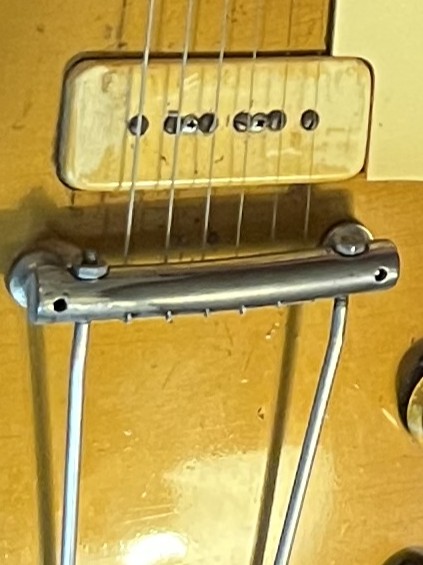
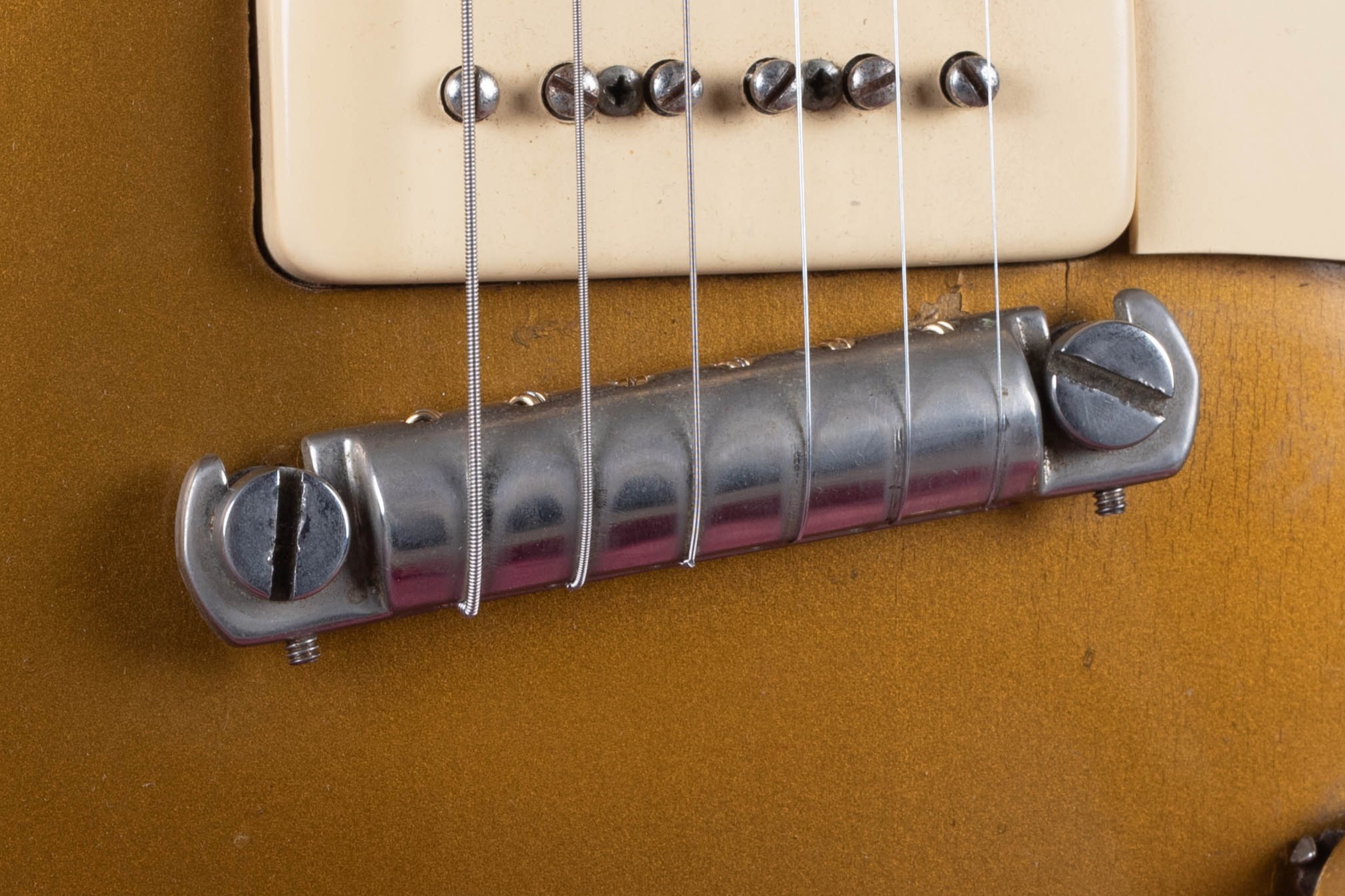
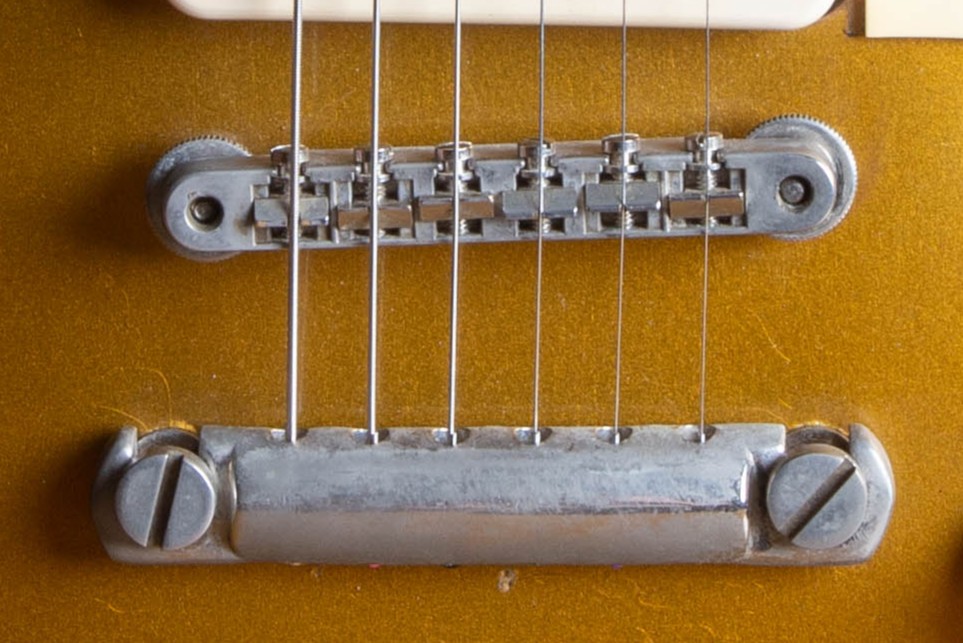
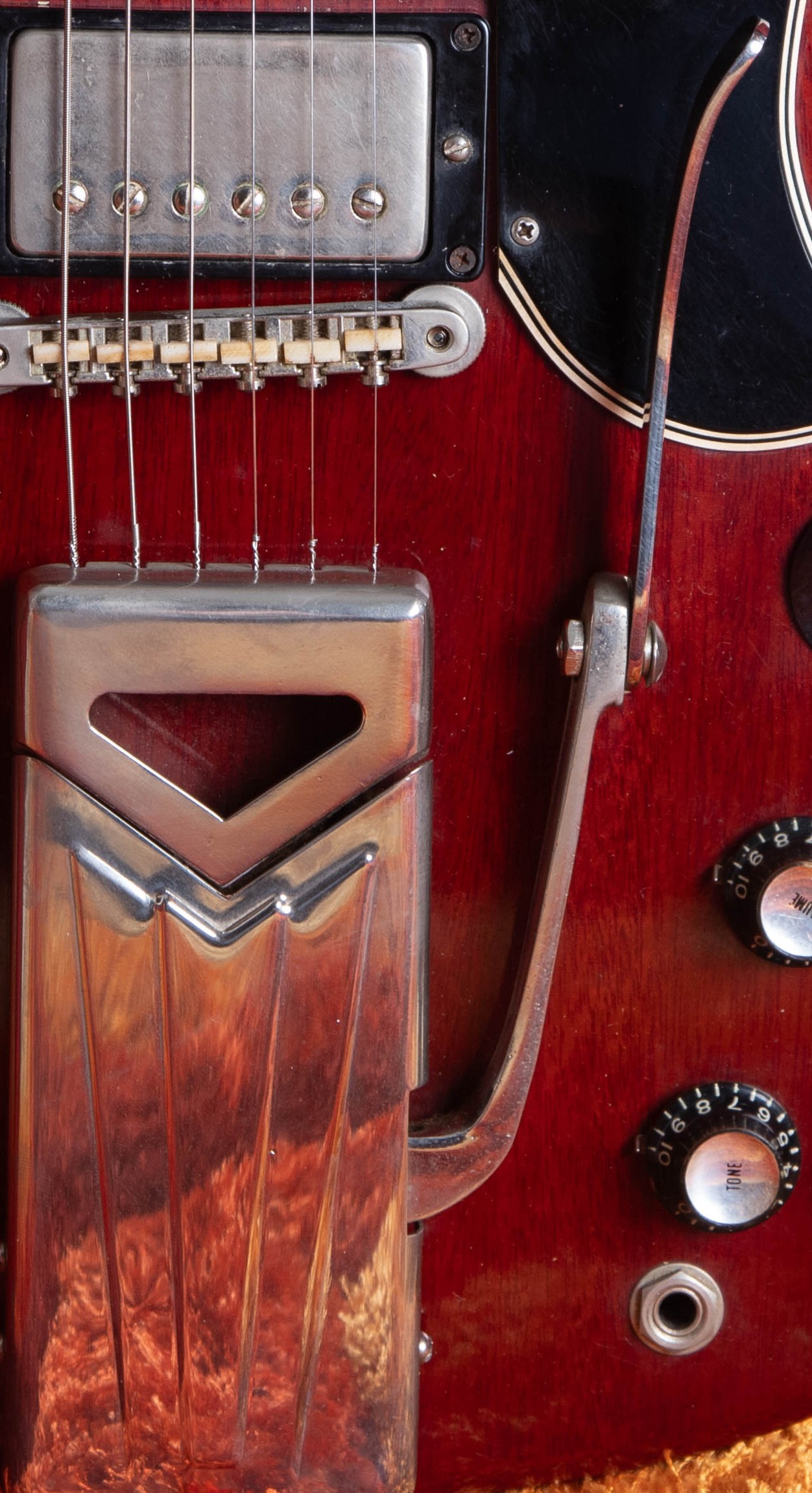
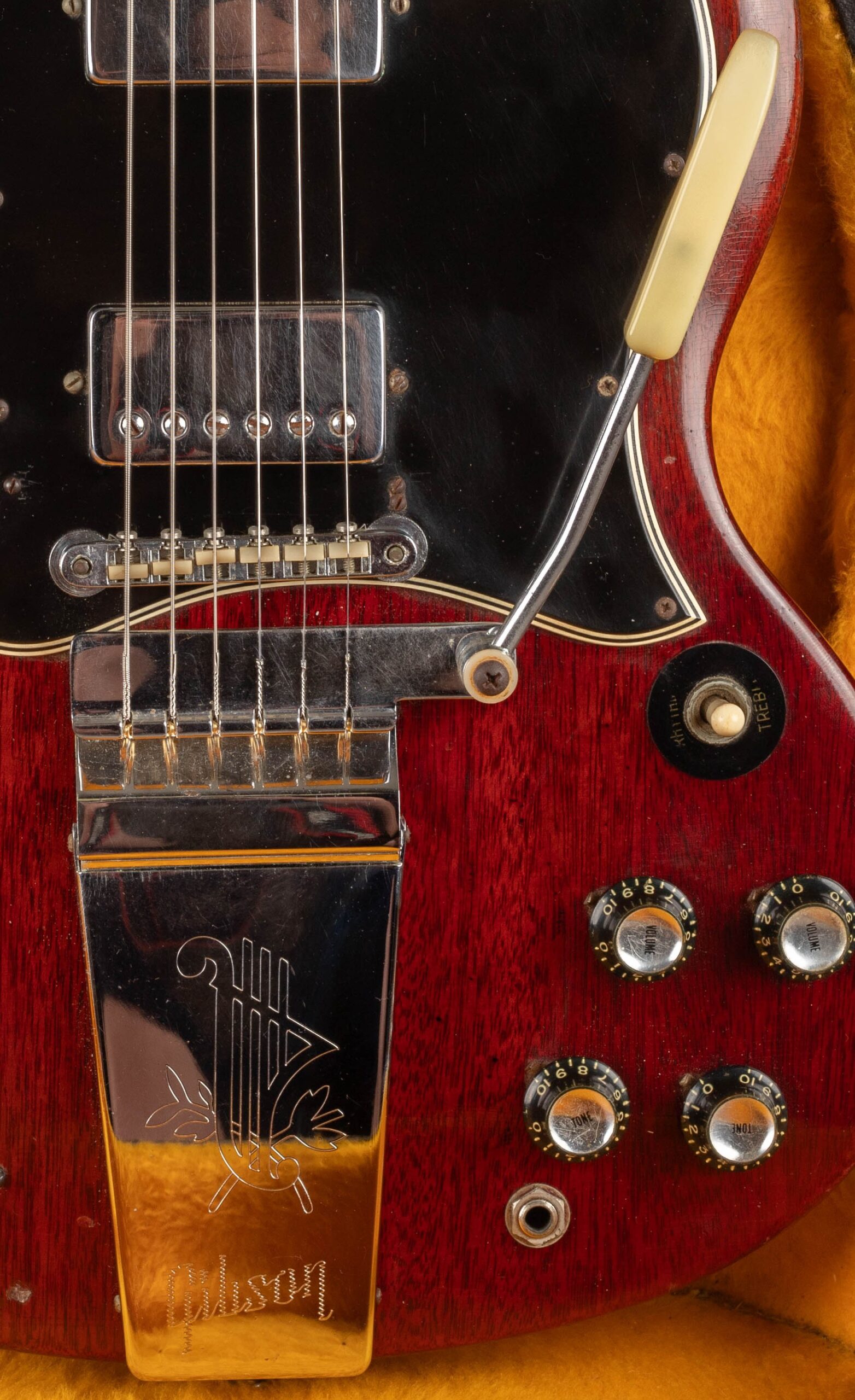
All genuine pre-1965 Les Paul hardware is nickel plated, not chrome. Nickel develops a warm, slightly yellowish tarnish with age — chrome stays bright and silver. If the hardware on a claimed early Les Paul looks pristine and bright silver, it has either been polished, replated, or replaced. Aged nickel patina consistent with the instrument's age is one of the strongest indicators of original, unmodified hardware.
Gibson Les Paul Custom
Introduced 1954 · The "Black Beauty" · Gibson's Flagship Les Paul
The Les Paul Custom was introduced in 1954 as Gibson's premium version of the Les Paul — positioned above the Goldtop Standard in terms of appointments, finish, and price. Where the Standard was a working musician's guitar, the Custom was designed to be Gibson's showpiece: bound in multiple layers of binding, finished in ebony black, and fitted with gold hardware. Collectors call early examples "Black Beauties," and genuine original Custom models from the 1950s are among the most valuable vintage Gibsons in existence. The Custom went through significant specification changes across its history, and knowing those changes is essential for accurate dating.
Think of the Custom as the luxury version of the Les Paul. It has more layers of decorative binding around the body and neck, gold-plated hardware instead of nickel, an ebony fingerboard instead of rosewood, and distinctive multi-ply headstock binding. The Standard was about tone; the Custom was about tone and presentation. Both are extraordinarily collectible — but the Custom's different specifications mean you date it slightly differently.
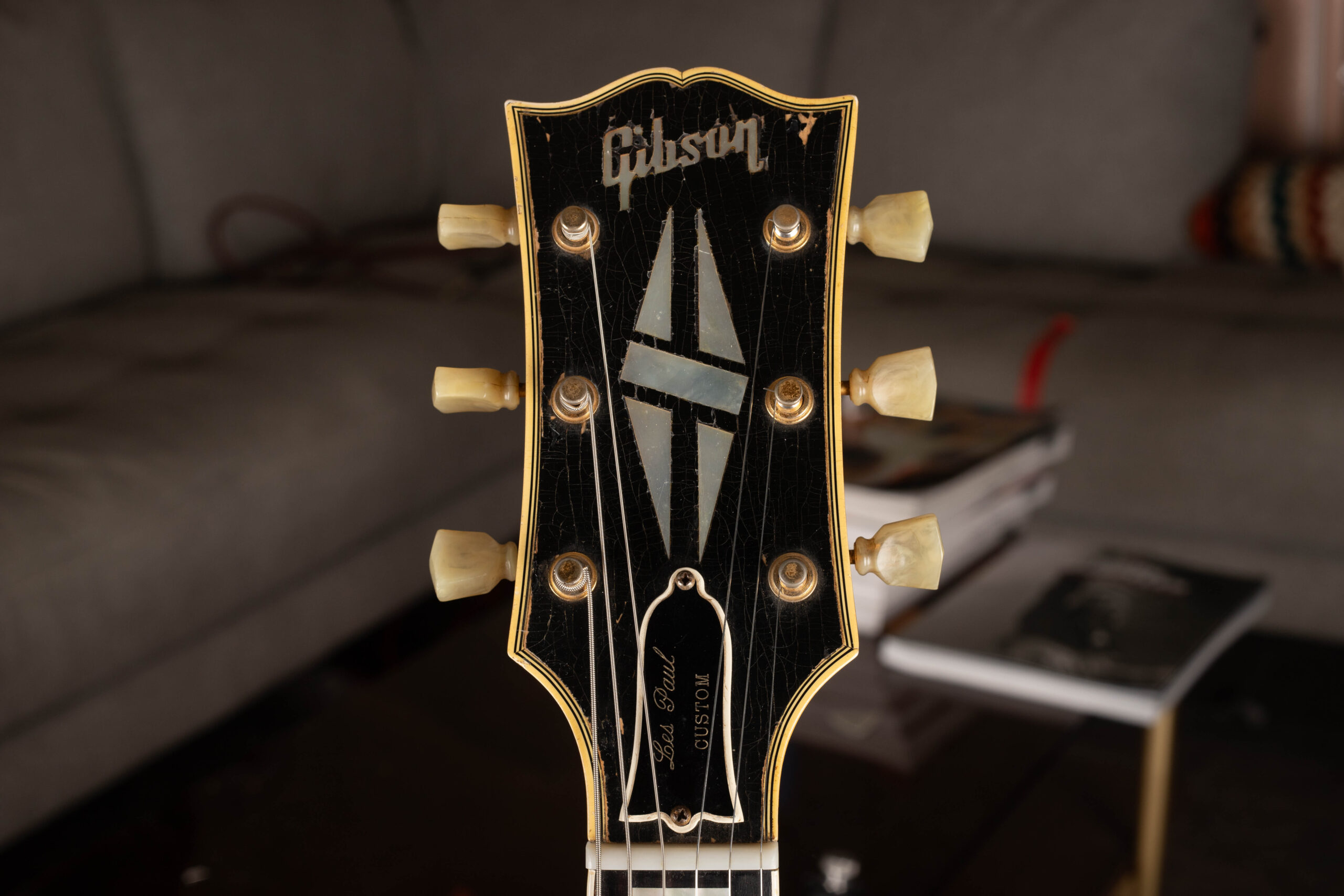
Les Paul Custom — Key Specifications by Year
| Year Range | Pickups | Key Identifying Features |
|---|---|---|
| 1954–1956 | P-90 soapbar (neck) + Alnico V staple pickup (bridge) | Ebony finish, gold hardware, multi-ply binding, "fretless wonder" low frets, ABR-1 Tune-O-Matic bridge introduced 1954. The Alnico V staple pickup at the bridge is exclusive to this era of the Custom. |
| 1957–1960 | Two PAF humbuckers (standard) · Three PAF humbuckers (more common variant) | The most collectible Custom era. Two-pickup versions are rarer and more collectible than three-pickup examples. Gold Kluson waffle-back tuners. No retaining wire on ABR-1. Ebony finish. |
| 1961–1963 | PAF or early Patent Number humbuckers | Body changes to the SG-style double cutaway. See the SG section for dating details specific to this body style. |
| 1968–1975 | Patent Number or T-Top humbuckers | Single-cut body returns. Ebony or Wine Red finish options. Three-piece mahogany neck from approximately 1969. Volute present 1969–1981. Gold hardware retained throughout. |
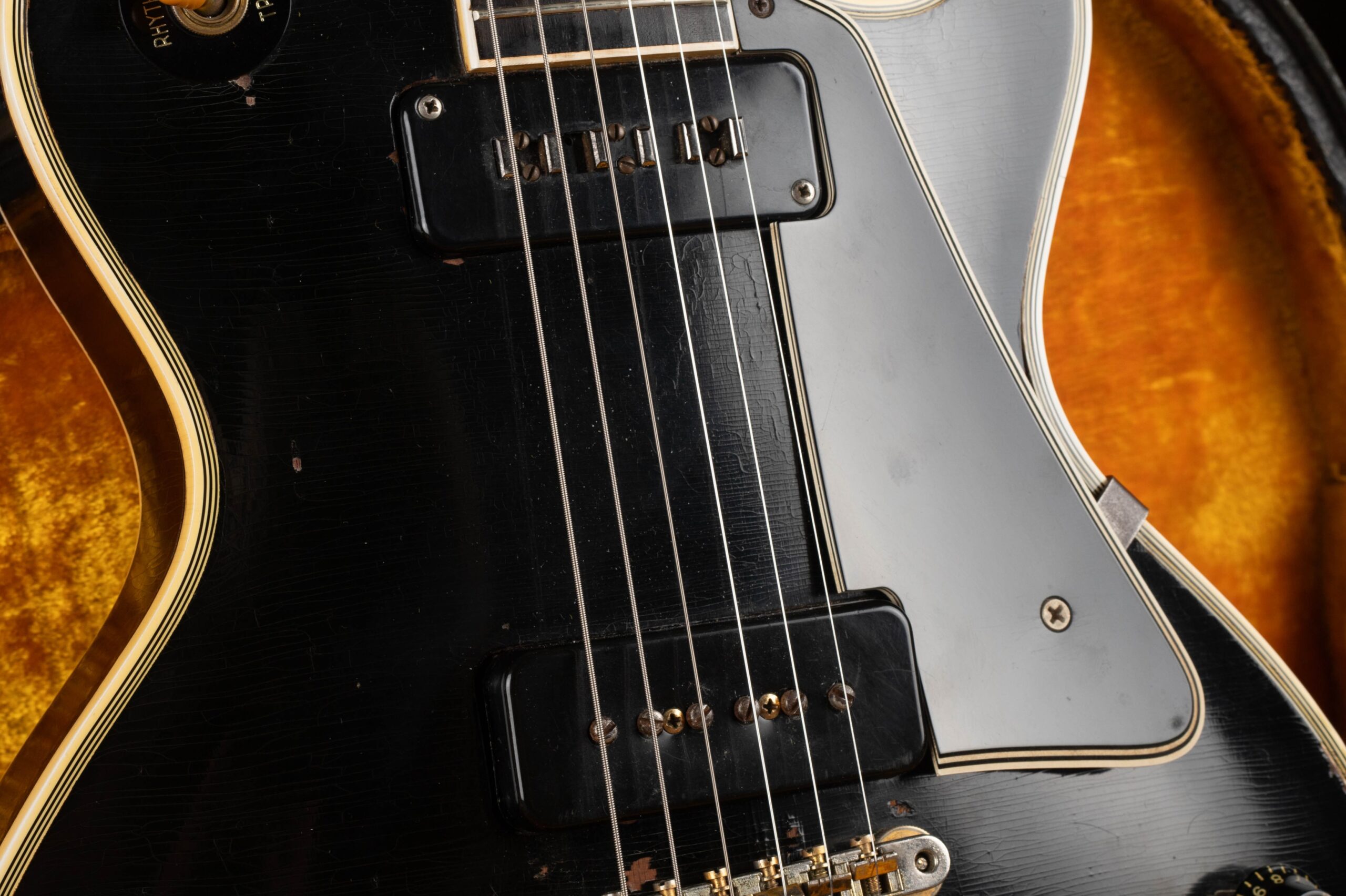
The Alnico V "staple" pickup — named for its distinctive row of rectangular polepieces that resemble staples — was used exclusively on the Les Paul Custom at the bridge position from 1954 through 1956. If your Custom has this pickup, it dates firmly to 1954–1956. No other production Les Paul model used this pickup at the bridge.
Some Les Paul Customs from 1957–1960 were ordered with three PAF humbuckers. These three-pickup "Black Beauties" are well known and visually striking — but it is the two-pickup Custom that is rarer and more collectible. Two-pickup examples from this era are harder to find in original condition and consistently command higher prices among serious collectors. Do not assume a two-pickup Custom is a lesser version of the three-pickup model — it is the opposite.
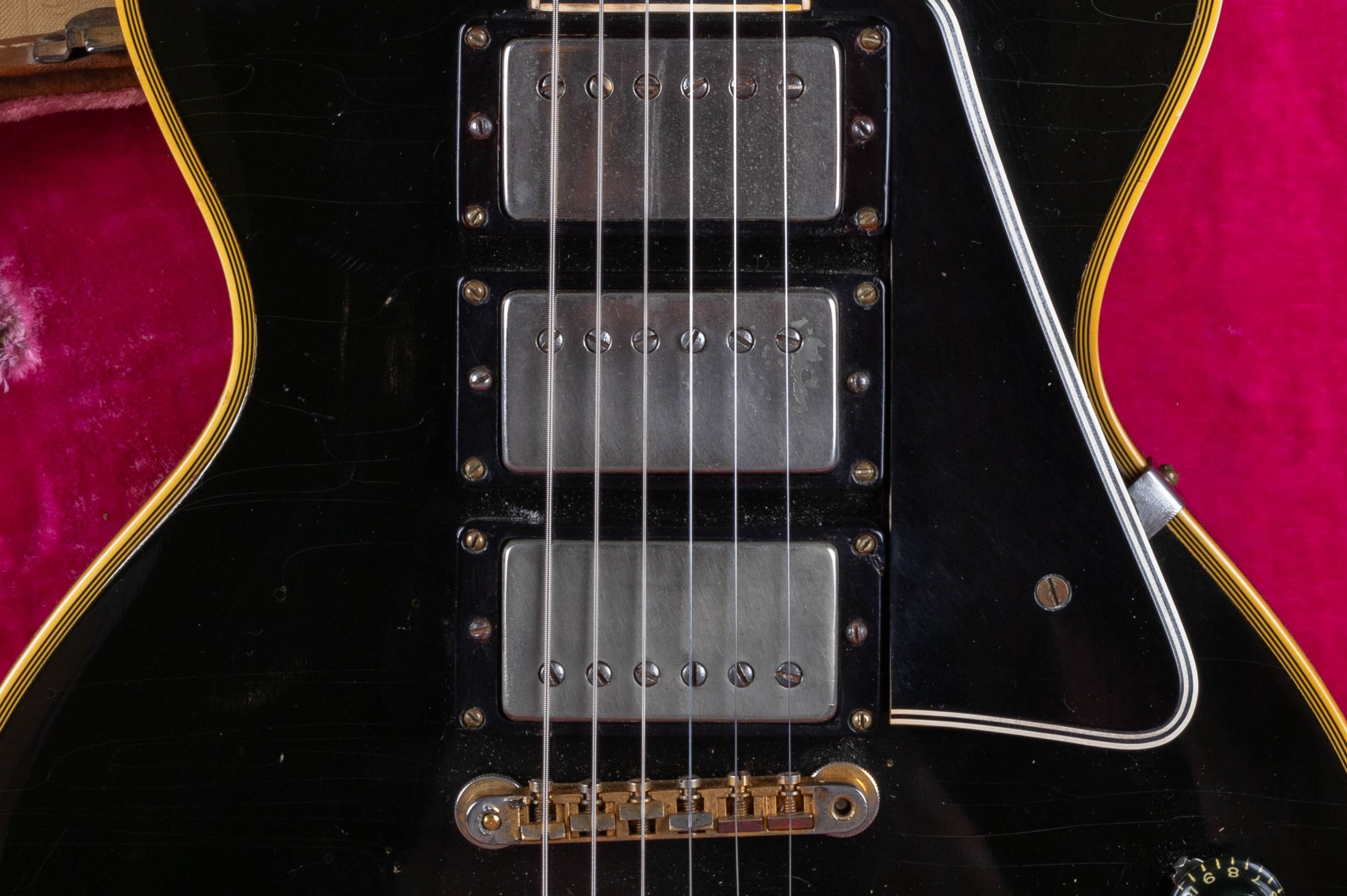
Gibson Les Paul Special
Introduced 1955 · TV Yellow and Cherry Finishes · Two P-90s
The Les Paul Special was introduced in 1955 as a mid-range alternative to the Goldtop Standard — simpler in construction, lighter in weight, finished in a distinctive flat yellow color, and priced to be accessible to a wider range of players. Where the Standard had a carved maple top, the Special had a flat slab mahogany body. Despite its more modest original positioning, the Les Paul Special has become one of the most beloved vintage Gibsons among players — prized for its raw, direct tone from the two P-90 pickups and its comfortable lightweight construction. Original examples in good condition are increasingly collectible.
The original Les Paul Special finish was an off-white or pale yellow color that Gibson called "Limed Mahogany" — but because it looked clean and readable under the harsh studio lighting used in 1950s television broadcasts, it quickly became known as "TV Yellow." The name stuck, and it remains one of the most iconic and instantly recognizable finishes in vintage guitar history.
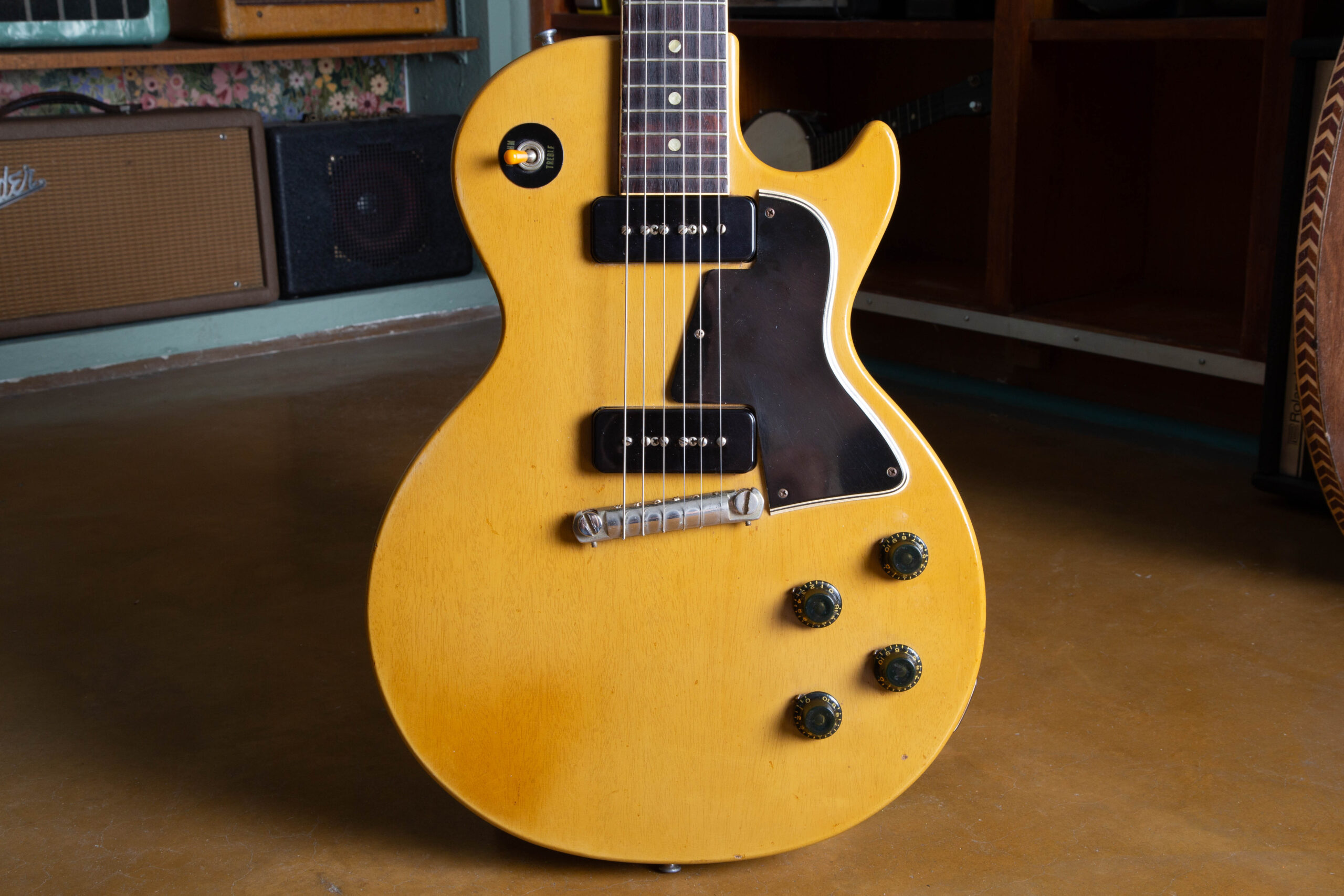
Body Style and Cutaway Changes
The Les Paul Special went through a significant body design change in 1959 — from a single-cutaway slab body to a double-cutaway body — making body shape one of the fastest dating tools on the Special.
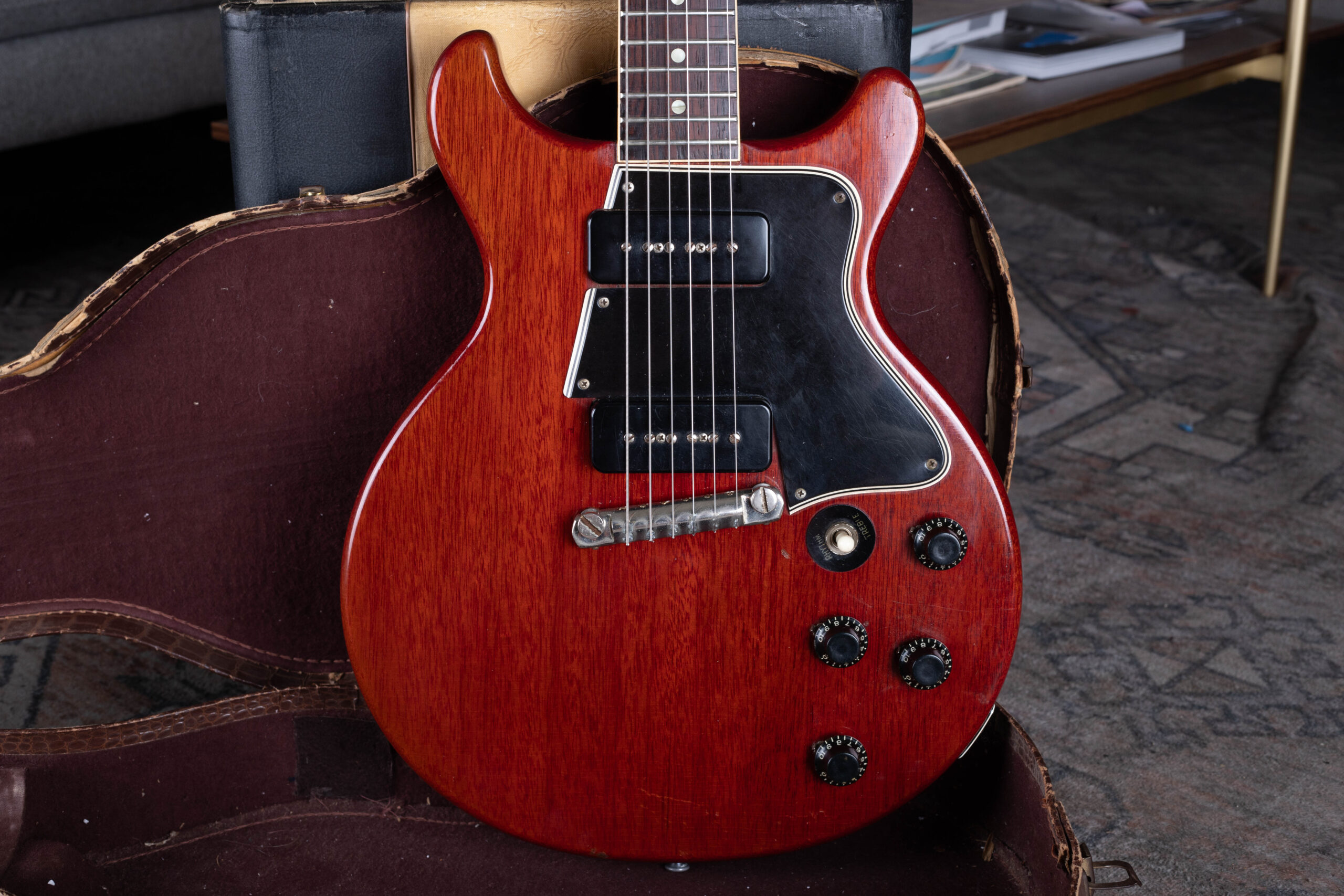
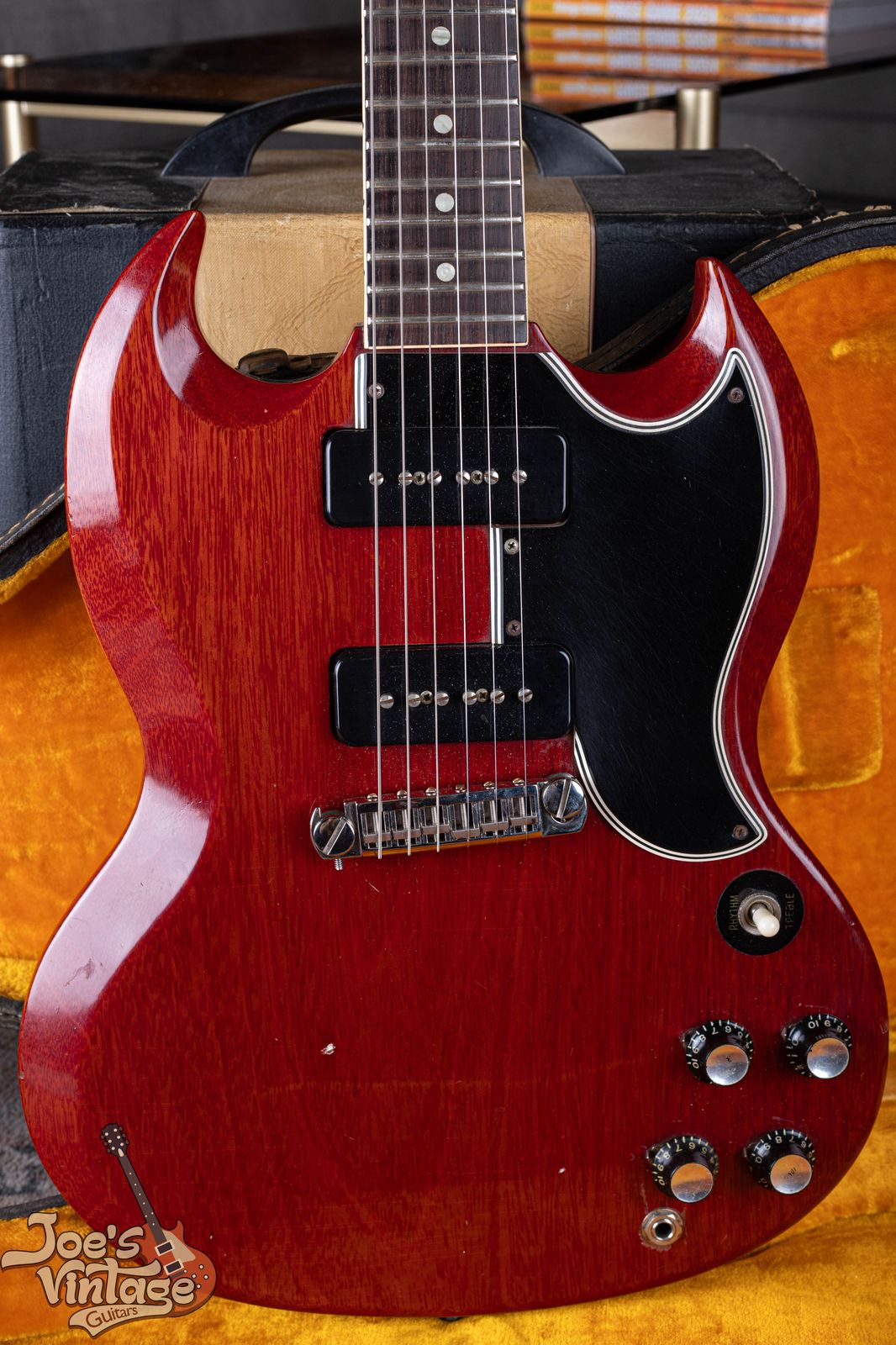
| Body Style | Years | Notes |
|---|---|---|
| Single cutaway (slab) | 1955–1958 | Flat mahogany slab body, one cutaway on the treble side. TV Yellow finish standard. Two P-90 soapbar pickups. Wrap-over bridge/tailpiece combination. |
| Double cutaway (slab) | 1959–1960 | Two equal cutaways giving greater access to higher frets. Still a flat slab mahogany body. TV Yellow or Cherry finish. P-90 pickups retained. Highly regarded among players for balance and feel. |
| SG-style body | 1961–1963 | Thinner, more sculpted double cutaway — the same body change that affected all Les Paul models in 1961. After 1963 the model continued as the SG Special. |
Finish and Color Timeline
| Finish | Years | Notes |
|---|---|---|
| TV Yellow (Limed Mahogany) | 1955–1960 | The original and most iconic Special finish. A pale, slightly greenish yellow that often ages to a deeper butterscotch or ochre over 65+ years. Original TV Yellow with natural aging is preferred by collectors. |
| Cherry | 1959–1963 | Introduced alongside the double-cutaway body change. A vibrant transparent red showing the mahogany grain. Cherry Specials from 1959–1960 are increasingly collectible. |
| White | Some SG-body examples, 1961–1963 | White finish is seen more commonly on the SG Special than on the single or double-cutaway Les Paul Specials. More on this in the SG section. |
Original TV Yellow on a 1950s Les Paul Special will have aged significantly over 65+ years. The original pale yellow often deepens to warm butterscotch, amber, or dark ochre depending on UV exposure. Do not assume a heavily aged Special has been refinished simply because the finish looks darker than a fresh TV Yellow — this aging is natural, expected, and on a verified original example, desirable. A finish that looks too fresh and uniform for its claimed age is the more significant red flag.
The Les Paul Special and Les Paul Junior look similar at a glance — both have flat slab mahogany bodies and simple construction. The key difference is the number of pickups: the Special has two P-90 pickups (neck and bridge), while the Junior has one P-90 pickup (bridge only). If your guitar has two pickups, it is a Special. If it has one pickup, read the Junior section below.
Gibson Les Paul Junior
Introduced 1954 · Single P-90 · The Player's Les Paul
The Les Paul Junior was introduced in 1954 as Gibson's entry-level Les Paul — a stripped-down, affordable instrument designed for students and beginners. One P-90 pickup, a simple wrap-over bridge, a flat slab mahogany body with no binding, and a plain sunburst or cherry finish. No frills. What Gibson did not anticipate is that the Junior's simplicity would become its greatest asset. The direct, unfiltered signal path from a single bridge P-90 through a minimal circuit produces a raw, aggressive tone that decades of famous players have sought out specifically. Original 1950s Les Paul Juniors in good original condition are now genuinely collectible instruments.
When the Junior was made in the 1950s it was Gibson's cheapest Les Paul — aimed at beginners who could not afford a Standard. But decades later, what makes vintage guitars valuable is not what they cost new but what they sound like, how they feel to play, and how many still exist in original condition. The Junior's single P-90 tone has become legendary, and because it was a budget guitar, many were played hard and poorly cared for — making clean original examples increasingly rare and therefore increasingly valuable.
Body Style and Cutaway Changes
Like the Special, the Junior went through a body change from single-cutaway to double-cutaway — but the Junior made this change in 1958, one year earlier than the Special. Body shape is one of the fastest dating tools on the Junior.
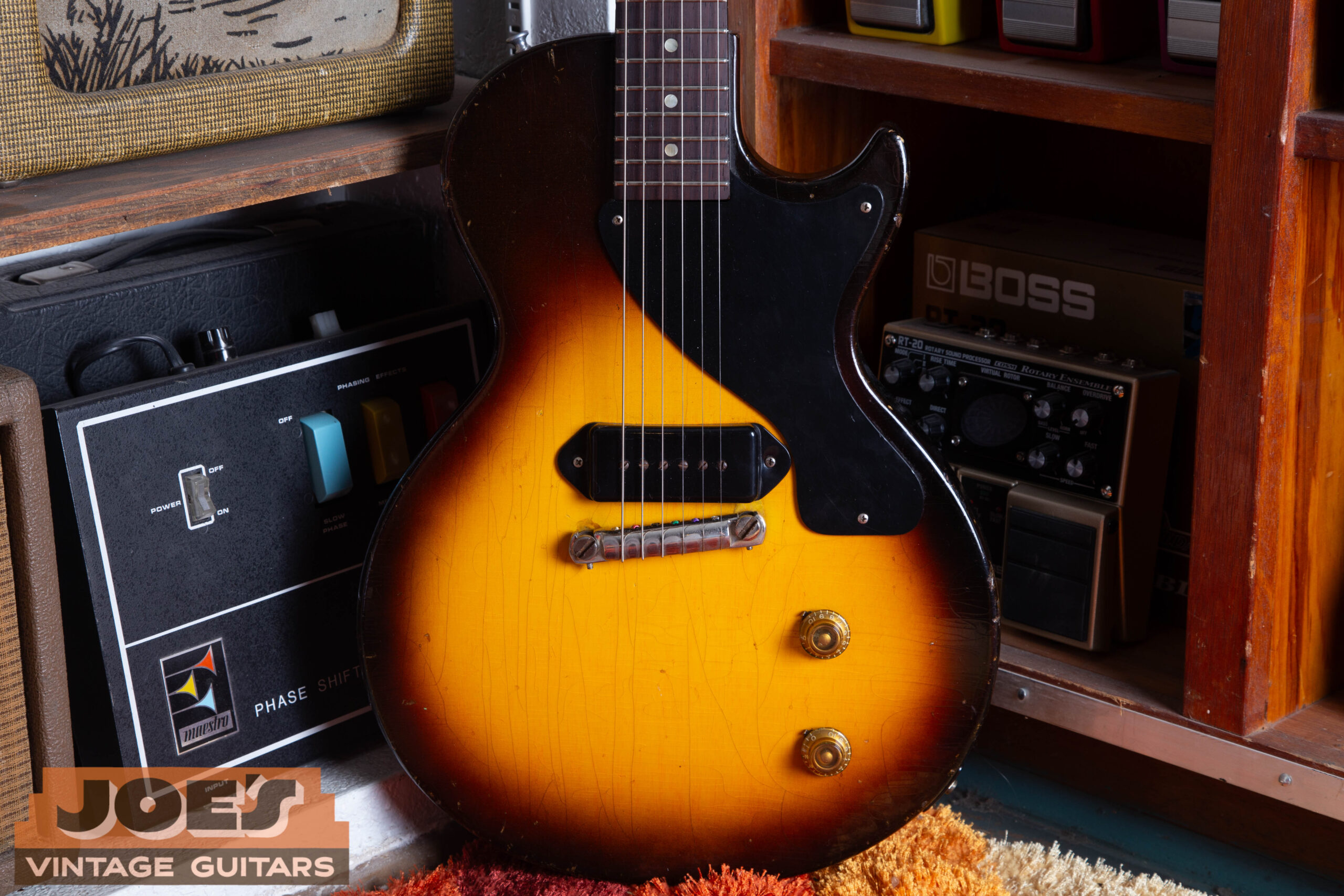
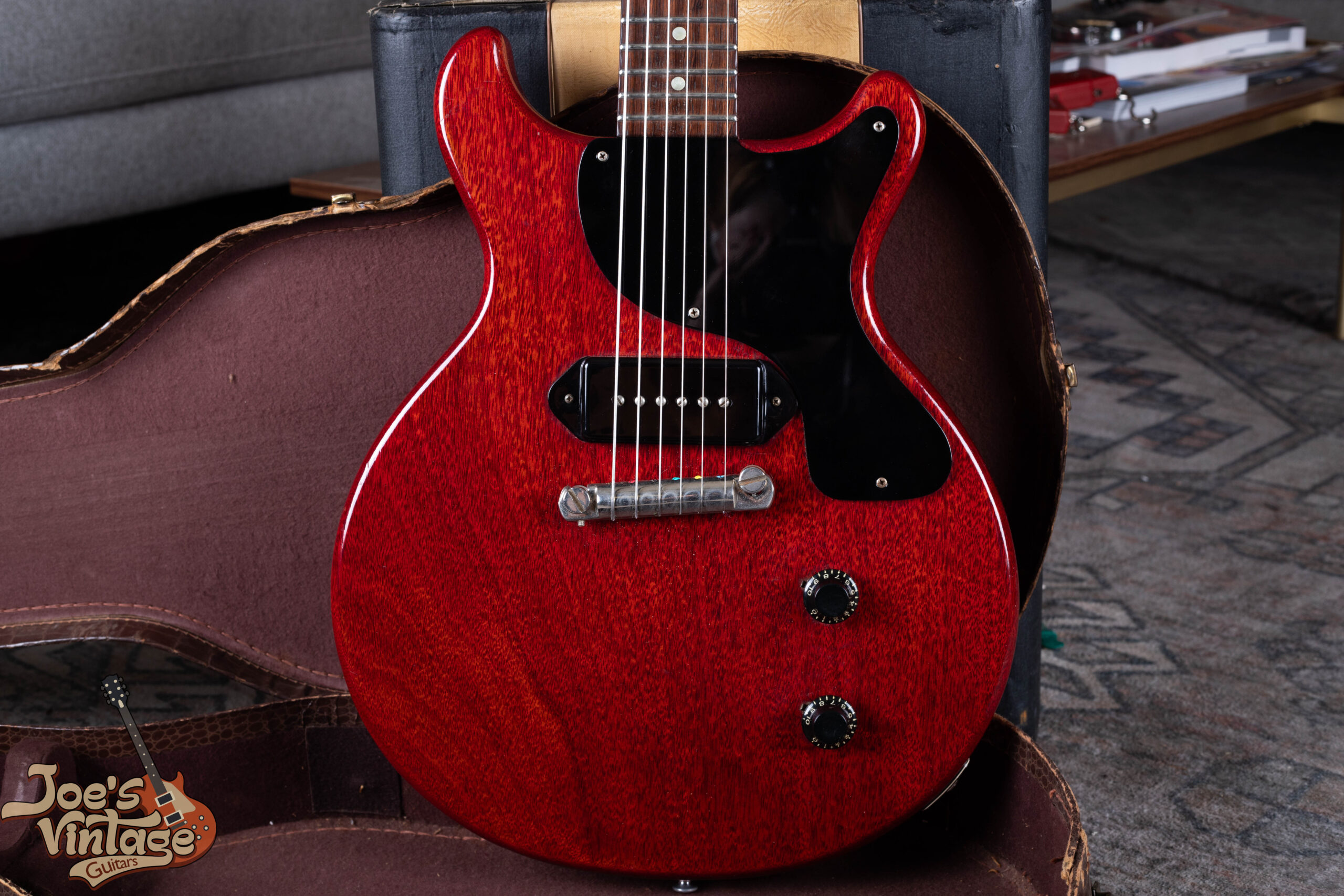
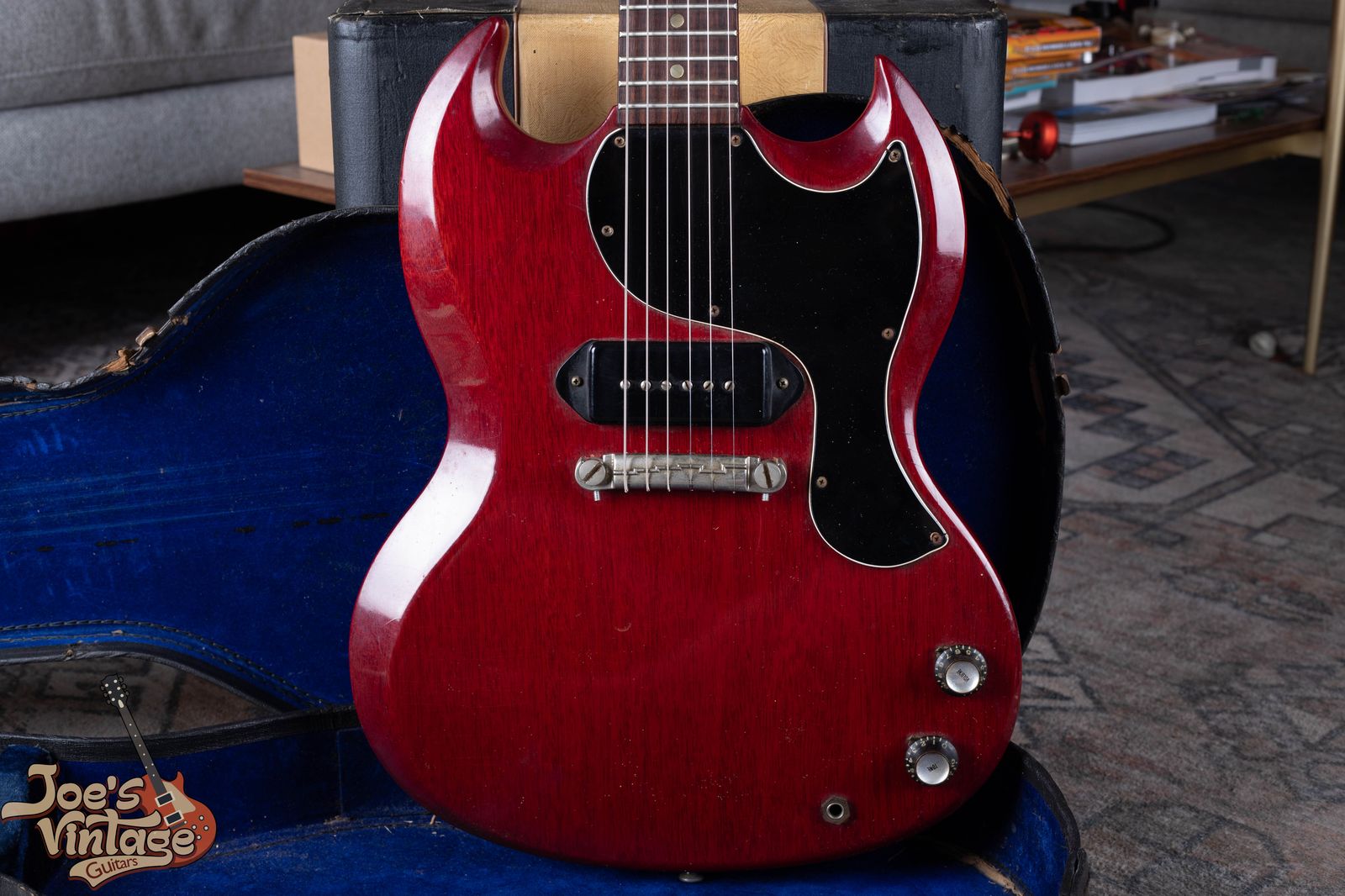
| Body Style | Years | Notes |
|---|---|---|
| Single cutaway (slab) | 1954–1958 | Flat unbound mahogany slab body. One cutaway on the treble side. Sunburst finish standard. Wrap-over bridge. One P-90 at the bridge position only. |
| Double cutaway (slab) | 1958–1960 | Two equal cutaways. Still flat slab mahogany, still one P-90. The transition happened partway through 1958 — serial numbers and pot codes are essential for dating mid-1958 examples precisely. |
| SG-style body | 1961–1963 | Thinner sculpted double cutaway. After 1963 the model continued as the SG Junior. |
Finish and Color Timeline
| Finish | Years | Notes |
|---|---|---|
| Two-tone Sunburst | 1954–1958 | Dark brown-black at the edges fading to yellow at the center. The original and most common Junior finish. Expected on all single-cutaway examples. |
| Cherry | 1958–1963 | Introduced with the double-cutaway body. A solid transparent red that became the most recognizable Junior finish. Cherry double-cutaway Juniors from 1958–1960 are the most collectible Junior configuration. |
| TV Yellow | Select examples — 3/4 size model | TV Yellow was used on the Junior 3/4 size model and some standard examples. A TV Yellow Junior is a rarer configuration worth identifying carefully. |
The Junior switched from single-cutaway to double-cutaway partway through 1958 — one year earlier than the Special made the same change. A double-cutaway Junior with a serial number beginning with 8 could be from the first or second half of that year. Pot codes are essential for pinning down mid-1958 examples precisely. A pot date from early 1958 on a double-cutaway body is unusual and worth examining carefully with a specialist.
Les Paul Juniors were student guitars that got played hard. The two most common alterations on vintage Juniors are replaced pickguards and refinished bodies. Original pickguards on pre-1960 Juniors are single-ply black plastic — if the pickguard looks too clean, too thick, or too new relative to the rest of the guitar's wear, it may be a replacement. Refinished bodies are common and significantly reduce value — check for finish thickness inconsistencies, paint in the control cavity, and overspray on the pickup covers and hardware for signs of a refin.
Not sure what year your Les Paul is? Send Joe a text or email with photos of the headstock, pickups, serial number, and full body — he'll give you a free assessment and let you know exactly what you have.
Get a Free AssessmentGibson SG — Dating by Model and Features
Covers: SG Standard · SG Custom · SG Special · SG Junior
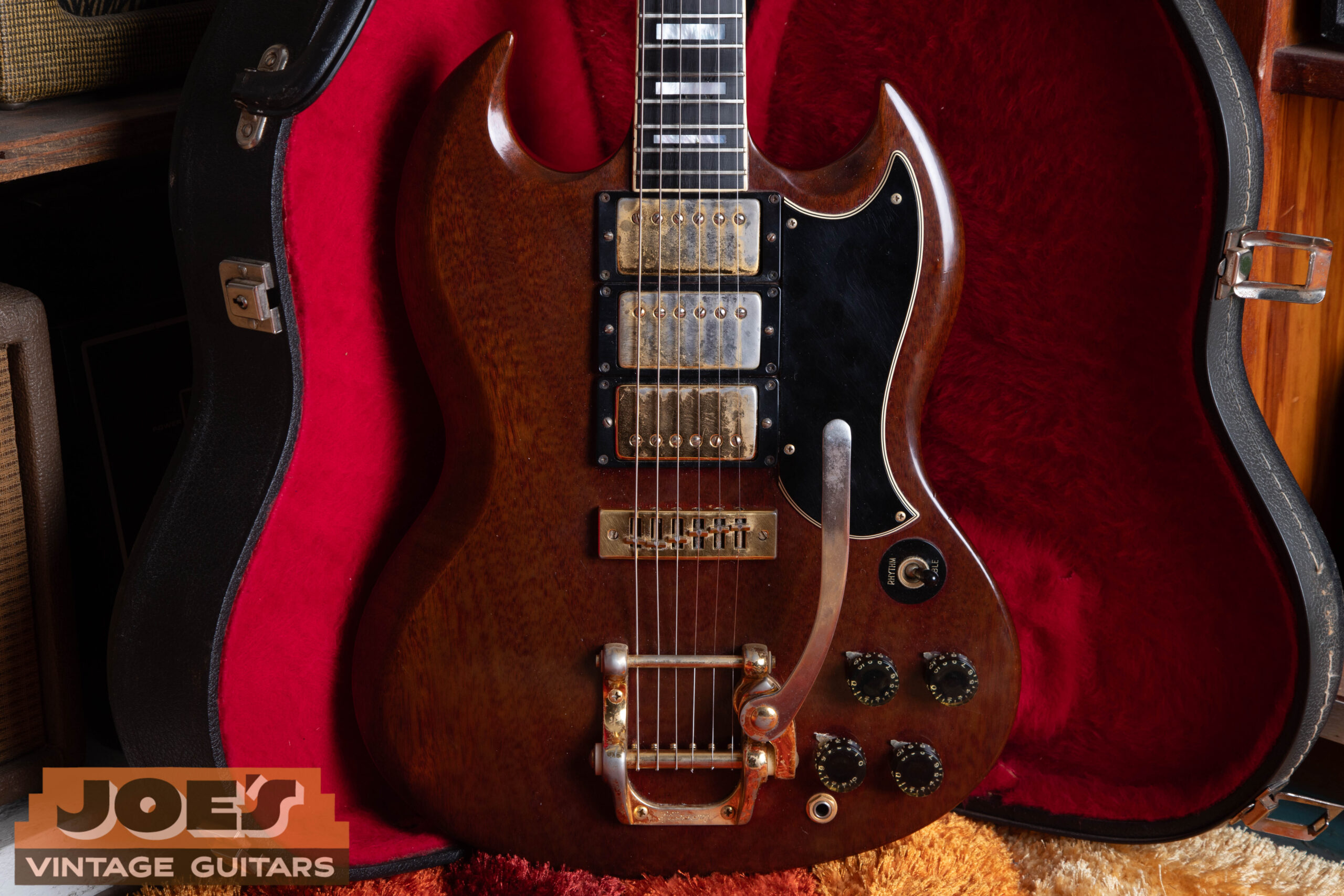
The SG has one of the most confusing origin stories in Gibson's history, and that confusion directly affects how these guitars are dated and valued. When Gibson introduced the new thin double-cutaway body in 1961, it was still called the Les Paul — not the SG. The SG name did not become firmly established until around 1963. This means the earliest and most collectible SGs are technically Les Paul models by name, and the transition between the two identities is one of the most important dating zones on any Gibson from this era. If you have a guitar from 1961 to 1963 with this body style, read this section carefully before drawing any conclusions from the serial number alone.
The Les Paul / SG Transition — 1961 to 1963
In 1961 Gibson replaced the single-cutaway Les Paul body with a new thinner, lighter double-cutaway design. This new body style was initially marketed under the Les Paul name — Gibson had no intention of retiring the brand. However Les Paul himself was unhappy with the new design and did not renew his endorsement contract when it expired in 1963. From that point the Les Paul name was removed and the guitars were sold simply as the SG Standard, SG Custom, SG Special, and SG Junior.
The practical effect for collectors is that the most desirable early SGs — built between 1961 and 1963 with the thinnest bodies, lightest weight, original PAF or early Patent Number humbuckers, and one-piece mahogany necks — carry the Les Paul name. Instruments from 1964 onward carry the SG name. Both are the same model. The name on the headstock is a dating clue, not a different guitar.
If your SG-body guitar has "Les Paul" on the headstock, it was built during the transitional window before Gibson and Les Paul parted ways. This places it in the 1961–1963 range and makes it one of the most collectible early SG configurations. Cross-reference with the serial number and pickup details below to narrow it down further.
| Period | Name on Guitar | Years | Notes |
|---|---|---|---|
| Transitional | Les Paul / SG | 1961–1963 | SG-style double-cutaway body carrying the Les Paul name. Most collectible era — thinnest body, lightest weight, PAF or early Patent Number humbuckers, one-piece mahogany neck, no volute. |
| SG Era | SG | 1963–1969 | Les Paul name retired. SG identity fully established. One-piece mahogany neck, Patent Number then T-Top humbuckers. No volute. Cherry standard finish. |
| Early Norlin | SG | 1969–1975 | Norlin acquisition. Three-piece mahogany neck introduced. Volute appears from 1969. Walnut finish option added. Quality and construction begin to diverge from the golden era. |
| Mid / Late Norlin | SG | 1975–1984 | Three-piece maple neck on some models. TP-6 fine-tuning tailpiece appears 1977. Volute remains. Most instruments from this window are valued as players rather than collectibles. |
Gibson SG Standard
Introduced 1961 (as Les Paul/SG) · Cherry, Walnut, and Ebony Finishes · Two Humbuckers
The SG Standard is the most produced and most widely recognized model in the SG lineup. Introduced in 1961 as the replacement for the single-cutaway Les Paul Standard, it established the visual template for the SG that continues to this day — thin mahogany body, twin pointed cutaways, two humbuckers, and a glued-in mahogany neck with a slender profile. The earliest examples from 1961 and 1962 are the most collectible, combining the lightest body construction, PAF humbuckers, and one-piece mahogany necks with the slim profile that players have sought out ever since.
SG Standard — Finish and Color Timeline
The SG Standard was available in Cherry from the beginning — it is the color most people associate with the model. Walnut and Ebony were added as options in the Norlin period. If your SG Standard is Cherry, that finish was available across the entire production history and does not narrow the date on its own. Walnut, Ebony, and Tobacco Burst, however, are all Norlin-era introductions and their presence immediately rules out a pre-1969 production date.
| Finish | Years | Notes |
|---|---|---|
| Cherry | 1961 onward | Standard finish throughout the entire SG production history. A vibrant transparent red over mahogany. Does not narrow the date on its own — use hardware, pickups, and neck construction to date a Cherry SG. |
| Pelham Blue | Some 1960s examples | A factory custom color available on special order during the 1960s. Pelham Blue SGs are rare and highly collectible. Genuine examples will show natural aging of the finish consistent with the era. |
| Walnut | 1969 onward | Introduced during the early Norlin period. A dark brown transparent finish over mahogany. Its presence immediately rules out a pre-1969 production date. |
| Ebony | 1970 onward | Solid black finish. Primarily associated with the SG Custom. Its presence places the instrument firmly in the Norlin era or later. |
| Tobacco Burst | 1970s | A sunburst finish shading from a dark brown or black edge to a warm amber or honey center. Seen on some Norlin-era SGs — not a common finish on the model and considered a relatively rare factory variant. Its presence places the instrument firmly in the 1970s. |
| Natural | Late 1970s | A Norlin-era variation showing the bare mahogany. Uncommon on the Standard — more frequently seen on other models from this period. |
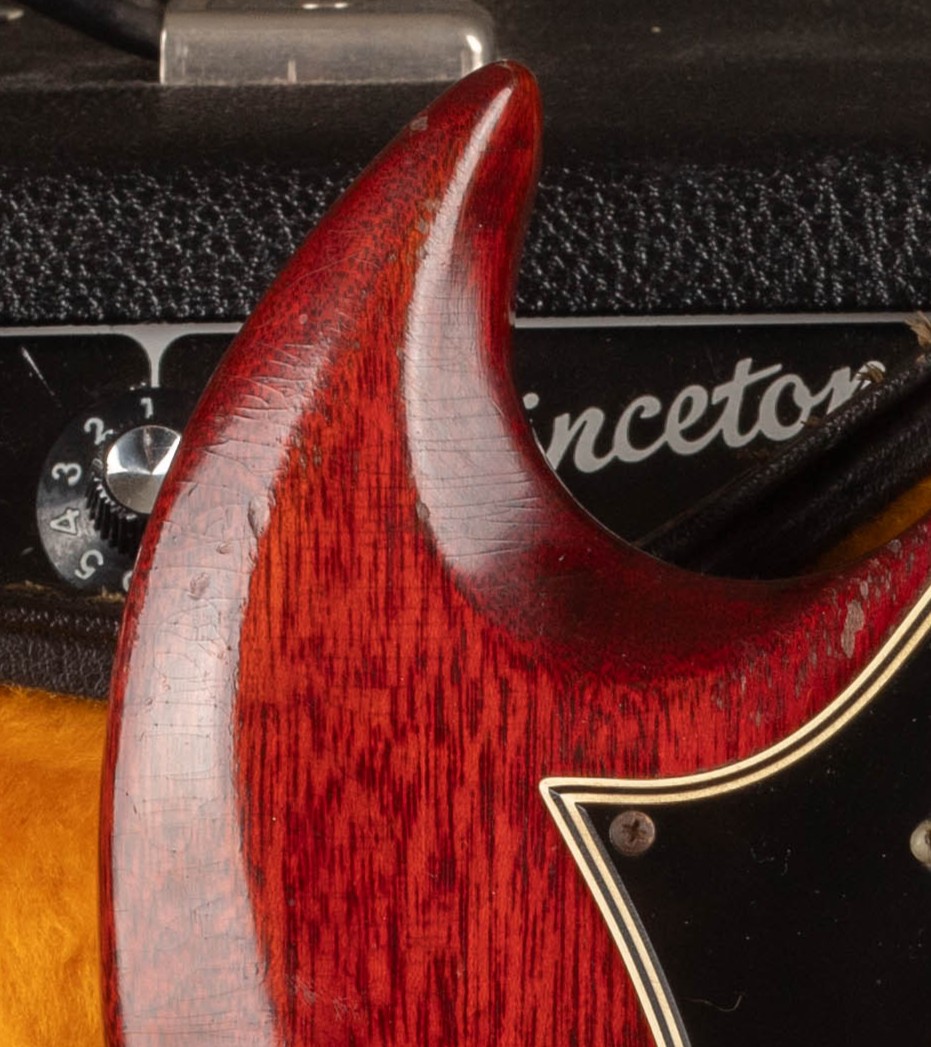
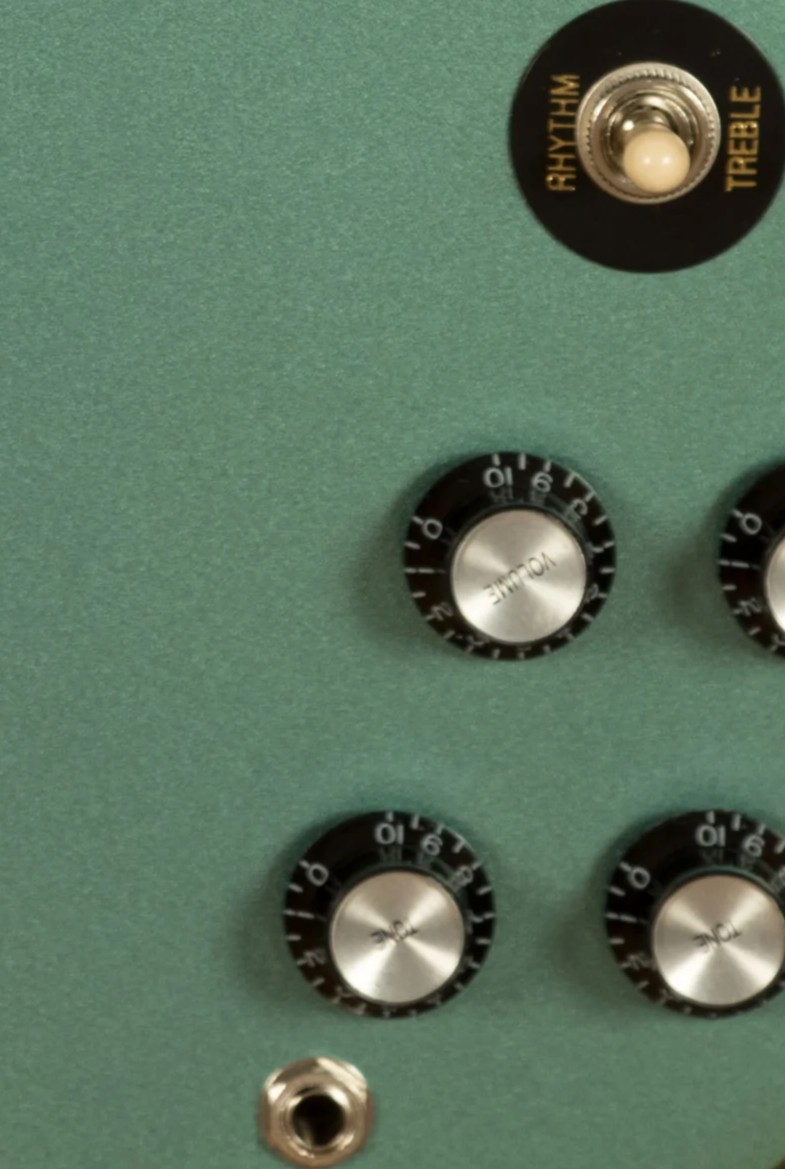
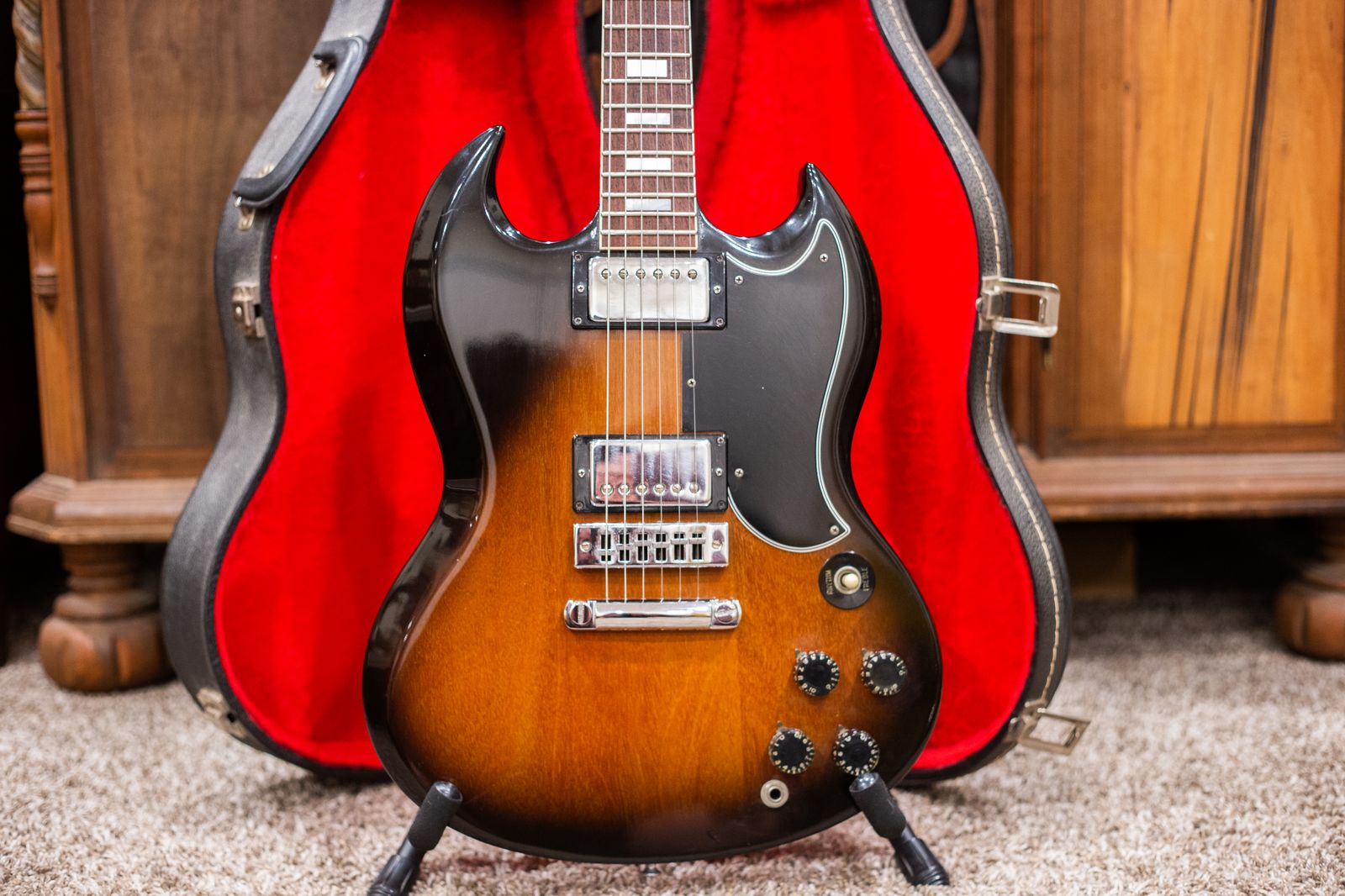
SG Standard — Pickup Timeline
| Pickup | Years | How to Identify |
|---|---|---|
| PAF Humbucker | 1961–1962 | "Patent Applied For" sticker on the base of the pickup. The most desirable and most faked pickup configuration on the SG. See the PAF authentication note in the Les Paul section for full verification details. |
| Patent Number Humbucker | 1962–1965 | "Patent No. 2,737,842" sticker on the base. Visually identical to the PAF. Tonally very similar — considered slightly less desirable by collectors but excellent sounding instruments. |
| T-Top Humbucker | 1965–1975 | Raised "T" molded inside the pickup bobbin. Immediately identifies a mid-1960s to mid-1970s instrument. |
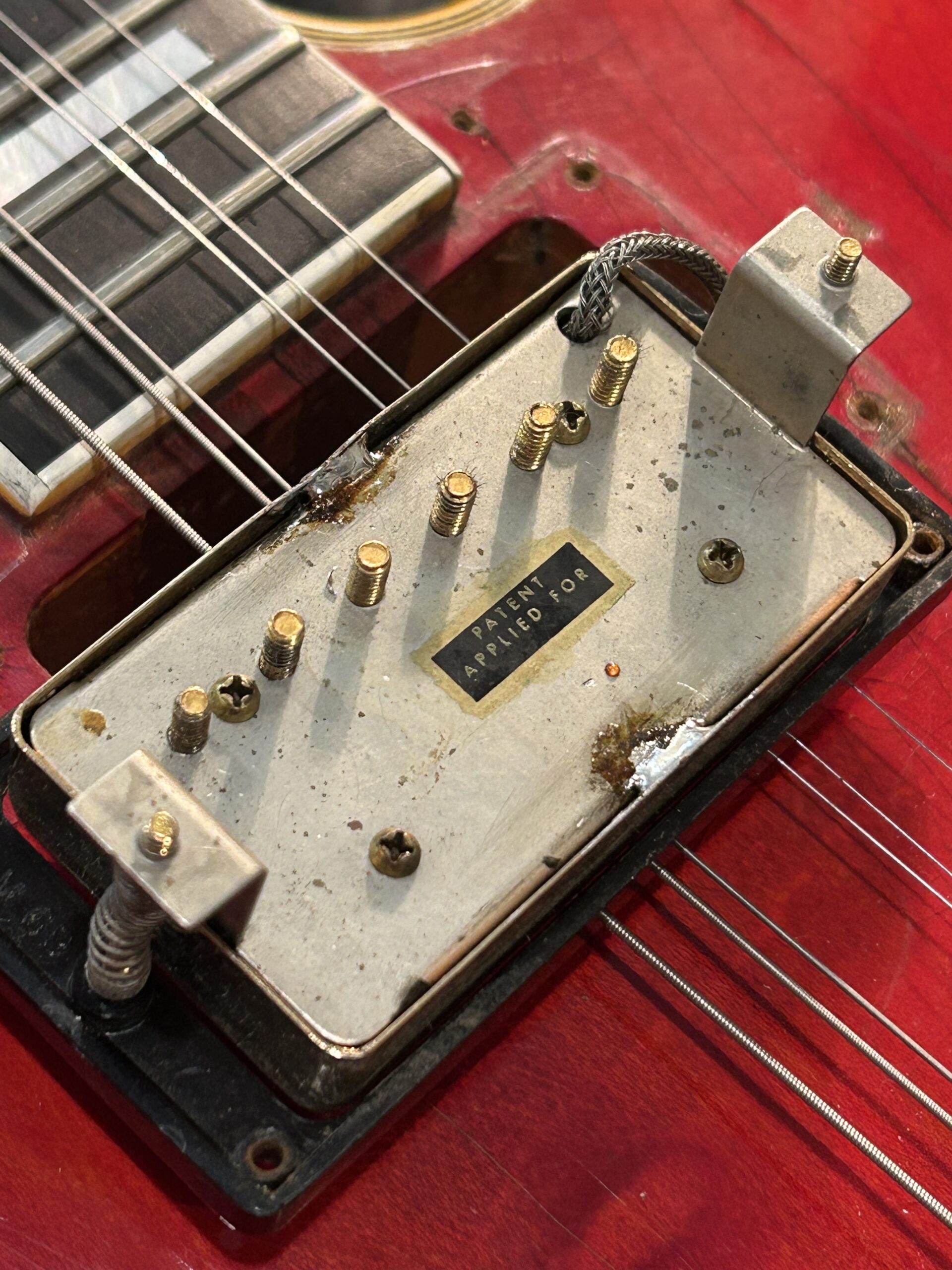
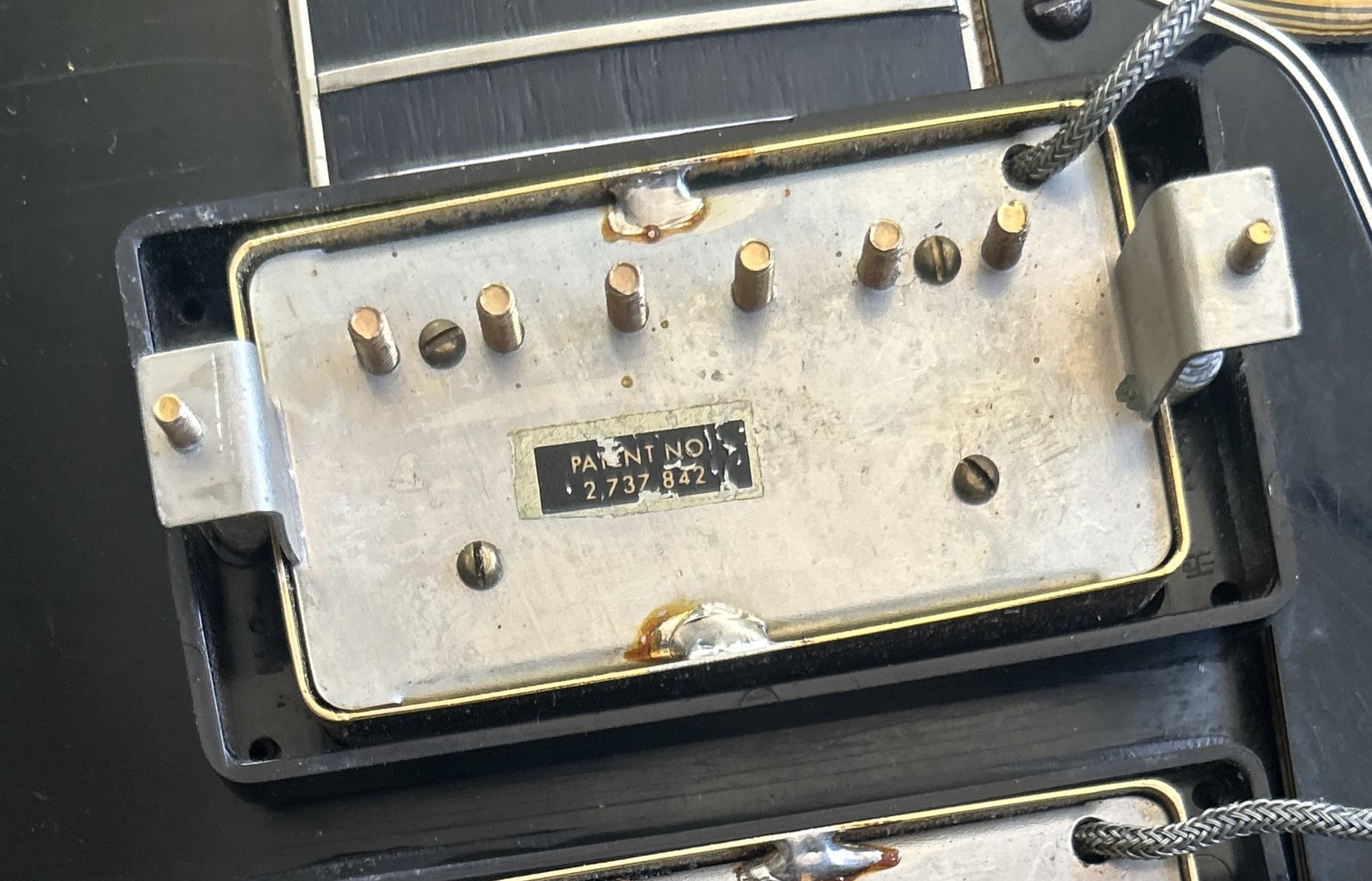
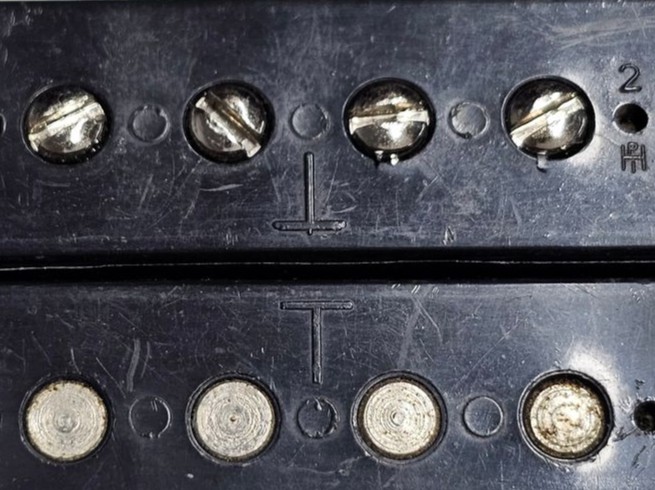
SG Standard — Tailpiece and Hardware Timeline
Gibson experimented with several vibrato tailpiece designs on the SG during the 1960s — partly to compete with the Fender Stratocaster's tremolo system and partly because the SG's thin, lightweight body made it well suited to vibrato use. Each tailpiece design was used in a specific window of years, making the tailpiece one of the most precise and underutilized dating tools on early SGs.
| Tailpiece | Years | Notes |
|---|---|---|
| Sideways vibrola | 1961–1962 | A side-pull vibrato where the arm moves the tailpiece horizontally rather than up and down. Found on the earliest SG-body Les Paul models. Many were replaced — making original examples with the sideways vibrola intact desirable. |
| Stop bar / stud tailpiece | 1961 onward | Simple bar that strings wrap over. The most common SG tailpiece configuration — fitted as standard or in place of the vibrola depending on the order. Present across the entire SG production history. |
| Lyre vibrola | 1963–1966 | A vibrato tailpiece with a large decorative lyre-shaped backplate. One of the most visually striking hardware configurations in the entire Gibson catalog. Highly collectible when original and intact — the ornate lyre plate is frequently damaged or lost. |
| Maestro vibrola (small) | 1963–1966 | A smaller, simpler vibrola found on some SG models as an alternative to the lyre. Less visually distinctive but functionally similar. |
| Bigsby vibrato | 1970s | A flat-top mounted Bigsby vibrato appears on some Norlin-era SGs, either factory fitted or dealer installed. Identifiable by the large spring-loaded arm and the distinctive Bigsby casting. Factory examples will show original screw holes consistent with the finish age — aftermarket installations often show signs of prior hardware or filled holes at the original tailpiece position. |
| TP-6 fine-tuning tailpiece | 1977–1982 | A tailpiece with individual thumbwheel fine-tuners for each string. Easy to identify by the row of small silver adjustment wheels. Its presence immediately places the guitar in the late Norlin period. |
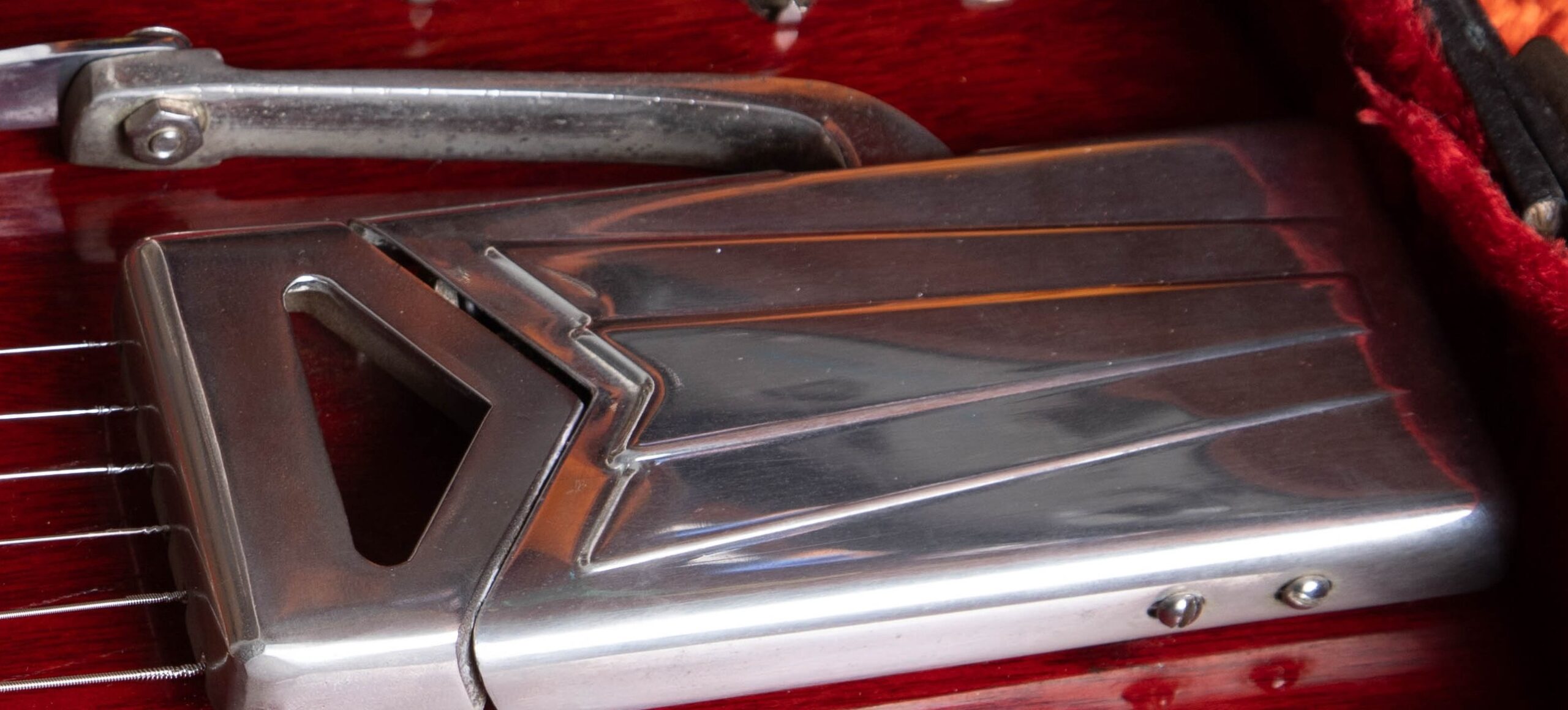
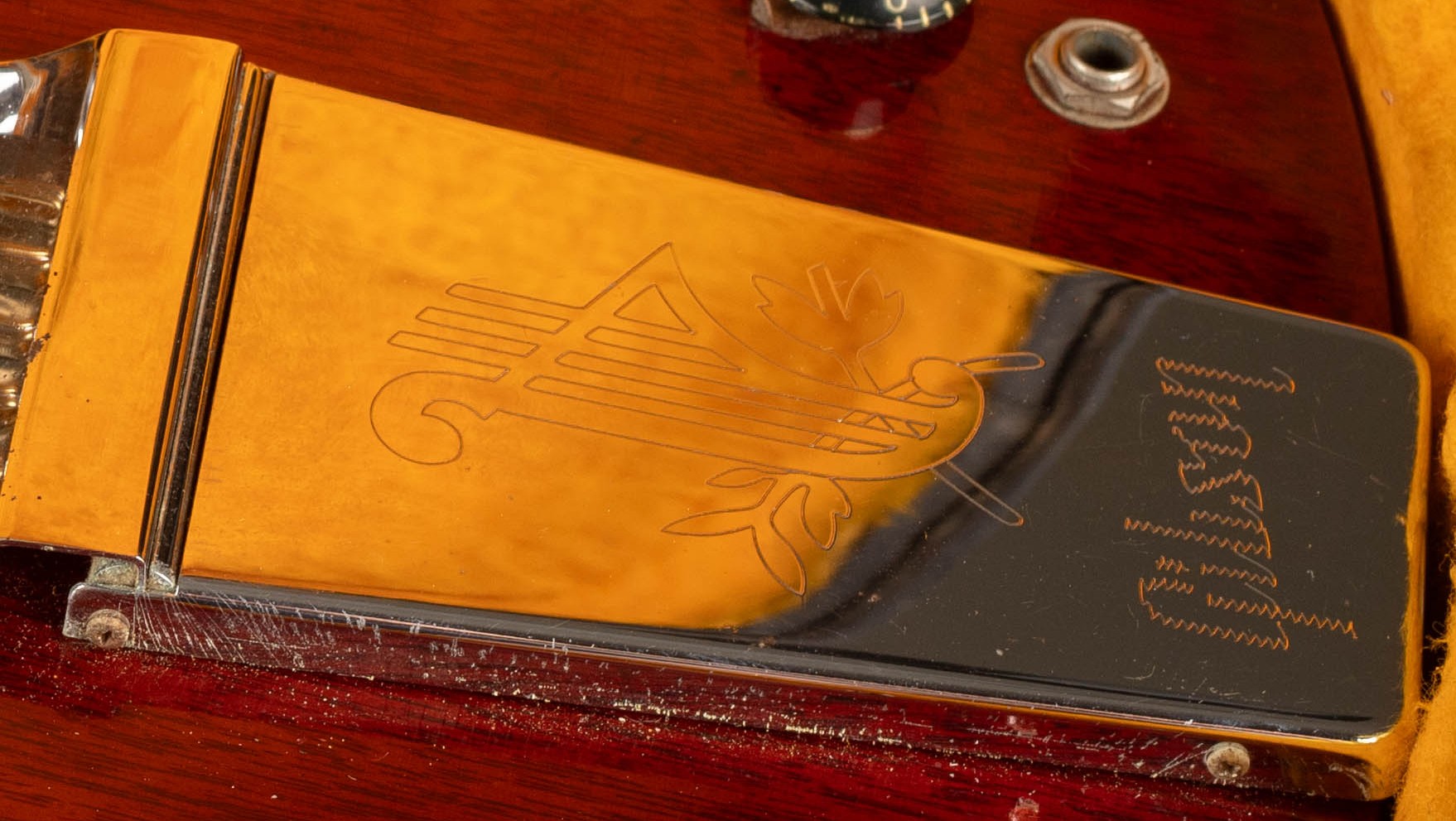
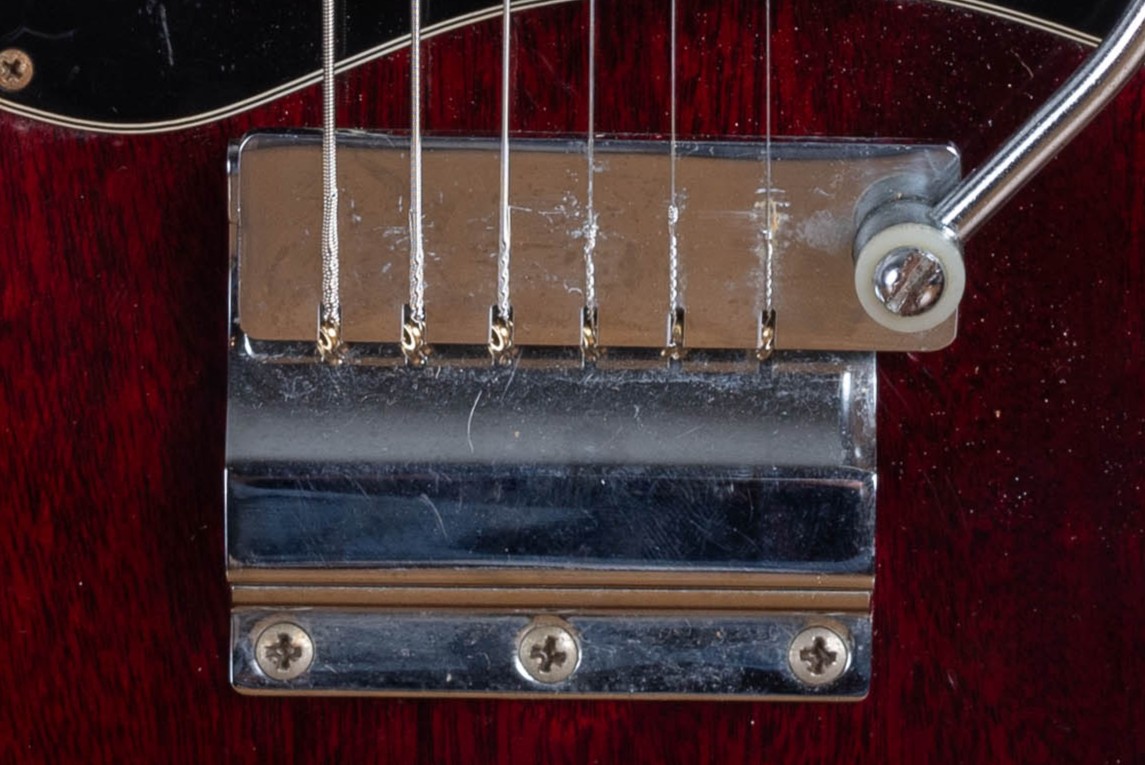
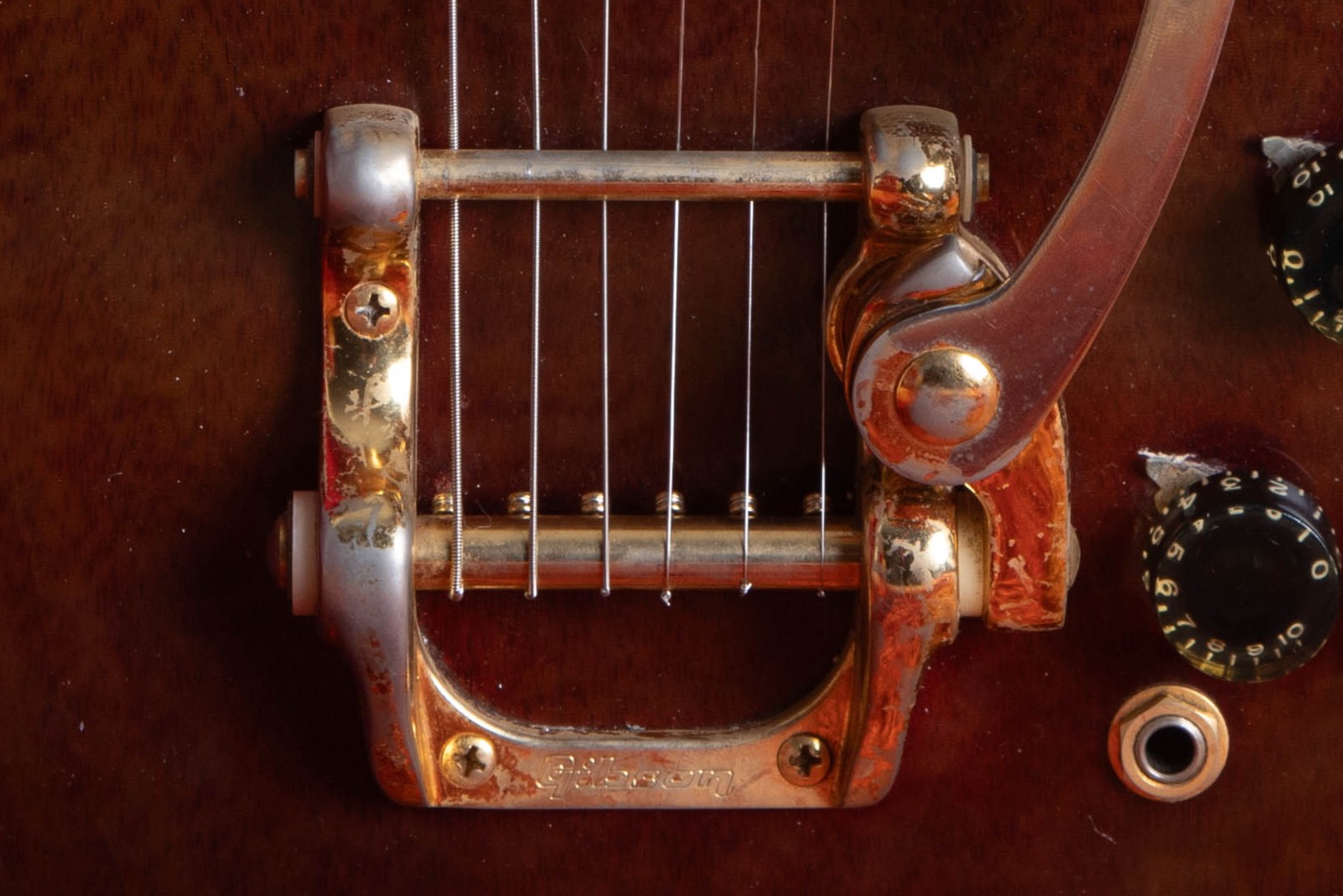
A complete, undamaged original lyre vibrola is one of the rarest intact hardware configurations on a vintage SG. The ornate lyre backplate is fragile and was frequently removed, lost, or broken — many SGs that originally left the factory with a lyre vibrola now have a stop bar in its place. If the original stop bar stud holes have been filled and refinished, or if the body shows signs of prior hardware at the tailpiece position, investigate whether the guitar originally had a lyre vibrola. Restoration to original lyre configuration can significantly affect value.
SG Standard — Neck Profile and Construction
The SG is well known for having some of the thinnest neck profiles Gibson ever produced, particularly on 1961–1963 examples. This characteristic is correct and expected on early instruments — it is a dating confirmation, not a defect. Both the neck profile and the nut width changed meaningfully across the SG's history and together are among the most useful physical dating tools available.
| Neck Construction | Years | Notes |
|---|---|---|
| One-piece mahogany — slimmest profile, 1‑11/16" nut | 1961–1963 | The thinnest SG neck profiles Gibson produced. No glue lines on the back of the neck. Nut width of 1‑11/16" — the wider, more player-friendly dimension. The defining feel of the earliest and most collectible SGs. |
| One-piece mahogany — slightly thicker, 1‑11/16" nut | 1964 | Profile begins to fill out slightly from 1964. Still one-piece mahogany, still the wider 1‑11/16" nut width. No volute. A noticeable but subtle difference from the 1961–1963 examples. |
| One-piece mahogany — thicker profile, 1‑9/16" nut | 1965–1969 | Nut width narrows to 1‑9/16" from 1965 — considered less desirable by most players and collectors. Profile continues to thicken gradually. Still one-piece mahogany, no volute. |
| Three-piece mahogany + volute | 1969–1975 | Norlin transition. Two thin glue lines visible on the back of the neck. Volute present at the headstock joint. 1‑9/16" nut retained. See the volute section above for dating details within this window. |
| Three-piece maple + volute | 1975–1984 | Lighter color than mahogany, two glue lines visible, volute present. Brighter tonal character. Firmly places the instrument in the mid-to-late Norlin period. |
The SG's thin neck and angled headstock joint is one of the most vulnerable points on any Gibson electric. Headstock breaks are extremely common on SGs — far more so than on Les Pauls or ES models — and a significant percentage of SGs on the market have had at least one headstock repair in their lifetime. A well-executed repair by a qualified luthier does not necessarily disqualify an instrument, but it must be disclosed and reflected in the price. Always examine the back of the headstock under a strong light for signs of a prior break — finish checking that radiates from a single point, color mismatches, or visible glue lines in the wood are all indicators. A blacklight will reveal repairs that are invisible in normal light.
Gibson SG Custom
Introduced 1961 (as Les Paul Custom) · Three Humbuckers · Gold Hardware
The SG Custom is the premium version of the SG lineup — the direct continuation of the Les Paul Custom onto the new double-cutaway body. Like its predecessor, the SG Custom is distinguished from the Standard by its multi-ply binding, gold hardware, ebony fingerboard, and — most visually distinctive of all — three humbuckers instead of two. It is one of the most immediately recognizable vintage Gibsons and one of the most consistently collectible SG variants.
The quickest visual checks are the number of pickups and the hardware color. The SG Custom has three pickups and gold hardware. The SG Standard has two pickups and nickel or chrome hardware. The Custom also has more elaborate binding — multiple white and black layers running around the body, neck, and headstock. If your SG has three pickups and gold hardware, you have a Custom.
SG Custom — Key Specifications by Year
For photo examples of PAF, Patent Number, and T-Top humbuckers, see the SG Standard pickup section above — the same pickup types apply to the Custom in the same years.
| Year Range | Pickups | Key Identifying Features |
|---|---|---|
| 1961–1963 | Three PAF humbuckers | Les Paul Custom name on headstock. Thinnest body construction. One-piece mahogany neck. Gold Kluson waffle-back tuners. Multi-ply binding. Ebony finish standard. Most collectible era. |
| 1963–1965 | Three Patent Number humbuckers | SG Custom name established. Same construction as transitional era. Still one-piece mahogany neck, no volute, gold hardware throughout. |
| 1966–1969 | Three Patent Number or T-Top humbuckers | Gold Grover Rotomatic tuners replace Klusons on many examples. Profile thickening. One-piece mahogany neck still present. 1‑9/16" nut from 1965. |
| 1969–1975 | T-Top humbuckers | Norlin transition. Three-piece mahogany neck. Volute present. Gold hardware retained on Custom. Walnut and Ebony finishes available alongside White. |
| 1975–1980 | T-Top or later humbuckers | Three-piece maple neck on some examples. Volute. TP-6 tailpiece appears 1977. Increasingly inconsistent quality control. |
White is one of the most recognizable SG Custom finishes and is seen more commonly on the Custom than on any other SG model. It was available from the mid-1960s onward and is the finish most associated with the model in popular culture. A White SG Custom does not narrow the date as precisely as other features — use the pickup type, tuner style, neck construction, and volute to pin down the year.
The SG Custom transitioned from gold Kluson waffle-back tuners to gold Grover Rotomatic tuners during the mid-1960s — generally around 1966 on most examples. Klusons point to an earlier instrument; Grovers suggest 1966 or later. This is a useful secondary dating detail when the serial number is inconclusive. Always verify tuner originality — tuners are among the most commonly replaced hardware on vintage instruments.
Gibson SG Special
Introduced 1961 (as Les Paul Special) · Two P-90s · TV Yellow, Cherry, and White
The SG Special is the direct continuation of the Les Paul Special onto the SG body — a mid-range instrument with two P-90 soapbar pickups and simpler appointments than the Standard or Custom. It carried the Les Paul Special name through the transitional period before becoming the SG Special in 1963. Among players the SG Special is prized for exactly the same reason as the Les Paul Special — the raw, direct tone of two P-90s through a simple circuit is one of the most expressive sounds Gibson ever produced, and the lightweight SG body gives it a feel and balance that many players find exceptional.
SG Special — Finish and Color Timeline
| Finish | Years | Notes |
|---|---|---|
| TV Yellow | 1961–1963 | Carried over from the Les Paul Special. Increasingly rare in original unrestored condition. Highly desirable among collectors — see the TV Yellow aging note in the Les Paul Special section above. |
| Cherry | 1961 onward | Available from the beginning of the SG Special's production. The most common SG Special finish from 1963 onward. |
| White | 1963 onward | White is seen more commonly on SG models than on the earlier single or double-cutaway Les Paul Specials. A white SG Special is a legitimate factory finish and a collectible configuration, particularly on earlier examples. |
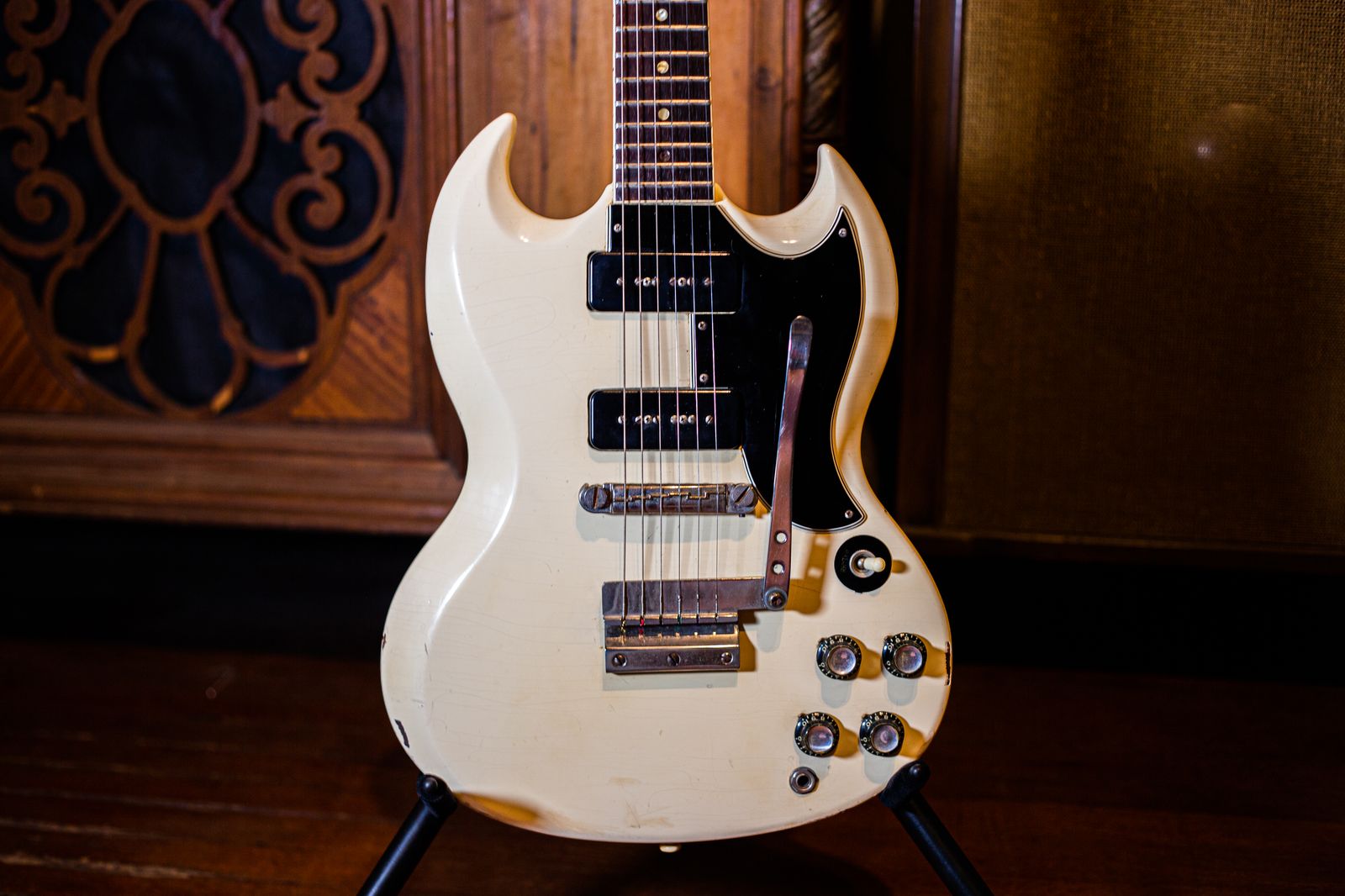
SG Special — Pickup Configuration
The SG Special retained P-90 soapbar pickups throughout the 1960s — one of the few Gibson models to do so after the widespread adoption of humbuckers. The pickup type is therefore a quick and reliable dating tool on the Special.
| Pickup | Years | Notes |
|---|---|---|
| P-90 soapbar (two) | 1961–1971 | The defining pickup configuration of the SG Special. Black or cream rectangular plastic covers. Two pickups — neck and bridge. If your SG Special has P-90s, it was almost certainly made before 1971. |
| Mini-humbuckers | Some early 1970s examples | A small number of SG Specials from the early Norlin period were fitted with mini-humbuckers. Narrower and smaller than standard humbuckers — identifiable by their slimmer profile. Covers are typically chrome but black-covered examples exist. If your Special has mini-humbuckers it dates to the early 1970s. |
| Full-size humbuckers | 1971 onward | Gibson transitioned the SG Special from P-90s to full-size humbuckers around 1971. A Special with full-size humbuckers was made during the Norlin period. |
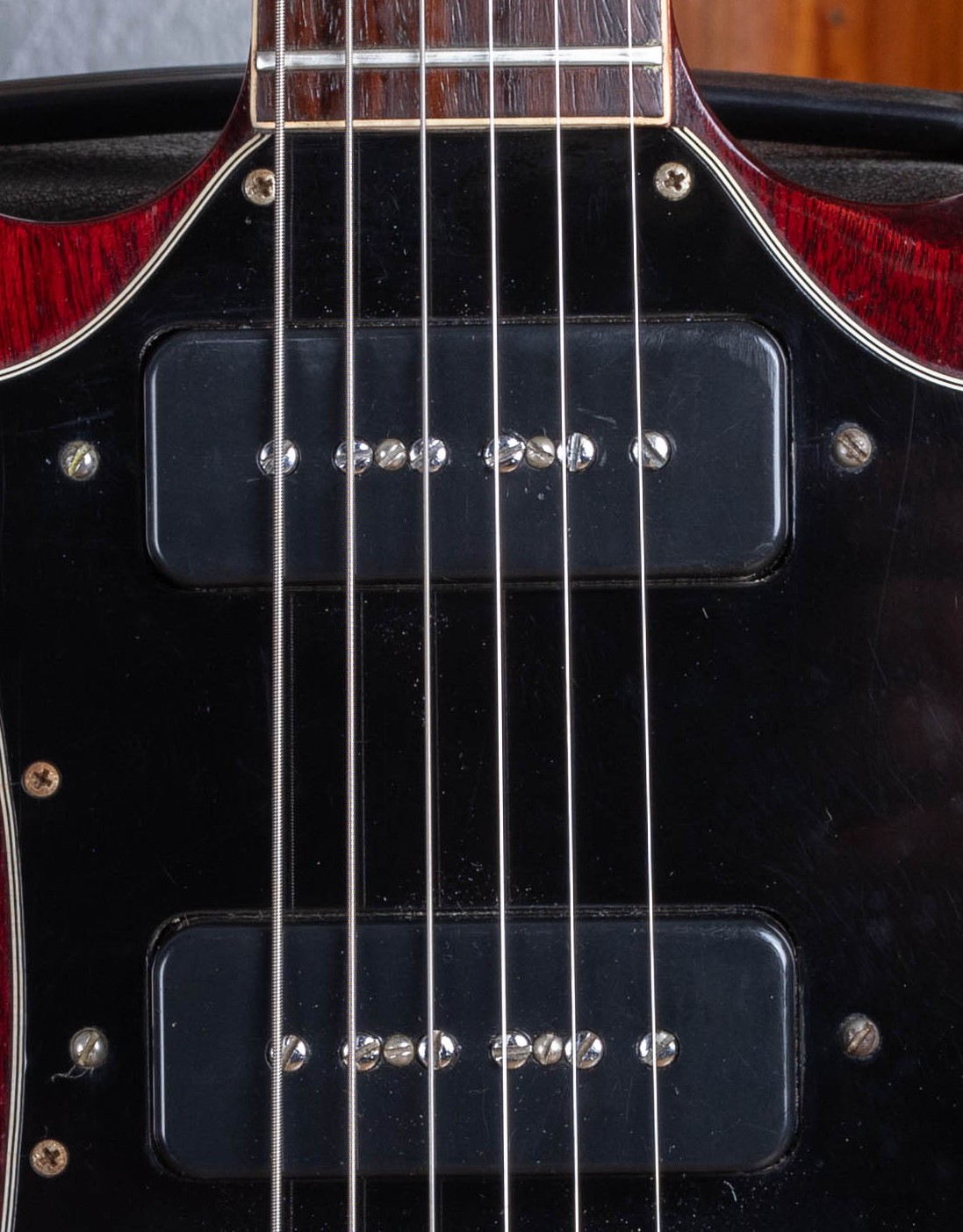
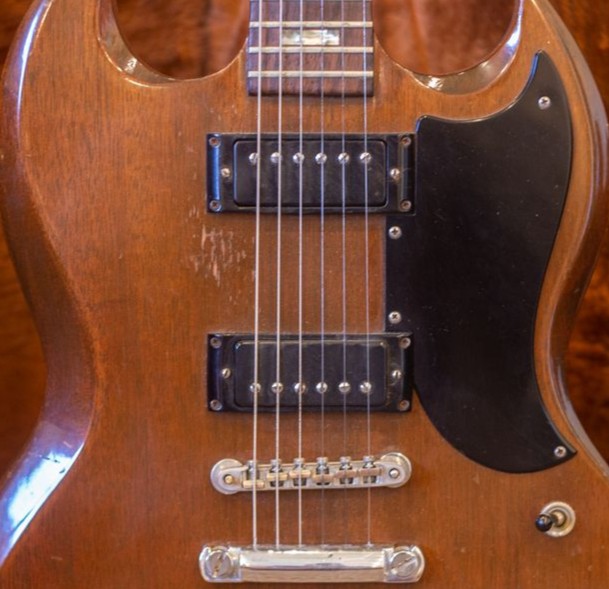
TV Yellow on an SG-body Special is one of the rarer finish configurations in the entire Les Paul and SG family. The finish was carried over from the Les Paul Special but was phased out relatively quickly after the transition to the SG body — most SG Specials from 1963 onward are Cherry or White. An SG-body Special in original TV Yellow is a genuinely uncommon find.
The SG Special and SG Standard look similar at a glance. The key differences are the pickups and the binding. The Special has P-90 soapbar pickups (large rectangular plastic covers with no visible pole screws) and minimal or no body binding. The Standard has humbucker pickups (narrower covers with visible pole screws) and single-ply body binding. If your SG has large rectangular plastic-covered pickups, it is a Special.
Gibson SG Junior
Introduced 1961 (as Les Paul Junior) · Single Dog-Ear P-90 · Cherry and White
The SG Junior is the continuation of the Les Paul Junior on the SG body — the stripped-down, no-frills entry point into the SG lineup. One P-90 pickup at the bridge, a wrap-over tailpiece, no binding, no inlays beyond dot markers, and a plain Cherry finish. The Junior uses a dog-ear P-90 — named for the small mounting tabs that extend from each side of the pickup cover like ears — rather than the soapbar P-90 found on the Special. Like the Les Paul Junior before it, the SG Junior's simplicity is its selling point — the single P-90 through a minimal circuit produces a direct, aggressive tone that has made these instruments highly sought after by players for decades. Clean original examples are increasingly difficult to find and increasingly valuable as a result.
The SG Junior is the simplest guitar in the SG lineup. It has one pickup (at the bridge position only), no binding around the body or neck, dot fret markers rather than blocks or trapezoids, and a plain Cherry or White finish. The single pickup has small mounting tabs extending from each side — this is the dog-ear P-90. If your SG has one pickup with no binding anywhere on the guitar, it is almost certainly a Junior.
SG Junior — Key Specifications and Changes Over Time
| Year Range | Pickup | Key Features |
|---|---|---|
| 1961–1963 | Single dog-ear P-90 | Les Paul Junior name. Thinnest body. Wrap-over bridge/tailpiece. Cherry finish standard. One-piece mahogany neck. No binding, dot inlays. Most collectible era. |
| 1963–1965 | Single dog-ear P-90 | SG Junior name established. Same construction. Some examples fitted with a small vibrato tailpiece rather than the wrap-over. Cherry standard. |
| 1966–1969 | Single dog-ear P-90 | Profile thickening on neck. White finish appears alongside Cherry. One-piece mahogany neck still present. No volute. |
| 1969–1971 | Single dog-ear P-90 | Early Norlin. Three-piece mahogany neck. Volute introduced. SG Junior discontinued around 1971. |
The SG Junior used a simple stud wrap-over bridge throughout its production — the same design used on the earlier double-cutaway Les Paul Junior. This is a consistent feature across all years of the model and confirms the Junior configuration when combined with the single dog-ear P-90 and absence of binding. A Junior with an ABR-1 Tune-O-Matic bridge has either had its bridge replaced or is not a Junior.
SG Juniors, like Les Paul Juniors, were entry-level guitars that were played hard. Missing or replaced pickguards, replaced pickup covers, and stripped tuner buttons are extremely common. The original pickguard on a 1961–1966 SG Junior is a multi-ply black and white piece that wraps around both the pickup and the control area — it is large, distinctive, and frequently cracked or replaced. A Junior with its original intact pickguard in good condition is notably more desirable than one with a replacement.
Not sure what year your SG is? Send Joe a text or email with photos of the headstock, pickups, serial number, and full body — he'll give you a free assessment and let you know exactly what you have.
Get a Free AssessmentGibson ES-335 Family — Dating by Model and Features
Covers: ES-335 · ES-345 · ES-355 · ES-330
Introduced in 1958, the ES-335 was unlike anything Gibson had built before. By routing out two f-holes and gluing a solid maple center block through the middle of an otherwise hollow thinline body, Gibson created a guitar that combined the warm resonance of a hollow body archtop with the feedback resistance and sustain of a solidbody. It was a genuine engineering breakthrough, and the thinline semi-hollow format it established has never gone out of production. The earliest examples — built in 1958 and 1959 — are among the most collectible and most valuable vintage guitars in existence. Learning to date them accurately requires attention to a specific set of physical features that changed in distinct, documented windows across the instrument's history.
Gibson built four distinct models on the thinline semi-hollow platform introduced in 1958. The ES-335 is the base model — two humbuckers, dot or block inlays, no Varitone, cherry or sunburst finish. The ES-345 is the mid-tier — adds the Varitone circuit and stereo wiring, gold hardware, and block inlays. The ES-355 is the top of the line — the most binding, the most hardware options, mono or stereo, frequently fitted with a Bigsby or sideways vibrola. The ES-330 looks similar from a distance but is fundamentally different — it is fully hollow with no center block, uses P-90 pickups instead of humbuckers, and has a neck joint at the 16th fret rather than the 19th. Understanding which model you have is the essential first step before attempting to date it.
Gibson ES-335
Introduced 1958 · Semi-Hollow · Two Humbuckers · Dot then Block Inlays
The ES-335 is the model that defined the semi-hollow electric guitar category and remains one of the most important and widely played vintage Gibsons. Its production history spans from 1958 to the present, and the physical features of the instrument changed significantly across that span. The 1958–1964 dot-neck examples are the most collectible. The 1965–1969 block-neck examples are highly sought after as players. Norlin-era instruments are valued primarily for use rather than collection. Dating any ES-335 accurately requires looking at the cutaway shape, the inlays, the finish, the hardware, and the internal construction — not just the serial number.
The Cutaway Shape — The Single Most Important Visual Dating Tool
The shape of the upper bout cutaways on the ES-335 changed in a specific and visually identifiable way in 1962, and that change is one of the most reliable single dating indicators on the entire instrument. Learning to recognize it eliminates a large window of uncertainty before you ever look at a serial number.
On guitars built from 1958 through 1961, the upper cutaway horns are rounded and full — they curve generously into the body with a soft, almost symmetrical shape. The tips of the horns are blunt and wide. This is commonly called the "Mickey Mouse ear" shape by collectors, and once you see it, you will recognize it immediately. On guitars built from 1962 onward, the upper cutaway horns are sharper and more pointed — the tips narrow and the overall shape has a more angular, aggressive profile. The transition happened around 1962 and is consistent enough to be used as a primary dating reference.
If the upper cutaway horns on your ES-335 are full, rounded, and blunt at the tips — what collectors call "Mickey Mouse ears" — the guitar was almost certainly built before 1962. This single feature, combined with dot inlays, puts the instrument firmly in the 1958–1961 window and into the most collectible tier of the ES-335 family. Sharp, pointed horns indicate 1962 or later.
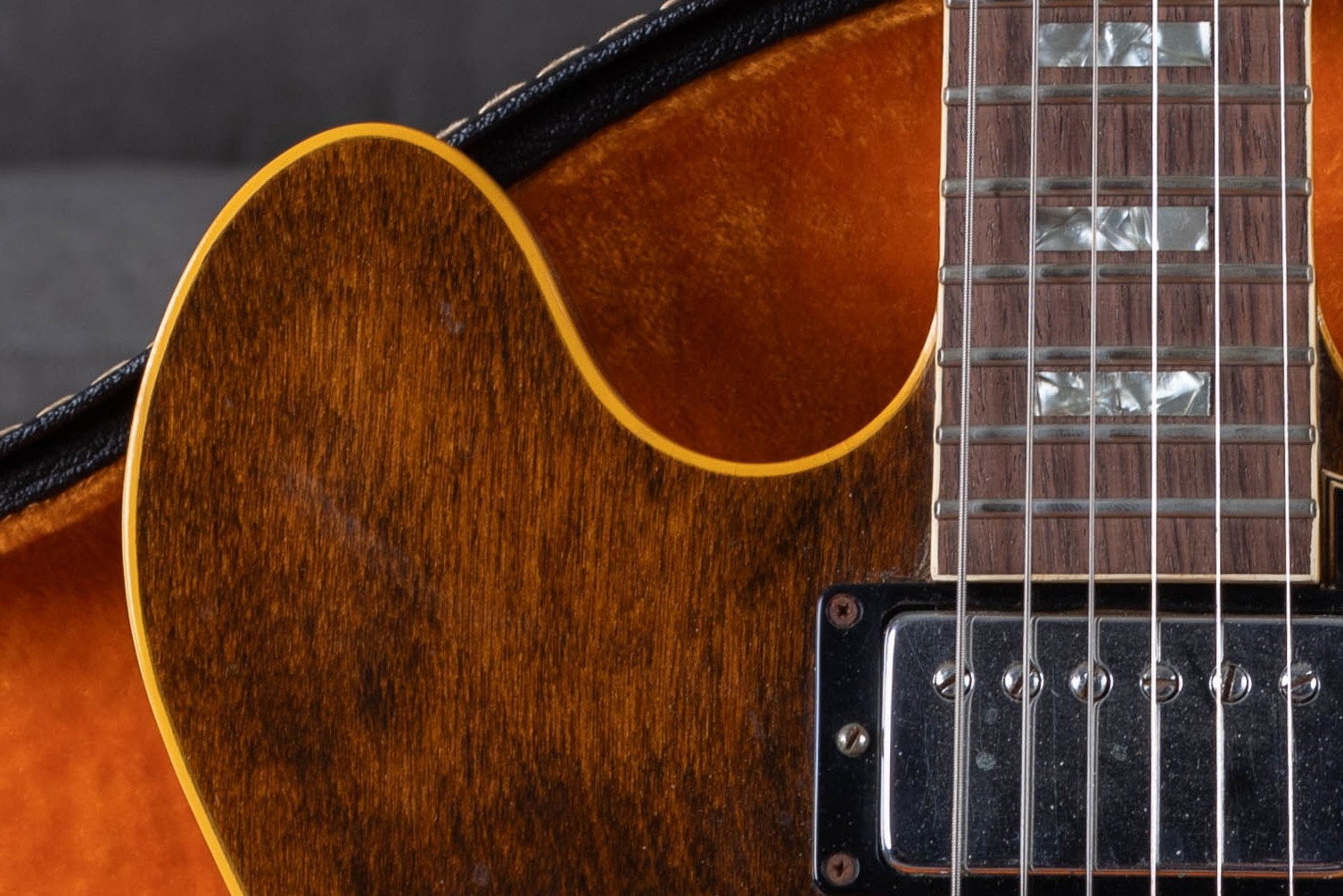
Dot Inlays vs. Block Inlays — The Other Key Visual Marker
The ES-335 was introduced with small round dot inlays on the fingerboard. In late 1962, Gibson switched to larger rectangular block inlays. This change — combined with the cutaway shape change that happened around the same time — creates a clear visual division between the earliest and most collectible ES-335s and the later production instruments.
Dot inlays (1958–1962): Small circular position markers. Simple, understated, and to many players and collectors the more elegant of the two configurations. A 335 with dot inlays and rounded horns is a pre-1962 instrument and represents the top tier of ES-335 collectibility.
Block inlays (late 1962 onward): Large rectangular markers that fill more of the fingerboard width. More visually prominent. Block-neck 335s from 1963–1969 are excellent instruments — slightly less collectible than the dot-necks but highly regarded as players and increasingly valuable in the current market.
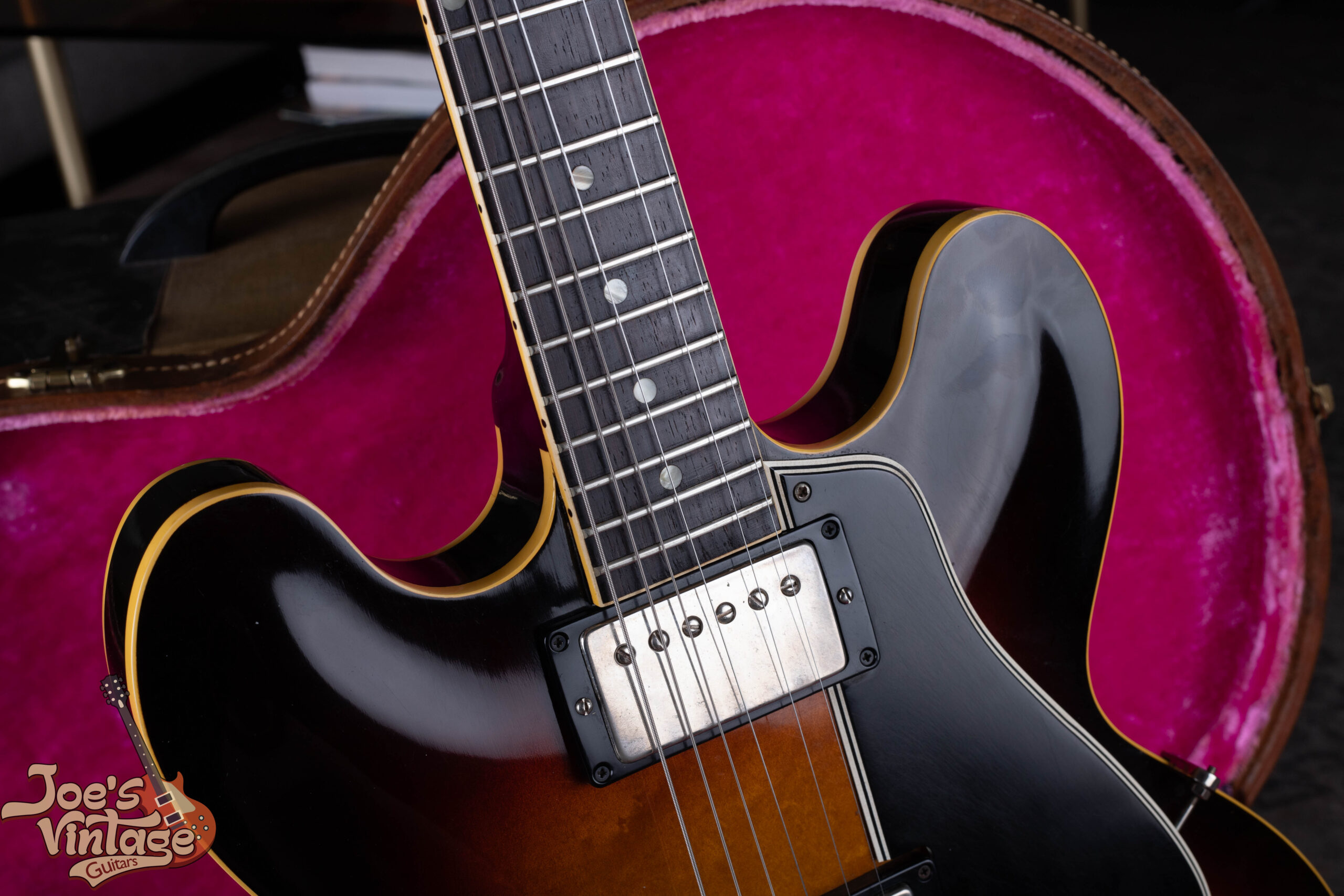
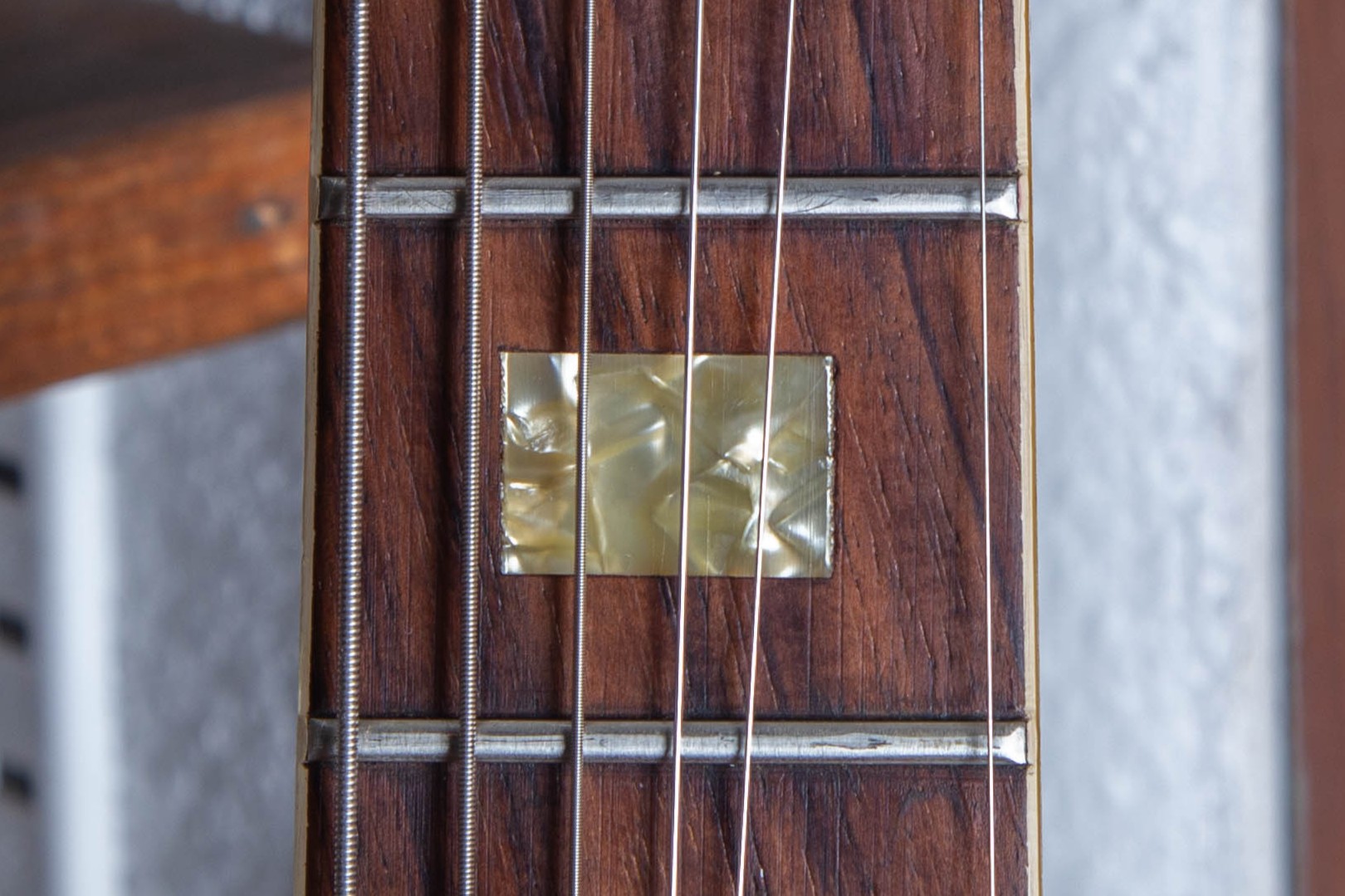
Because dot-neck ES-335s command a significant premium over block-neck examples, the vintage market has seen cases where block-neck fingerboards are replaced with dot-inlay boards to simulate an earlier instrument. If you are buying a dot-neck 335 at dot-neck prices, verify that the neck and fingerboard are original to the guitar. Signs of a neck reset or fingerboard replacement — binding inconsistencies, finish overspray at the neck joint, mismatched fret wire, or a finish line at the fingerboard edge that does not match the body — all warrant closer inspection or professional authentication.
The cutaway shape and inlay changes both happened during 1962 but not simultaneously or overnight — Gibson was building guitars on an assembly line, and transitions between specifications happened gradually as old parts were used up and new ones introduced. This means that some 1962 ES-335s exist with rounded horns and block inlays, or with pointed horns and dot inlays. These transitional instruments are fascinating to collectors and are not anomalies — they are simply mid-transition production examples. A 1962 serial number paired with unusual feature combinations is more likely to be a genuine transitional example than a modified instrument.
ES-335 — Finish and Color Timeline
| Finish | Years | Notes |
|---|---|---|
| Sunburst | 1958 onward | A warm tobacco or cherry sunburst shading from dark edges to a honey or amber center over the maple top. The original and most common finish throughout the 335's history. Present across all eras — does not narrow the date on its own. |
| Natural | 1958 onward | A fully transparent finish showing the bare maple top with no shading. Less common than sunburst. Natural finish 335s from the dot-neck era are particularly collectible. |
| Cherry | 1960 onward | A transparent red finish over the maple top. Introduced in 1960 and quickly became one of the most popular 335 configurations. Cherry dot-necks from 1960–1962 are among the most sought-after examples in the family. |
| Walnut | 1969 onward | A dark brown transparent finish introduced in the Norlin period. Its presence immediately rules out a pre-1969 production date. |
| Ebony (black) | Some 1970s examples | Seen on some Norlin-era instruments. Not a common ES-335 finish. Firmly places the instrument in the 1970s. |
ES-335 — Pickup Timeline
| Pickup | Years | Notes |
|---|---|---|
| PAF Humbucker | 1958–1962 | "Patent Applied For" sticker on the base. The most desirable and most faked pickup in the vintage market. Aligns with the dot-neck era on the 335. All confirmed PAF examples should be carefully authenticated — see the PAF authentication notes in the Les Paul section above. |
| Patent Number Humbucker | 1962–1965 | "Patent No. 2,737,842" sticker. Visually and tonally nearly identical to the PAF. Overlaps with the transition from dot to block inlays. An excellent pickup on an excellent guitar. |
| T-Top Humbucker | 1965–mid-1970s | Raised "T" molded inside the bobbin. Identifies the mid-1960s through mid-1970s production window. Tonally somewhat different from the PAF and Patent Number — still a very capable humbucker. |
For photo examples of PAF, Patent Number, and T-Top humbuckers, see the Gibson SG Standard pickup section or the Les Paul Standard pickup section earlier on this page — the same pickup types appear on the ES-335 in the same years.
ES-335 — Tailpiece and Hardware Timeline
| Tailpiece / Bridge | Years | Notes |
|---|---|---|
| ABR-1 Tune-O-Matic + stop bar | 1958 onward | The standard bridge and tailpiece configuration throughout the vintage ES-335 era. Early ABR-1 bridges (pre-1965) have no retaining wire holding the saddles in place — a small but useful detail. Later examples have a thin wire threaded through the saddle slots. Nashville bridge replaces the ABR-1 in the Norlin period. |
| Bigsby vibrato | Factory option throughout | Available as a factory option across the entire production history. A factory Bigsby will show original finish under the mounting plate and consistent hardware aging. Aftermarket Bigsys are very common on 335s — look for filled or refinished holes at the original stop bar stud positions if a Bigsby is present. On factory Bigsby ES models from approximately the early 1960s through the 1970s, Gibson fitted a stamped metal "Custom Made" plaque to cover the two stop bar stud holes that were drilled before the Bigsby option was selected. This plaque sits between the Bigsby unit and the bridge and is a known factory-correct detail — its presence on a Bigsby ES model is a sign of an original factory Bigsby installation rather than an aftermarket conversion. A missing plaque on a claimed factory Bigsby guitar, or stud holes that appear filled and refinished rather than covered, is worth investigating. |
| Trapeze tailpiece | 1965+ | Beginning in 1965, Gibson switched to a trapeze tailpiece, doing away with the stoptail. |
| Nashville bridge | 1970s onward | A larger, heavier Tune-O-Matic design with wider string spacing than the ABR-1. Immediately identifies a Norlin-era or later instrument. The mounting posts fit directly into the wood without thumbwheel anchors, unlike the ABR-1. |
| TP-6 fine-tuning tailpiece | 1977–1982 | Individual thumbwheel fine-tuners for each string. Its presence firmly places the instrument in the late Norlin period. |
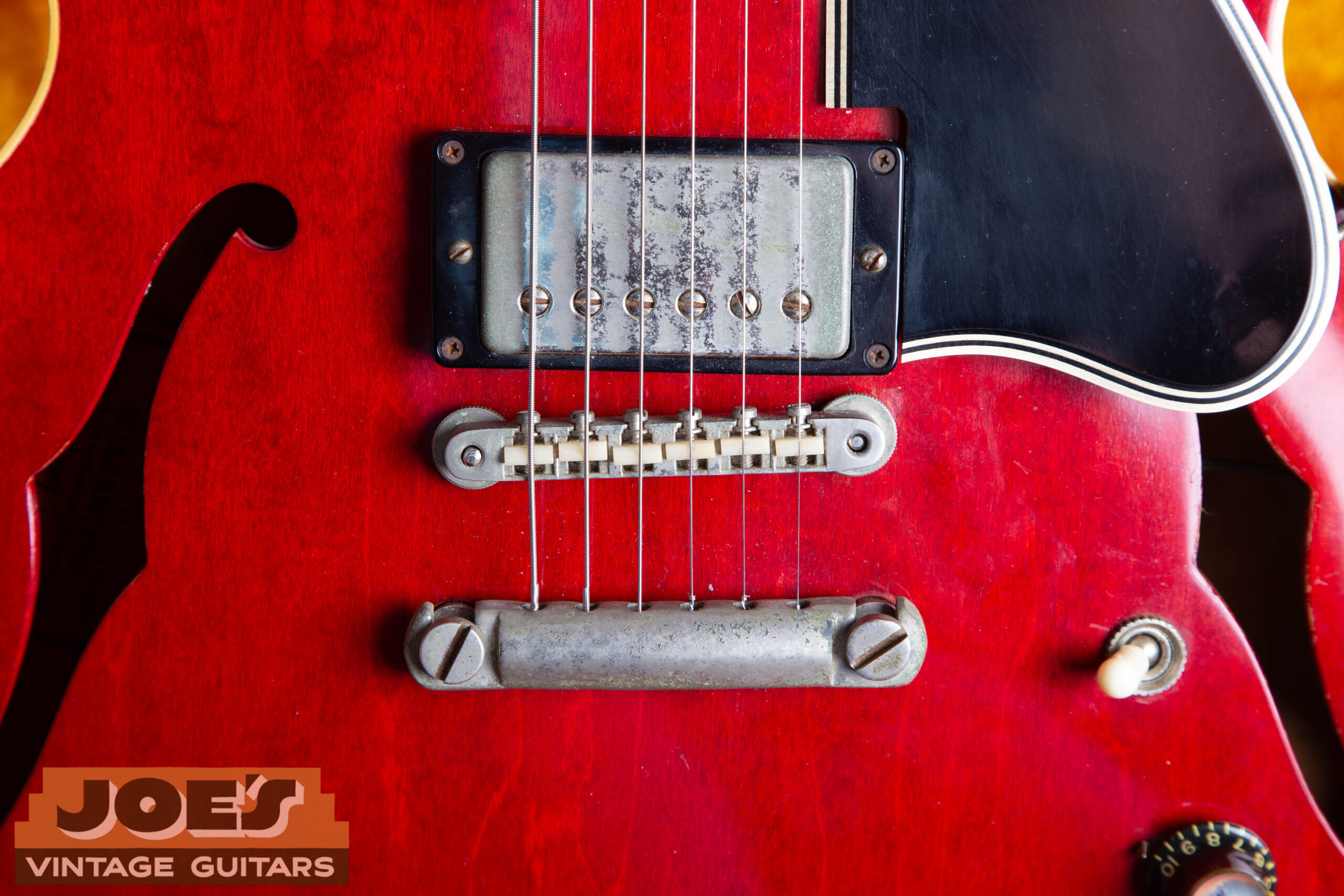
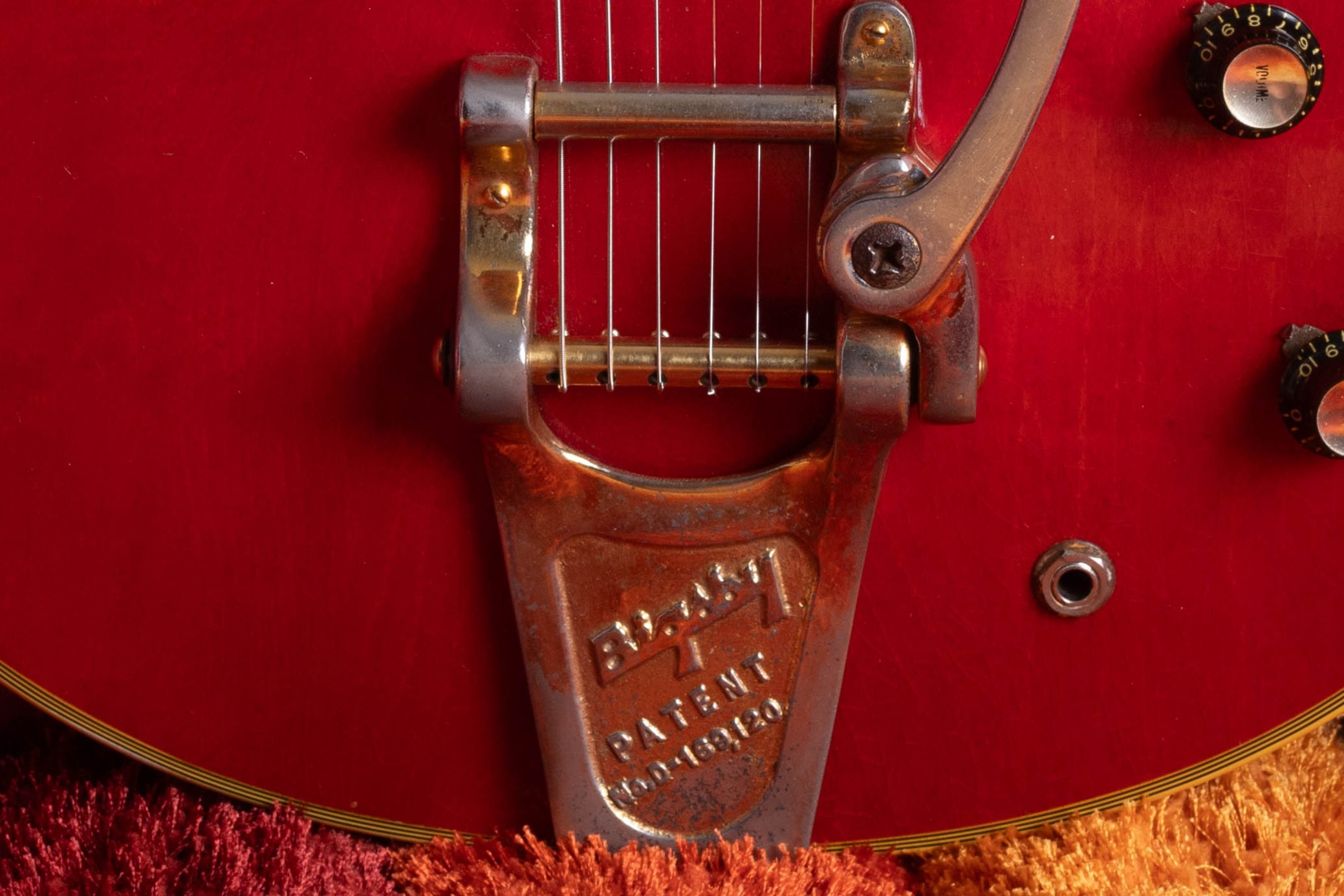
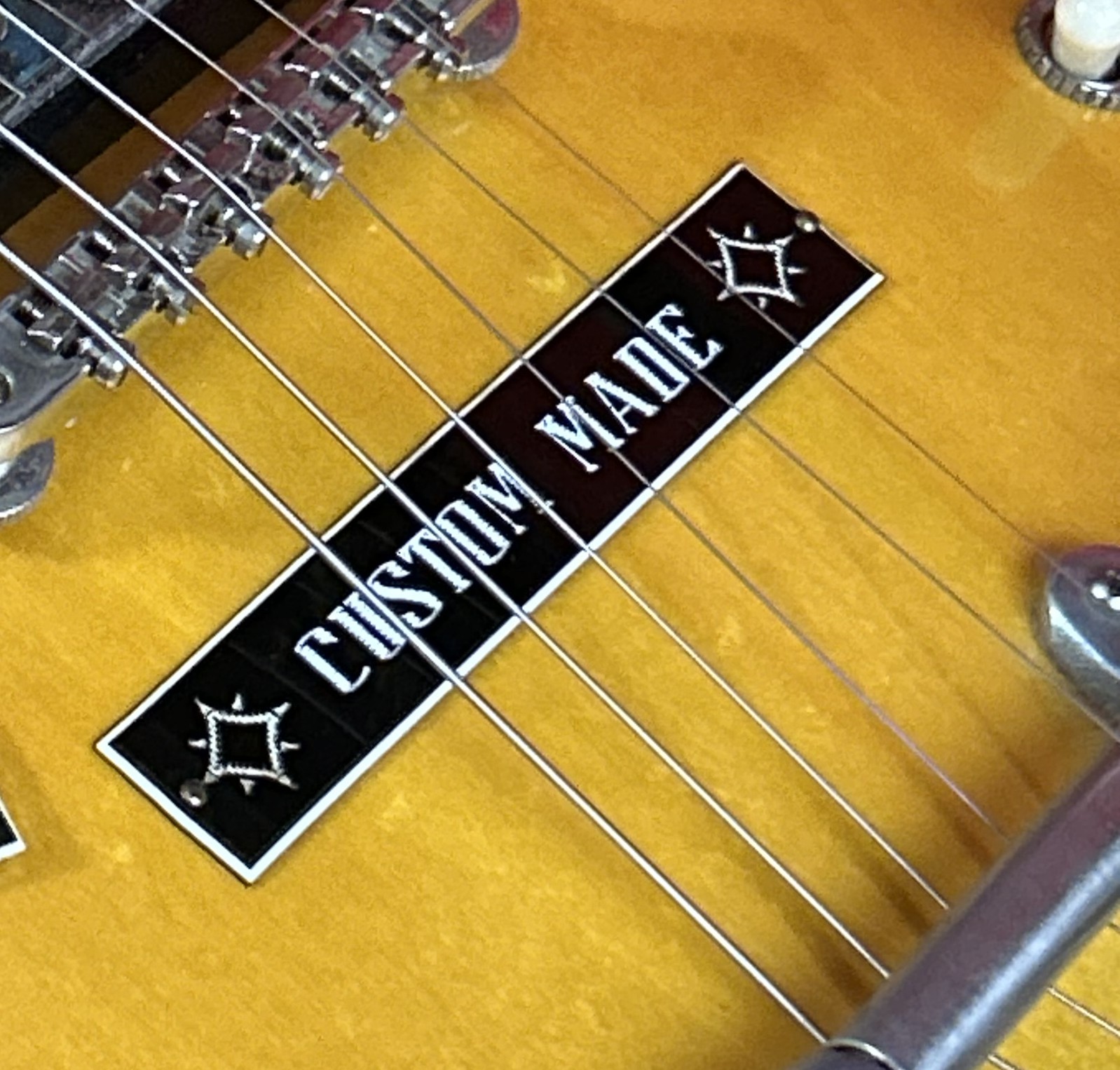
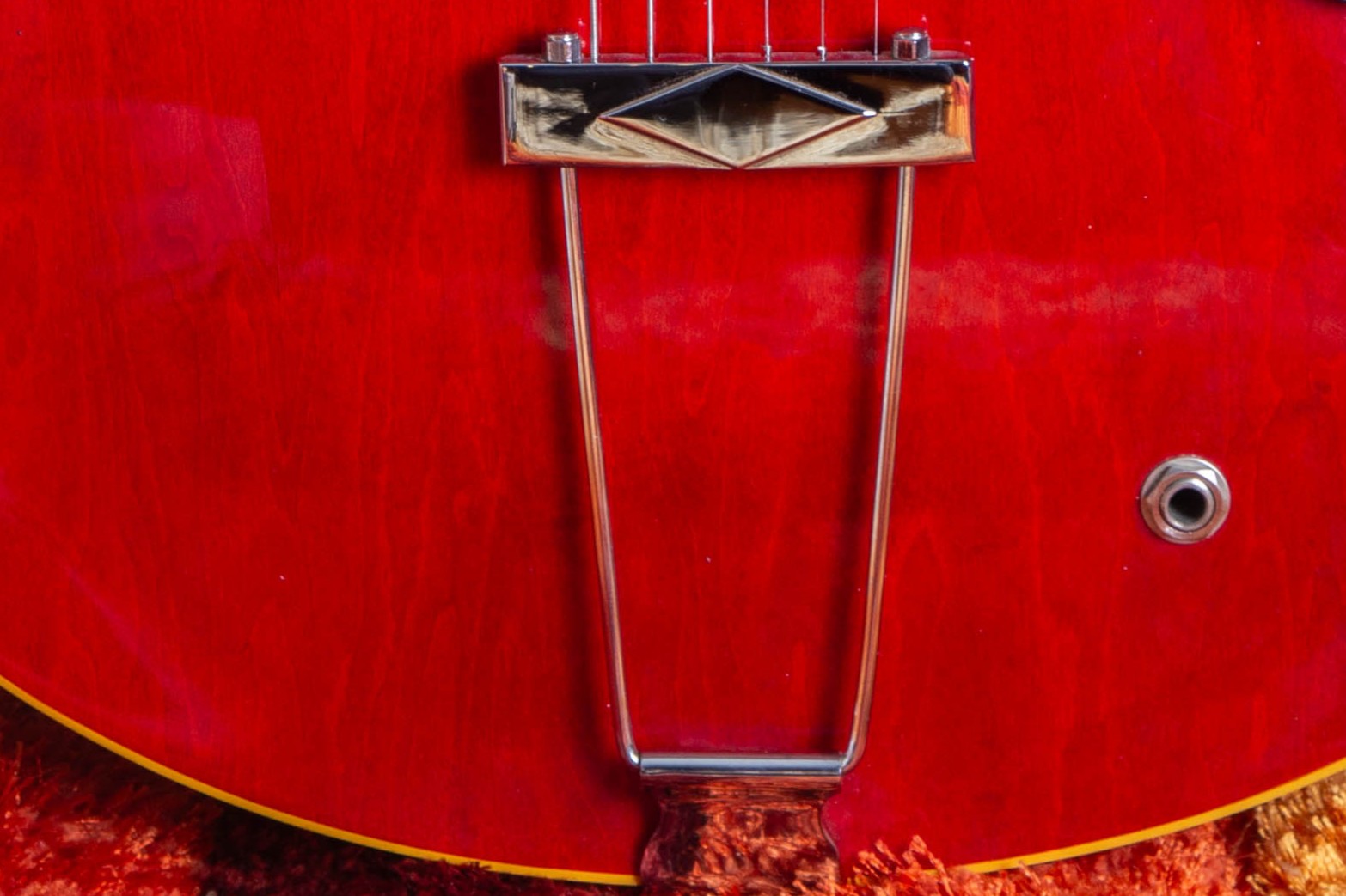
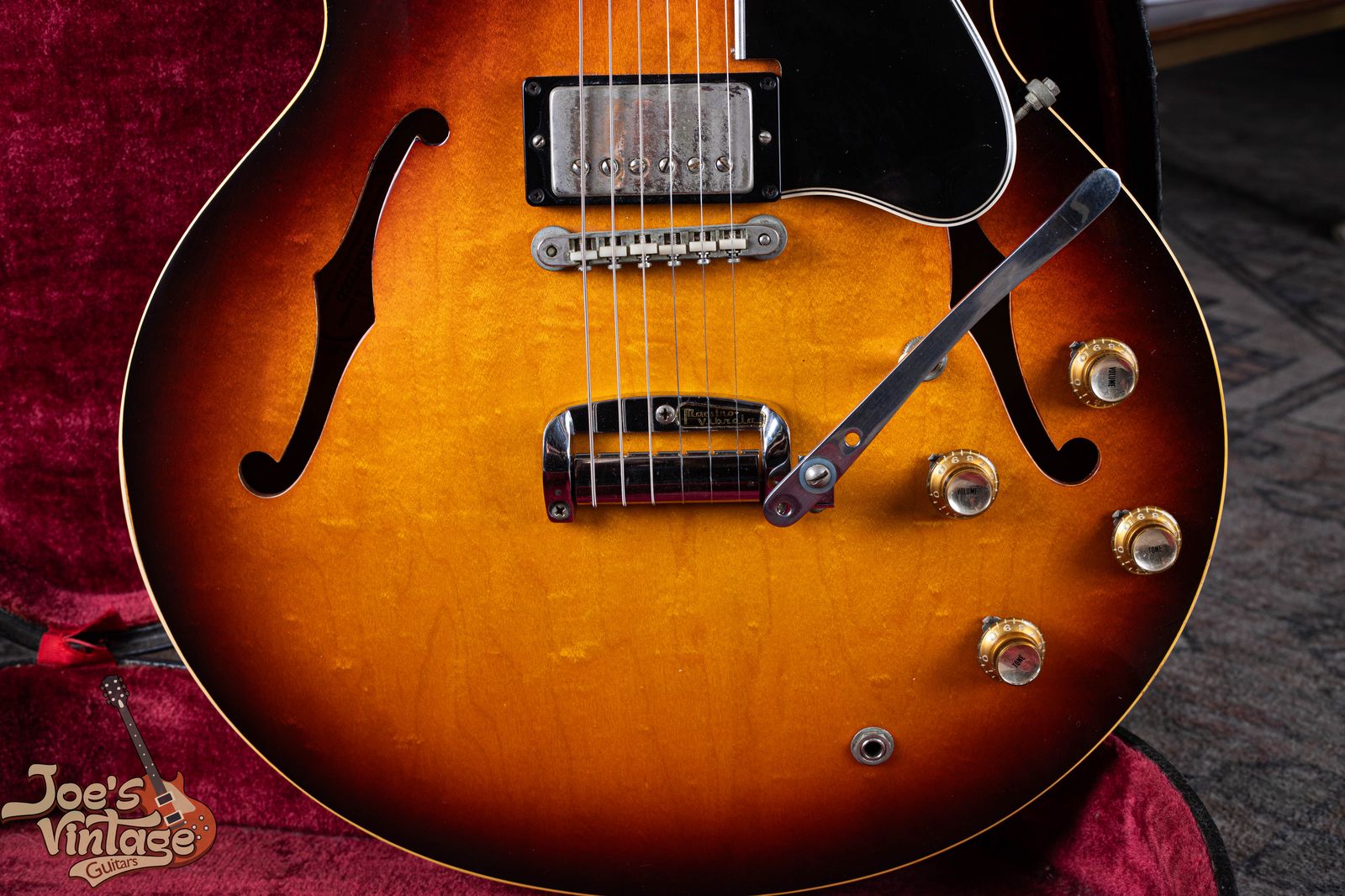
ES-335 — Neck Profile, Construction, and Other Physical Features
| Feature | Years | Notes |
|---|---|---|
| Long neck tenon | 1958–1969 | On pre-Norlin ES-335s the neck tenon — the part of the neck that glues into the body — extends deep into the body, reaching to or past the bridge pickup rout. This can be felt by reaching through an f-hole. A long tenon is an indicator of pre-1969 construction and is considered better for tone and structural integrity than the short tenon used later. |
| Short neck tenon | 1969 onward | Norlin-era change. The tenon is significantly shorter. Combined with other Norlin construction changes — three-piece maple neck, volute, heavier body — it helps identify the era definitively. |
| Rounded horns, 1‑11/16" nut | 1958–1961 | Fuller cutaway shape. Wider nut — the more player-friendly dimension. One-piece mahogany neck on most examples. No volute. |
| Pointed horns, 1‑9/16" nut | 1965 onward | Nut width narrows. Horns fully pointed. One-piece mahogany neck still through the 1960s. Volute and three-piece neck arrive with Norlin in 1969. |
| Volute + three-piece neck | 1969–early 1980s | See the volute section earlier on this page for detailed dating within this window. Three-piece maple neck on many Norlin examples — lighter color, visible glue lines. |
| Single-ply binding (body) | 1958 onward | The standard ES-335 has single-ply cream body binding. Multi-ply binding indicates an ES-345 or ES-355. A 335 with multi-ply binding should be investigated carefully — it may be a higher model or a refinish/modification. |
| Kluson tuners | 1958–mid-1960s | Single-ring or double-ring Kluson Deluxe tuners with tulip plastic buttons. Replaced by Grover Rotomatics on many examples from the mid-1960s onward. Original Klusons are a pre-1965 indicator; their absence doesn't prove replacement since Gibson transitioned voluntarily. |
| Grover Rotomatic tuners | Mid-1960s onward | Larger enclosed tuning machines. Their presence does not rule out an earlier guitar — many pre-1965 ES-335s have had Klusons replaced with Grovers over their lifetime. Check the headstock for filled Kluson mounting holes if Grovers are present on an early serial number instrument. |
One of the most useful and least-known authentication techniques on a vintage ES-335 is checking the length of the neck tenon by reaching a finger through the treble-side f-hole toward the neck block. On a pre-Norlin instrument the tenon will extend well past the neck pickup rout — you can feel it clearly. On a Norlin instrument the tenon ends significantly shorter. This takes about five seconds and tells you immediately whether you are looking at a pre-1969 or post-1969 construction, regardless of what the serial number says.
A genuine vintage ES-335 from the 1958–1969 era is a light guitar. The semi-hollow construction with the maple center block produces an instrument that typically weighs between 7 and 8.5 pounds. If an ES-335 presented as a 1960s example feels unusually heavy — over 9 pounds — that is worth investigating. Norlin-era instruments are generally heavier due to thicker tops, heavier hardware, and construction changes. An unexpectedly heavy "vintage" 335 may have replacement parts, a replaced body, or may simply be a later instrument with an earlier serial number applied.
ES-335 — Complete Dating Summary by Era
| Era | Years | Inlays | Horn Shape | Nut Width | Pickups | Neck |
|---|---|---|---|---|---|---|
| Dot-neck / Round-horn | 1958–1961 | Dots | Rounded | 1‑11/16" | PAF | 1-piece mahogany, no volute |
| Transitional | 1962 | Dots or blocks | Rounding to pointed | 1‑11/16" | PAF or Patent No. | 1-piece mahogany, no volute |
| Block-neck / Classic era | 1963–1964 | Blocks | Pointed | 1‑11/16" | Patent No. | 1-piece mahogany, no volute |
| Block-neck / Narrower nut | 1965–1969 | Blocks | Pointed | 1‑9/16" | Patent No. → T-Top | 1-piece mahogany, no volute |
| Early Norlin | 1969–1975 | Blocks | Pointed | 1‑9/16" | T-Top | 3-piece mahogany, volute |
| Mid / Late Norlin | 1975–1984 | Blocks | Pointed | 1‑9/16" | Various | 3-piece maple, volute |
Gibson ES-345
Introduced 1959 · Semi-Hollow · Varitone Circuit · Stereo Wiring · Gold Hardware
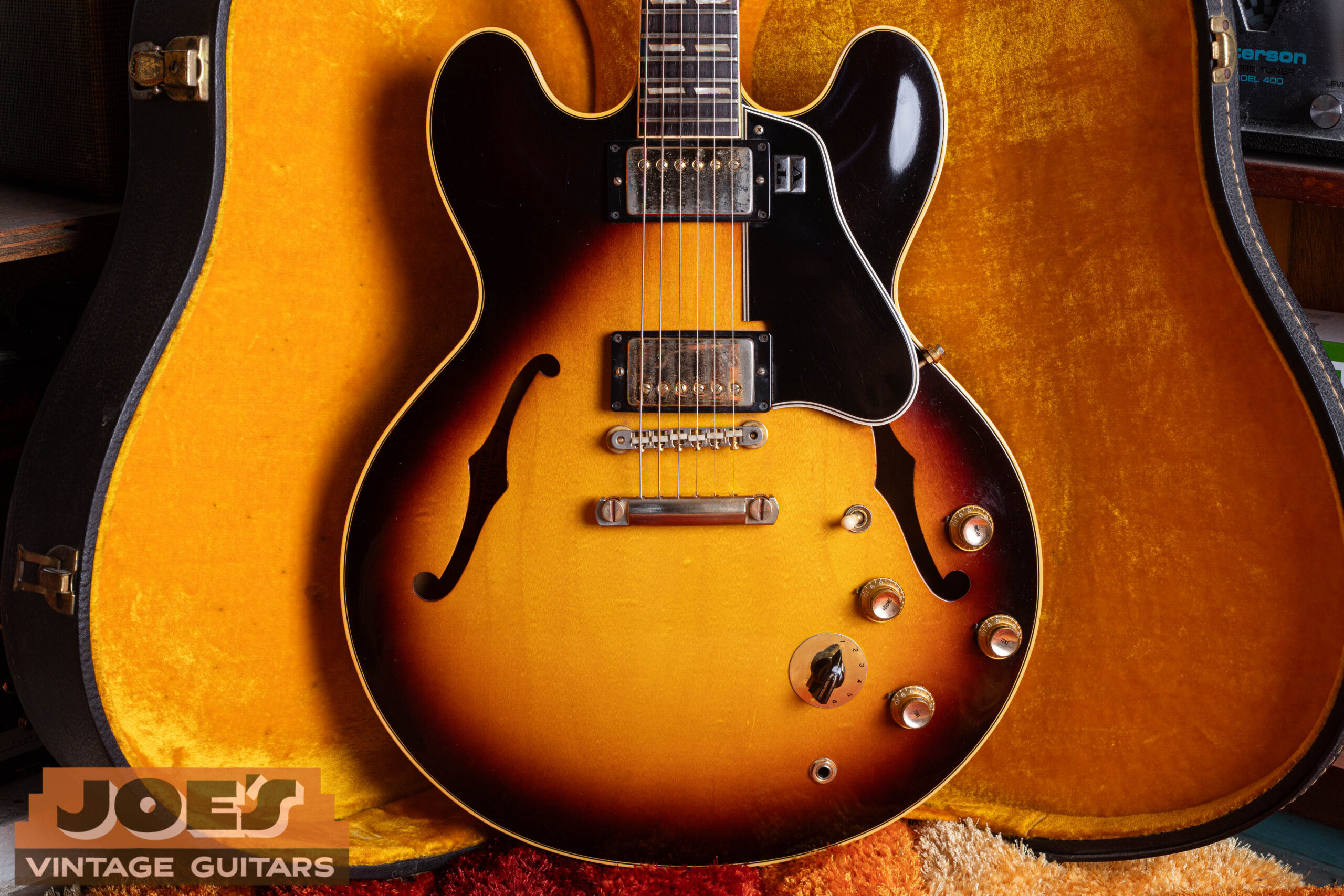
The ES-345 sits in the middle of Gibson's thinline semi-hollow lineup — above the 335 and below the 355. It shares the same semi-hollow body construction and two-humbucker layout as the 335 but adds three significant features that distinguish it: the Varitone circuit, stereo output wiring, and gold hardware throughout. The ES-345 was introduced in 1959, one year after the 335, and was produced through the mid-1970s. It is less commonly seen than the 335 and considerably rarer in the vintage market, making clean original examples genuinely collectible.
The Varitone is a rotary switch — typically a six-position selector — that engages different notch filters in the guitar's signal path to alter the tonal character of the output. It is the most immediately visible difference between an ES-345 and an ES-335: the 345's control layout includes the Varitone rotary switch mounted between the standard volume and tone controls, and the guitar has a stereo output jack (or a mono jack wired for mono use) rather than the single standard output of the 335. Some players find the Varitone useful for tonal variety; others bypass or remove it. An ES-345 with its original Varitone circuit intact and functioning is more complete and more collectible than one that has been bypassed or modified.
ES-345 — Key Features and How They Differ from the ES-335
| Feature | ES-335 | ES-345 |
|---|---|---|
| Inlays | Dots (1958–62), blocks (1962+) | Block inlays throughout — no dot-neck era equivalent |
| Hardware color | Nickel / chrome | Gold throughout — tuners, bridge, tailpiece, pickguard bracket |
| Varitone | None | Six-position rotary Varitone switch between volume and tone pots |
| Output | Mono | Stereo (two output jacks or a stereo jack) — left and right channels for neck and bridge pickups respectively |
| Body binding | Single-ply | Multi-ply — additional binding layers around body top and back |
| Finishes | Sunburst, natural, cherry, walnut | Sunburst, cherry — limited finish options compared to 335 |
The ES-345 shares the same body construction, horn shape evolution, neck changes, and pickup progression as the ES-335. The rounded vs. pointed horn shape change, the neck tenon length, the pickup type, and the tuner style all follow the same timeline as described in the ES-335 section above. Use those references to date a 345 — then use the Varitone, stereo wiring, gold hardware, and multi-ply binding to confirm you are looking at a 345 rather than a 335.
A significant number of ES-345s in the market have had their Varitone circuits bypassed or removed and their stereo wiring converted to standard mono. This was commonly done by players who found the Varitone circuit limiting or who did not want to use a stereo setup. A bypassed Varitone does not make the guitar worthless, but it does reduce completeness and should be reflected in the price. Always check whether the Varitone switch is functional, whether the original choke coil is present under the pickguard, and whether the output jack wiring matches the original stereo configuration. A full restoration to original Varitone spec by a qualified technician is possible but adds cost.
Gibson ES-355
Introduced 1958 · Top-of-Line Semi-Hollow · Maximum Binding · Multiple Hardware Options
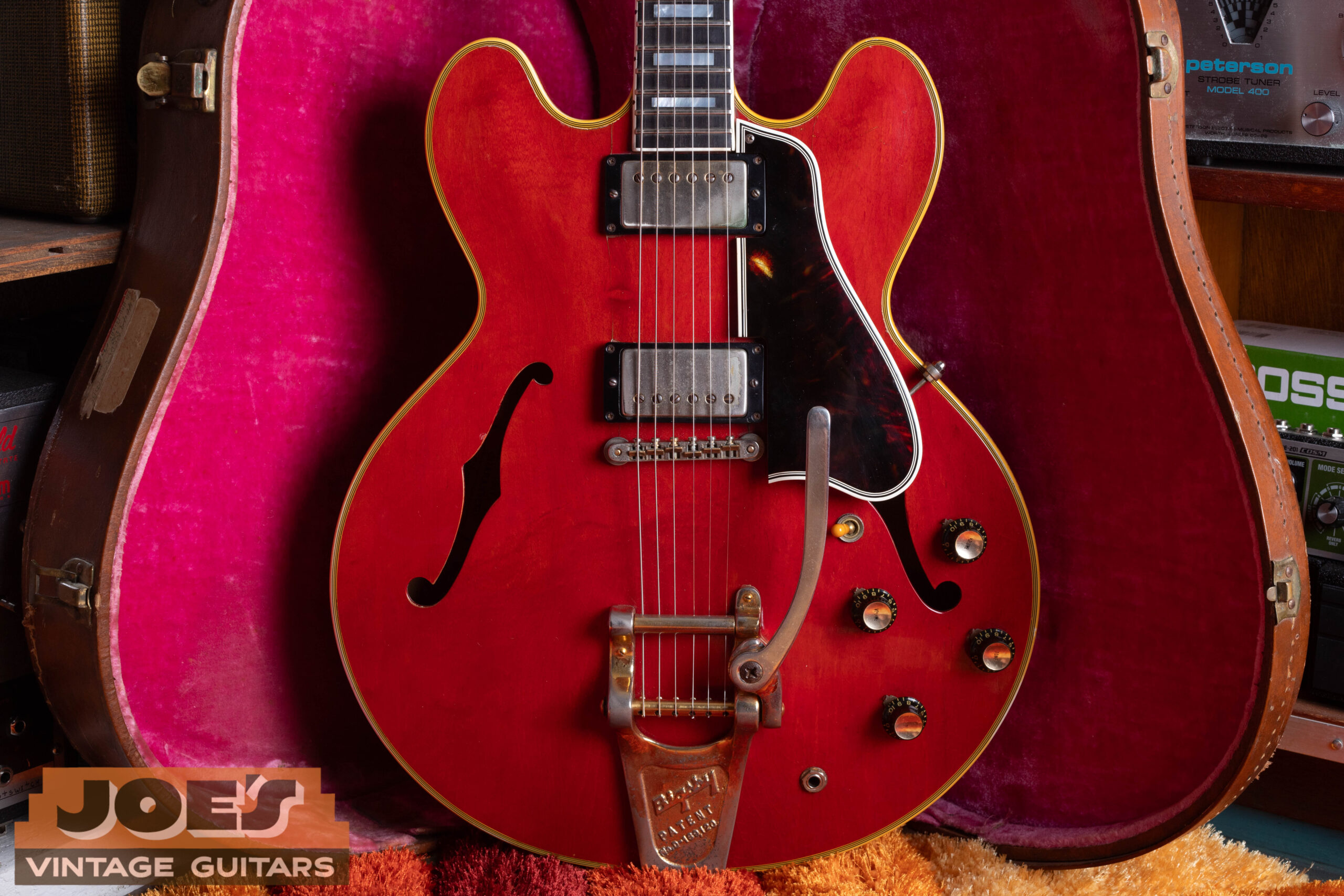
The ES-355 is the flagship of the thinline semi-hollow family — the most elaborately appointed, most heavily bound, and most hardware-diverse model in the ES lineup. Like the 345, it was introduced in 1958 alongside the original ES-335 and shares the same fundamental semi-hollow construction. What distinguishes the 355 is its maximum-specification appointments: five-ply binding on the body top and back, bound f-holes, a bound and inlaid headstock, block fingerboard inlays with additional side markers, and gold hardware throughout. The ES-355 was available in both mono and stereo versions and with a wider variety of tailpiece options than any other model in the family — including Bigsby, sideways vibrola, and the Maestro vibrola — making it the ES equivalent of the Les Paul Custom in terms of top-tier appointments and hardware variety.
The ES-355 is the most visually distinctive model in the family. Look for five-ply binding around the body edges (alternating black and cream layers), bound f-holes (a thin cream binding strip running around the inside edge of each f-hole), and a fully bound and inlaid headstock with an elaborate split-diamond or other decorative inlay. If your thinline Gibson has all three of these features plus gold hardware and block inlays, it is almost certainly an ES-355. An ES-335 or 345 will not have bound f-holes or five-ply body binding.
ES-355 — Key Specifications by Era
| Era | Years | Pickups | Tailpiece Options | Wiring |
|---|---|---|---|---|
| First year | 1958–1959 | PAF humbuckers | Sideways vibrola or stop bar. Bigsby available. | Mono standard. Stereo available on request. |
| PAF / early Patent No. | 1960–1962 | PAF then Patent Number | Sideways vibrola, stop bar, Bigsby. Lyre vibrola begins appearing. | Mono or stereo. Varitone added to stereo models. |
| Classic block-neck | 1963–1969 | Patent Number then T-Top | Lyre vibrola, Maestro, stop bar, Bigsby. | Mono or stereo with Varitone. |
| Norlin era | 1969–1975 | T-Top humbuckers | Stop bar standard; Bigsby available. | Mono primarily. Stereo versions rarer. |
Bound f-holes are the single quickest way to identify an ES-355 from across a room. No other standard production ES thinline model has binding running around the inside edge of the f-holes. If the f-holes have a visible cream or white binding strip following their contour, you are looking at a 355. This is also one of the hardest features to fake convincingly — a refinish or body swap that tries to pass a 335 body off as a 355 will typically show inconsistencies at the f-hole binding if examined closely.
The sideways vibrola — the same side-pull vibrato design that appeared on the earliest SG-body Les Pauls — was a factory option on the ES-355 from the beginning of production in 1958. It is more commonly seen on the 355 than on any other Gibson model. As with the SG, many sideways vibrolas were removed and replaced with stop bars by players who found the action of the vibrato unsatisfying. An original, unmolested ES-355 with its sideways vibrola intact is a rarer and more collectible configuration than one that has been converted to stop bar.
Gibson ES-330
Introduced 1959 · Fully Hollow · P-90 Pickups · 16th-Fret Neck Joint
The ES-330 looks almost identical to the ES-335 from a distance — same thinline double-cutaway body, same overall outline, similar appointments. But the ES-330 is a fundamentally different instrument. Where the ES-335 has a solid maple center block running through the body, the ES-330 is fully hollow — there is no center block, and the body is entirely air inside. This has significant consequences for the sound, the feel, and the behavior of the instrument. The ES-330 also uses P-90 pickups rather than humbuckers, and the neck joins the body at the 16th fret rather than the 19th fret on the 335 — which means the neck pickup sits further from the bridge and the upper register of the neck is less accessible. These are not subtle differences: the ES-330 is a hollow-body thinline with P-90s, not a semi-hollow with humbuckers.
If you are trying to determine whether your thinline Gibson is a 330 or a 335, check three things. First, reach through the f-hole and feel the inside of the body — a 335 will have a solid maple center block running down the middle; a 330 will be empty. Second, look at the pickups — a 330 has P-90s (large rectangular covers with no visible pole screws on top), while a 335 has humbuckers. Third, count the frets to the neck joint — a 330 neck joins at the 16th fret; a 335 neck joins at the 19th fret. Any one of these three tests is conclusive on its own.
ES-330 — Key Specifications and Changes Over Time
| Era | Years | Pickups | Inlays | Notes |
|---|---|---|---|---|
| Early production | 1959–1962 | Two P-90 soapbar pickups | Dot inlays | Rounded horn shape. Single-ply binding. Nickel hardware. Cherry or sunburst finish. The most collectible ES-330 configuration. Nut width 1‑11/16". |
| Transitional | 1962–1963 | Two P-90 soapbar pickups | Dots or blocks | Horn shape and inlay transition mirrors the 335. Some examples have dots, some blocks depending on production sequence. |
| Block-neck era | 1963–1969 | Two P-90 soapbar pickups | Block inlays | Pointed horn shape. Nut narrows to 1‑9/16" from 1965. Still fully hollow with P-90s throughout. |
| Late production | 1969–1972 | Two P-90 soapbar pickups | Block inlays | ES-330 was discontinued around 1972. Late examples show early Norlin construction changes. Less collectible than the earlier dot and block neck examples. |
Because the ES-330 is fully hollow with no center block, it is significantly more prone to feedback at high volume than the ES-335. This is an inherent characteristic of the instrument's construction and is not a defect. Players who use an ES-330 for jazz, blues, or lower-volume settings typically find this completely manageable. Players who use high-gain amplifiers at stage volumes will find the 330 more challenging to control. When evaluating an ES-330, this is simply a known characteristic of the model — not an indicator of any problem with the specific instrument.
ES-330 Finish Options
| Finish | Years Available | Notes |
|---|---|---|
| Sunburst | 1959–1972 | Standard finish throughout production. Warm tobacco or cherry sunburst over maple top. |
| Cherry | 1961–1972 | Transparent red. Became available slightly later than on the 335. A very desirable finish on a dot-neck 330. |
| Natural | Some early examples | Rare on the 330. Bare maple with no color shading. Genuine natural-finish 330s from the dot-neck era are uncommon. |
Because the ES-330 and ES-335 look so similar from the outside, mislabeled instruments appear in the market with some regularity — sometimes through honest misidentification, occasionally through deliberate misrepresentation. An ES-330 presented or priced as an ES-335 is a meaningful pricing error: 335s command significantly higher prices than 330s of the same year, particularly in the dot-neck era. Always perform the three physical checks — feel for the center block, identify the pickup type, and count the frets to the neck joint — before finalizing any purchase. These checks are conclusive and take under a minute.
Not sure which ES model you have, or what year it is? Send Joe photos of the full body, f-holes, neck joint, pickups, and headstock — he can identify the model and date it for free.
Get a Free AssessmentStill Not Sure? Get a Free Assessment From Joe’s Vintage Guitars
Dating and authenticating a vintage Gibson is rarely a one-detail exercise. The serial number is your starting point, but as this guide demonstrates, the physical features of the instrument — the logo, the tuners, the knobs, the bridge, the neck construction, the hardware finish, the pot codes, the volute, and the case — each tell part of a larger story. When those details align, you have a well-documented, authentic instrument. When they conflict, you have questions worth answering before any money changes hands. If you’ve worked through this guide and still have questions about your Gibson — or if you’re considering a purchase and want an experienced second opinion — we offer free assessments on vintage Gibson guitars. Send us clear photos of the headstock front and back, the serial number, the body, the hardware, the neck heel, and the interior label or pot codes if accessible, and we’ll tell you what we see. No charge, no obligation. We’ve been buying, selling, and authenticating vintage Gibsons for decades and we’re happy to help you get it right.
Frequently Asked Questions — Vintage Gibson Guitars
Answers to the questions we hear most often from Gibson owners, buyers, and collectors — covering refinishing, authenticity, originality, value, and the details that matter most when buying or selling a vintage Gibson.
A refinished Gibson is significantly less valuable than an original-finish example, and the signs are worth knowing. Look for overspray in the control cavity, pickup routes, and under the pickguard — original finish stops cleanly at the edges of these areas while a refin shows paint or lacquer where it shouldn't be. Check the binding color — original nitrocellulose lacquer yellows naturally over time and the binding will show a cream or amber cast, while a refin often has bright white binding because the lacquer is new. Original vintage nitro checks in a distinctive pattern with fine parallel lines, while a refin either has no checking or artificially induced checking that looks irregular. A blacklight will reveal a refin almost immediately — original nitro fluoresces differently than new lacquer and any overspray or touched-up areas will glow a different color than the surrounding finish.
Yes — and it happens. Serial numbers can be stamped onto replacement headstock veneers, transferred from less valuable instruments, or simply fabricated on counterfeit guitars. This is exactly why physical feature dating exists. A serial number that claims 1959 on a guitar with double-line Kluson tuners, a wired ABR-1, chrome hardware, and a three-piece neck is not a 1959 Gibson regardless of what the serial number says. Every physical detail on the instrument should be consistent with the claimed production year. When they are, the serial number is credible. When they conflict, the physical features are almost always more reliable than the stamp.
The Les Paul Standard was Gibson's production-level instrument — introduced as a Goldtop in 1952 and achieving its most celebrated form as the Sunburst from 1958 to 1960. The Les Paul Custom was the premium version, introduced in 1954 with a black finish, gold hardware, an ebony fretboard, and multiple binding layers — earning the nickname "Black Beauty." The Custom used higher-specification hardware including black speed knobs and gold Kluson waffle-back tuners while the Standard used gold versions. From a dating perspective the two models share most of the same era indicators but differ in hardware specification — always identify the model before applying dating details.
Nitrocellulose lacquer — nitro — was the standard finish on all Gibson electric guitars through the 1960s and into the early Norlin period. It is a thin, porous finish that allows the wood to breathe and vibrate more freely than modern polyurethane finishes, and it ages in a distinctive way — checking, yellowing, and developing a patina that many players and collectors feel contributes to the tone and feel of a vintage instrument. Gibson began transitioning to thicker polyester and polyurethane finishes during the Norlin era, and the difference between a nitro-finished vintage Gibson and a poly-finished later example is immediately apparent to an experienced eye and hand. Original nitro finish in unpolished condition with natural checking and aging is one of the strongest indicators of an unmolested vintage instrument.
All original means every component — tuners, bridge, tailpiece, pickups, knobs, pickguard, nut, and finish — is the factory-original part that left the Gibson factory with the guitar. No replacements, no upgrades, no repairs that involved swapping components. All-original vintage Gibsons command a significant premium over examples with replaced parts because originality is both an authenticity indicator and a preservation indicator — an all-original guitar has simply been looked after rather than modified. Even a single replaced component reduces value, and the premium for all-original examples on the most desirable instruments — late 1950s Les Paul Standards, early ES-335s — can be substantial. Always ask specifically about each major component when considering a vintage Gibson purchase.
Signs of a neck reset include finish disturbance at the neck heel, a visible gap or color difference between the neck finish and body finish at the joint, inconsistent aging between the neck and body, and evidence of the original finish having been broken at the heel. A professionally done neck reset on an acoustic is often considered legitimate maintenance and does not carry the same stigma as a refin or replaced hardware — but it should always be disclosed, and on a valuable vintage electric it is worth examining carefully. Check for finish checking patterns that stop abruptly at the neck joint, and look at the heel cap for any signs of touch-up lacquer or color mismatch.
The 1958 to 1960 Gibson Les Paul Standard with a sunburst finish — commonly called a "burst" — is consistently the most valuable production guitar Gibson ever made and one of the most valuable vintage guitars in existence. Fewer than 1,500 were produced across three years, each with a unique flame maple top, and prices for the best examples routinely exceed $500,000. The combination of scarcity, tonal reputation, and cultural association with players like Peter Green, Jimmy Page, and Eric Clapton makes the late 1950s Les Paul Standard the benchmark against which all other vintage Gibsons are measured.
Player grade is an informal term used by dealers to describe a vintage Gibson that has been played heavily, repaired, or modified to the point where it no longer qualifies as a collector-grade investment piece — but that still plays and sounds like the vintage instrument it is. A player grade vintage Gibson might have a refin, replaced tuners, a repaired headstock break, or non-original pickups. These instruments are often significantly more affordable than all-original examples and represent excellent value for players who want the tone and feel of a vintage Gibson without paying the collector premium for originality. At Joe's Vintage Guitars we carry both collector-grade and player-grade instruments and are always transparent about condition and originality.
Gibson stamped serial numbers directly onto the back of the headstock finish on solid body electrics from 1952 through 1960. The first digit is the last digit of the production year — so a serial beginning with 5 was made in 1955, not 1950 or 1965. The remaining digits are the sequential production number. A serial reading 59244 means it was made in 1955 and was the 9,244th unit produced that year. Early examples from 1952 may have only four digits total. This system was used exclusively on solid body electrics — if your guitar has an interior label with a serial number, a different decoding system applies. Use the decoder tool at the top of this page for all other serial number formats.
PAF stands for Patent Applied For — the sticker found on the underside of Gibson's original humbucking pickups from their introduction in 1957 through approximately 1962, when it was replaced with a sticker reading "Patent No." The PAF humbucker is widely considered the finest production pickup Gibson ever made and is a defining feature of the most valuable late 1950s Gibsons. Original PAFs are identified by the Patent Applied For sticker on the baseplate, specific bobbin construction, hand-scatter-wound coils, and unpotted wax-free construction. They vary considerably from unit to unit due to hand winding — which is part of what makes them so sought after. A genuine PAF-equipped Gibson commands a substantial premium and the pickups themselves are worth significant money independently of the instrument.
Headstock breaks are the single most common structural repair on vintage Gibsons, a consequence of the angled headstock design and the way the grain runs at the joint. A professionally repaired headstock break on a structurally sound instrument is not necessarily a dealbreaker — many of the most desirable vintage Gibsons in existence have had headstock repairs. What matters is the quality of the repair, full disclosure, and appropriate pricing. A clean, invisible repair on a structurally sound neck should be reflected in a moderate price reduction. A poor repair, a repair that has been concealed or not disclosed, or a repair that has compromised the structural integrity of the neck are more serious concerns. Always examine the back of the headstock carefully under a blacklight before purchasing any vintage Gibson.
The best way to sell a vintage Gibson is through a dealer who specializes in vintage instruments and has an established customer base actively looking for what you have. Auction houses can achieve strong prices for exceptional instruments but take significant commissions and outcomes are unpredictable. General online marketplaces reach a wide audience but also expose you to lowball offers, time wasters, and buyers who don't understand what they're looking at. A specialist vintage dealer can give you an immediate, informed offer based on accurate knowledge of the current market — and if you have a genuinely desirable instrument, a good dealer will be motivated to pay accordingly. At Joe's Vintage Guitars we buy vintage Gibsons outright and are always interested in quality instruments. Contact us for a free no-obligation assessment and offer.

Joe’s Vintage Guitars
47 N Fraser Dr E
Mesa, AZ 85203
Phone: (602) 900-6635
Email: joesvintageguitars94@gmail.com

Written by Joe Dampt
“Driven by a love for classic tunes, I specialize in buying, selling, and appraising vintage guitars, bringing music and history together.”


